Category: Leadership Voices

  • Unleash Your Voice: Why Teachers Should Become Blog Authors

    Unleash Your Voice: Why Teachers Should Become Blog Authors

    In the ever-evolving landscape of education, it’s becoming increasingly important for educators to amplify their voices and share their insights with the world. Blogging has emerged as a powerful platform for teachers to do just that. However, we understand that educators are busy individuals, and time is often a precious commodity. That’s where innovative tools like K12 Co-author come into play, helping you jumpstart your creativity and maximize the impact of your writing. Let’s explore why teachers should become blog authors and how teacher authors like you can overcome the time constraint hurdle with the assistance of AI.

    1. Share Your Unique Perspective:

    Every teacher has a unique perspective on education shaped by their experiences, challenges, and successes in the classroom. By becoming a blog author, you have the opportunity to share these insights with a global audience. Your voice matters, and your ideas can inspire and influence fellow educators, administrators, parents, and even policymakers. Blogging allows you to contribute to important conversations in education and make a positive impact on the field.

    1. Reflect and Improve:

    Blogging is not just about sharing; it’s also a powerful tool for personal and professional growth. When you write about your teaching experiences, you’re forced to reflect on your methods, strategies, and outcomes. This self-reflection can lead to valuable insights and improvements in your teaching practices. It’s a win-win situation – you help others by sharing your experiences, and you help yourself by becoming a more effective educator.

    1. Connect and Collaborate:

    Blogging creates opportunities for networking and collaboration. When you publish your thoughts and ideas online, you open the door to connect with like-minded educators who share your passion for teaching and learning. These connections can lead to exciting collaborations, partnerships, and opportunities to learn from others. By joining the blogging community, you become part of a supportive and dynamic network of educators.

    1. Overcoming the Time Barrier with AI:

    We understand that teachers are incredibly busy, and finding time for blogging can be challenging. This is where AI-powered tools like K12 Co-author come to your rescue. K12 Co-author can assist you in several ways:

    * Generate Ideas: Stuck on what to write about? Co-Author can suggest relevant topics and brainstorm ideas to kickstart your writing process.

    * Speed Up Writing: AI can help you write more efficiently. It can assist in drafting articles, proofreading, and even generating engaging headlines and introductions.

    * Enhance Research: AI can help you gather information and data quickly, saving you precious research time.

    * Increase Productivity: With AI’s assistance, you can write more in less time, allowing you to focus on other important aspects of your teaching profession.

    Becoming a blog author is a powerful way for teachers to amplify their voices, share their experiences, and make a meaningful impact on education. Don’t let a busy schedule hinder your writing aspirations. Embrace AI tools like K12 Co-author to streamline your writing process and make the most of your limited time. Your insights and ideas have the potential to shape the future of education, so start blogging today and join the community of educators who are making a difference through their words. Your voice matters, and the world is waiting to hear your story.

    Start using K12 Co-Author today by clicking here. We are ALWAYS looking to include the voice of educators here on K12Leaders.

    #ContinueTheConversation!

  • Meaningful Growth: Building Your K12Leaders Network

    Meaningful Growth: Building Your K12Leaders Network

    Is it every week that social media tries to re-invent itself? For all the (valid) dissatisfaction we seem to have with the social networks we’ve relied on for the past several years, it’s clear that we are also (justifiably) suspicious of the “next new thing.” But, as we pointed out when we launched K12Leaders last year, there is an unmistakable need for change… especially for educators.

    K12Leaders has grown significantly over the last several months. We’ve had our awkward moments, but we know that what we’re doing -creating a safe online space for educators to grow in their practice- has a huge value to the educators, staff, administrators, and partners we serve.

    Perhaps more precisely, it’s actually <you> we see growing… the K12 community. And we are certain that as the online community on K12Leaders grows, so will the value we collectively draw from it.

    Here, we’ll take a look at three ways we make it easy to invite, engage, and grow your community of practice. Including one important way we never will! Your invitation is not merely a connection; it’s an opportunity to engage your friends and colleagues in a learning environment that’s committed to supporting their personal and professional growth. Oh… and, yes. You can become a K12Leaders Ambassador, a testament to your commitment to our ongoing learning, along the way 😉

    So, let’s delve into these methods, unlocking the potential of connecting, collaborating, and collectively advancing education through K12Leaders:

    Exploring Three Methods to Invite Friends and Colleagues to Join K12Leaders

    Here are 3 ways to connect and grow your network. And every invitation you send adds to your tally of K12Leaders Ambassador Points.

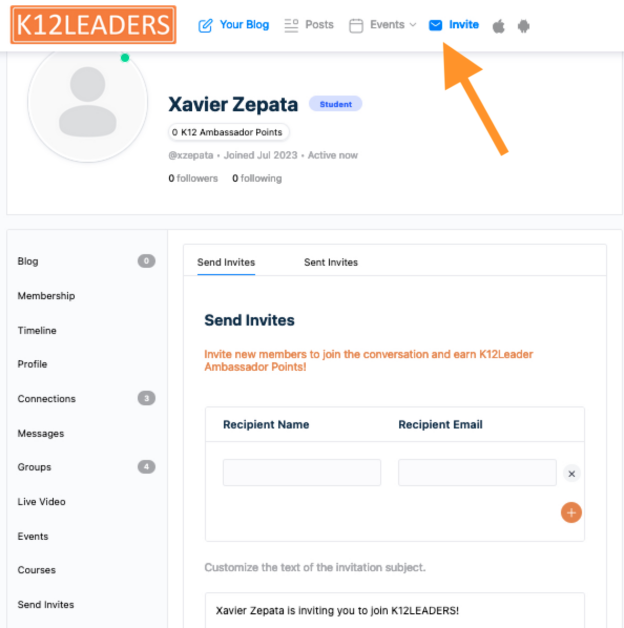
    Top Menu Invites

    Navigate to the top menu and select “Invite.” This simply lets you to enter the names and email addresses of the individuals you’d like to invite. Feel free to personalize both the subject and content of the invitation. It’s worth noting our dedicated mail server handles these invitations. That means there’s a chance the invitation might be flagged as spam. To ensure a successful connection, consider sending a follow-up message as well.

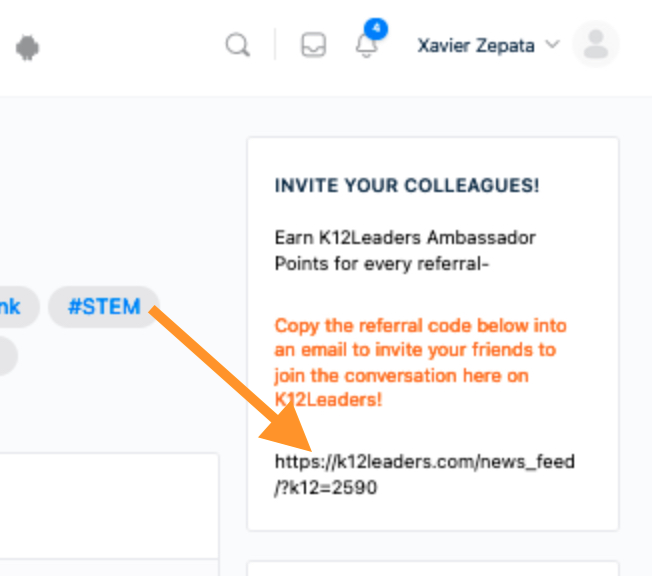
    Ad-hoc Sidebar Invite s

    While browsing pages like the News Feed and Member Directory, you’ll notice a sidebar with a unique URL you can easily copy and paste into your own email message. The embedded codes in this URL link the invitation directly to your account, guaranteeing you earn Ambassador Points for each invitation extended.

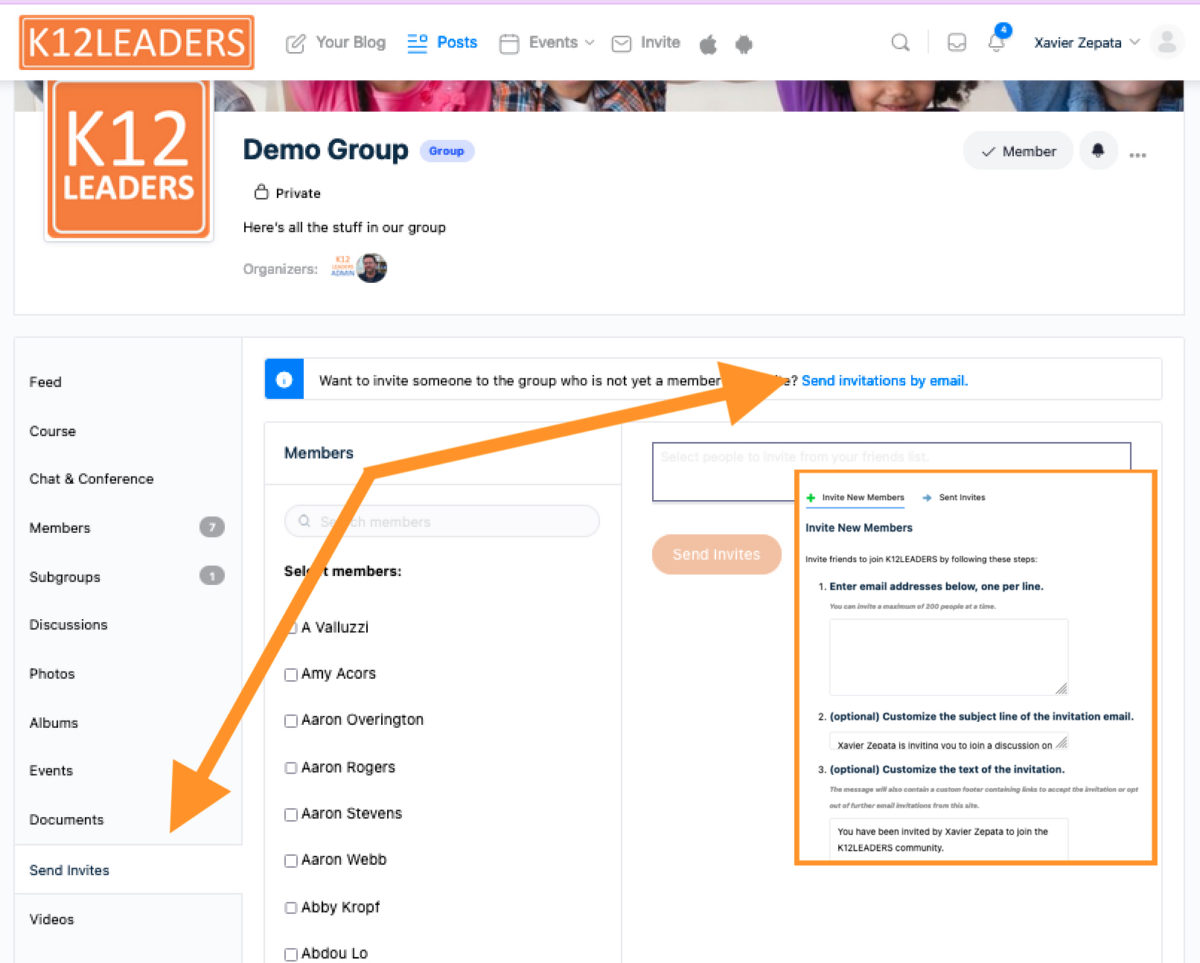
    Invitations to a Community

    To invite someone to join a specific community within the platform, the Community Organizer can activate the “Send Invite” menu. Upon selecting this menu, you’ll be presented with two options: inviting your K12Leaders friends from your internal network or opting for the “send invitations by email” choice. If you choose the email option, you can paste up to 200 email addresses and customize the invitation. Once your friends register, they will receive a notification, informing them of your invitation to join your group.

    And that really important one thing we’ll never do?

    Right… we didn’t forget. And this really is important.

    We’ll never suggest you “import your address book.” Ever.

    In our mind this is simultaneously one of the worst things we could ask of you, and one worst things we could do for this network.

    First, we see this option on other platforms as grossly devaluing their members. It betrays the fact that those platforms think numbers are more important than individuals. None of us chose a career in education to treat anyone “like a number.”

    Secondly, importing everyone would simply dilute the value of the network. K12Leaders isn’t for everyone; and that’s okay. We are here to serve those who serve education.

    Inviting friends and colleagues to join K12Leaders not only enriches your network but also contributes to the vibrant educational community we’re building together. Explore these three options to connect, collaborate, and earn Ambassador Points as you help K12Leaders grow!

  • We Need to Integrate 3D Interactive Content into our Curriculum today!

    We Need to Integrate 3D Interactive Content into our Curriculum today!

    A Gateway to the Future of Education

    In the swiftly advancing digital landscape, incorporating 3D interactive content into mainstream education represents a pivotal transformation and a requisite evolution. The academic syllabi must be metamorphosed to incorporate these technological advancements as we navigate a new educational epoch driven by AR, VR, and spatial computing advancements. Utilizing learning object repositories such as Safari Montage for effective content dissemination and integrating content from innovative providers like Phibonacci can be significant steps in this direction. Seeking XR and content guidance from experts at XR Terra can lay a solid foundation for this transition, nurturing a generation proficient and skilled in utilizing these platforms.

    Let’s Dive In

    Incorporating 3D interactive content into mainstream education heralds numerous benefits. It amplifies the learning experience by rendering complex concepts more tangible and understandable. Picture a biology student navigating the complex architecture of a cell in a 3D space or a history student immersing themselves in a vibrant simulation of an ancient civilization facilitated by resources from Safari Montage. Such immersive experiences can make learning more captivating and profound.

    This dynamic approach to learning fosters critical thinking and problem-solving capabilities. Students can hypothesize, alter, and validate their concepts in virtual settings, encouraging a hands-on and iterative learning method. It also facilitates visible thinking and fosters a deeper engagement and active participation.

    Prepping for a future significantly influenced by AR, VR, and spatial computing, weaving 3D interactive content into education assures students are acquainted with technologies that would predominantly shape their professional environments. This visionary approach nurtures a workforce that is not just tech-savvy but also capable of exploiting these technologies to the utmost extent, encouraging innovation and expansion in diverse fields.

    3D interactive educational settings are inclusive and accessible, allowing students with various learning styles and abilities to excel. Primarily, visual and kinesthetic learners stand to gain tremendously, having the opportunity to visualize and interact with the content that aligns with their learning preferences.

    To fully realize the potential of these technological advancements, a collaborative effort between educators and policymakers is imperative. Crafting progressive and adaptive curriculums, with training modules and integrated content facilitated through platforms like Phibonacci is essential. These empower teachers with the requisite skills and understanding to wield these tools efficaciously. This guarantees a fluid integration that amplifies the benefits of 3D interactive content in education, introducing students and educators to spatial and experiential concepts.

    In conclusion, the amalgamation of 3D interactive content with mainstream educational content transcends being a mere trend; it signifies a critical stride in readying the education sector for the unfolding developments in AR, VR, and spatial computing. By embracing these technologies, guided by insights from XR Terra, we can cultivate an immersive and captivating learning habitat, concurrently preparing students for a technologically advanced future. This fosters a generation adept at harnessing the expansive capabilities of these platforms. Now is the opportunity to advance, nurturing minds well-informed, flexible, and primed for the forthcoming challenges.

    Early drafts of this article were inspired by K12 Co-author.  Try it here.

  • Education is the role of parents, the state simply supports them

    Education is the role of parents, the state simply supports them

    We as educators must strive to create a supportive learning environment for the students and their families by providing them with the necessary resources and guidance to ensure their success. We must create a safe learning environment, where all members of the school community are respected and valued. We must welcome and encourage parental involvement in all aspects of their child’s education.

    We must also keep in mind that parents are the primary agents of socialization and moral formation for their children. Therefore, we must ensure that our educational strategies and curriculum are consistent with the values and beliefs of the families. We must also strive to help parents understand the importance of education and their role in their child’s success.

    Finally, we must be open to feedback and suggestions from parents, as their insights can help us to better meet the needs of the students. It is essential that we maintain open communication and dialogue with parents to foster a strong partnership in the education of their children.

  • Preparing Students to be Digitally Literate

    Preparing Students to be Digitally Literate

    Are the digital literacy efforts in your district as strong as you would like them to be?

    A survey conducted by Pew Research Center in 2022 found that 97% of teens use the internet daily, and 46% use it “almost constantly.” When online, teens can be exposed to thousands of media messages – some requiring extra effort to analyze and contextualize. With the continued technological advancements, even our youngest students have access to media messages.

    Do our students fully understand what they are seeing? Can they distinguish between real or altered AI-generated content? Now more than ever, digital literacy – the ability to use technology to locate, evaluate, interpret, and create – is a critical skill that needs attention if students are going to thrive in the classroom and beyond.

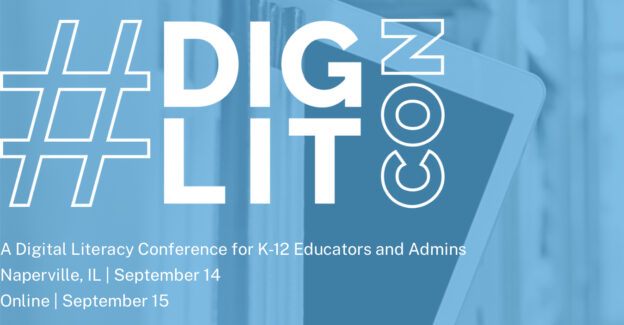
    The Learning Technology Center of Illinois (LTC) is helping prepare educators to confront these challenges through our 3rd annual Digital Literacy Conference. This year, #DigLitCon will be held September 14-15, 2023. The first day will consist of in-person workshops on important topics such as Media Literacy, The Power of Visual Note-Taking, and Artificial Intelligence in Education. Join other educators to learn what works for their students and make new connections. The second day will occur virtually and kick off with a keynote from media literacy expert and educator Julie Smith, followed by twenty breakout sessions. Attendees will receive access to recorded sessions for 30 days after the conference.

    Don’t miss the opportunity to participate in this unique and important event. Sign up to send your team today.

    Find the full schedule of sessions here: https://www.ltcillinois.org/diglitcon/ and register for one or both days here: https://ltcillinois.tfaforms.net/100?eid=a031Q00002JYjLtQAL

  • Licensed Professional Clinical Counselors  – Your Expertise is Needed for My Doctoral Project!

    Licensed Professional Clinical Counselors  – Your Expertise is Needed for My Doctoral Project!

    Hello fellow Licensed Professional Counselors!

    I am in the dissertation phase of my PhD in Counselor Education and Supervision through Capella University. Throughout this program, my interest in advocacy that counselors can engage in has grown significantly and increased my curiosity about the engagement of advocacy in counselors’ roles and barriers to advocacy engagement that may exist. I was interested in the study topic due to my experience working with children living in poverty that were students in a k-12 therapeutic alternative school setting and in a therapeutic ECSE setting through a school district in MN. Additionally, I have friends that have worked in school settings as LPCs through school-based partnerships which increased my interest in learning more about the role of LPCs in school settings across the nation. After moving to New Mexico in 2022, I gained awareness of the impact of living in a rural setting on mental health service availability and the unique needs of the rural population. I hope that this topic interests you to help me complete this study for describing LPCs’ advocacy engagement experiences working with students in rural school settings.

    I am working on a doctoral project, entitled, “GENERIC QUALITATIVE STUDY OF LICENSED PROFESSIONAL CLINICAL COUNSELORS’ EXPERIENCES WITH ADVOCACY ENGAGEMENT.” My research will be overseen by my faculty mentor, Dr. Carrie VanMeter.

    My research examines how clinical counselors working in the school setting will describe their experiences of advocacy engagement in rural areas utilizing the theoretical framework of Ecological Systems Theory for the guided interview questions. The main research question is “How do licensed professional counselors in rural school settings describe their experiences with advocacy engagement?” I will be recruiting clinical counselors that have both outpatient mental health setting and school setting work experience to participate in my study. I would like to conduct my research with participants from each region of the United States by incorporating multiple states with significant rural populations.

    I am requesting permission to engage in the following research activities::

    •  To recruit participants for the study
    •  To post about the research study on the group’s social media page for sharing about the study for recruiting participants

    This project will begin once I have obtained approval from Capella University’s Institutional Review Board (IRB). The IRB will review the adequacy of my plan for protecting participants. They will review data security and confidentiality procedures. A copy of the final letter from the Capella University IRB can be provided to you before any research activities begin. No recruitment will occur prior to IRB approval.

    My anticipated projected start date is August 2023 and I expect that this study will last 6 months.

    I am responsible for the preservation of the privacy of research participants. I will not name the research participants when I write my doctoral paper. I will not describe the participants in such a way that they will be identifiable. I will work to preserve site anonymity when I write my paper. However, I cannot guarantee that the site will remain unknown.

    If you have any concerns about this request or are able to support with participant recruitment, please contact me at the phone number or email listed below.

    Sincerely,

    Christine Herzog, MS, LPCC

    Cherzog@capellauniversity.edu

    (651) 238-0525

  • What Mindset is Required to Effect Change in Public Education?

    What Mindset is Required to Effect Change in Public Education?

    This is the second blog post in my summer series on instructional redesign in K-12 public education. Before I dive into the nitty gritty in future posts, let’s consider what mindset is required to effectively investigate, generate, evaluate, and implement the needed changes.

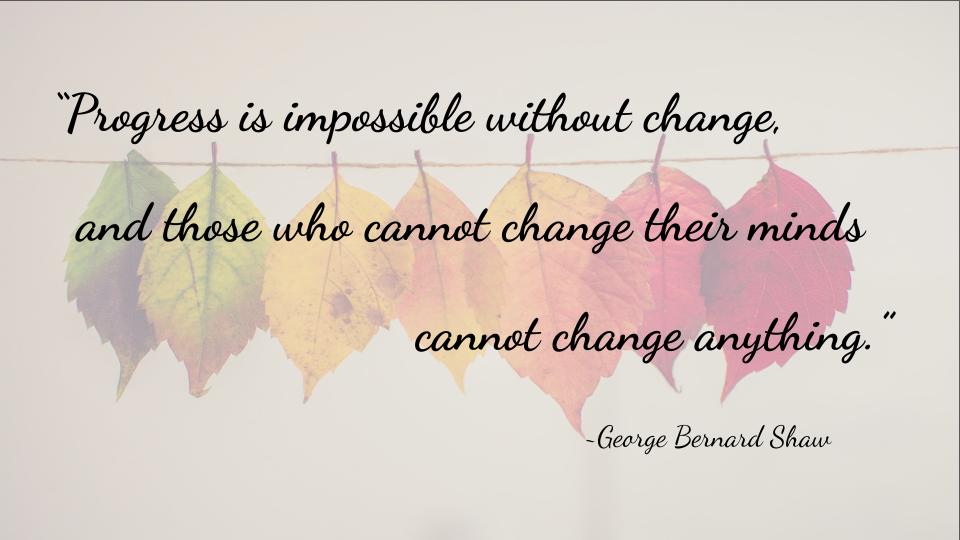
    George Bernard Shaw quote “Progress is impossible without change, and those who cannot change their minds cannot change anything.”

    Growth Mindset – It never hurts to start with some Carolyn Dweck, right? I’ll delve into her work in a future blog on the brain, cognition, and the science of learning. From a change management perspective, I like this definition from a Harvard Business School Online Blog: “When you have a growth mindset, you believe you can gain the knowledge and skills necessary to succeed, which makes every challenge a learning opportunity. People with a growth mindset tend to embrace challenges, persist in the face of setbacks, see effort as a path to mastery, learn from criticism, and find lessons and inspiration in the success of others.”

    Open-minded – How often do we find ourselves instinctively defending the status quo? It is understandable. In fact, it is human. Millions of years of evolution have conditioned us to resist change due to uncertainty, loss of control, fear of failure, and perceived loss of status. And there are times to defend – like from harmful groups like the Marms for Flibbertigibbet. (Using the words moms and liberty in the group’s actual name is an affront to both.) And, of course, we need to protect children. But that can’t keep us from considering new ideas that can better educate them. The principle of risk-reward applies to all improvements. And we need to honestly assess whether aspects of the traditional instructional do more harm than good.

    Check for bias – In Thinking, Fast and Slow , Daniel Kahneman explains System 1 or “fast thinking” – the ability to perform tasks unconsciously, automatically, and effortlessly. Based on his work with Amos Tversky, he also reminds us that this ability is vital to our survival but comes with a dark side – cognitive biases. (Here is a shortlist of 24 cognitive biases that are warping your perception of reality.) We know biases contribute to serious issues like institutional racism. Bias also influences perceptions of new ideas. We like homeostasis – things in balance – so we are more likely to be dismissive of new ideas or protective of traditional practices. It also means we should have a healthy skepticism of things that seem too good to be true. In short, I recommend ABtC, always be thinking critically. And since I’ll posit solutions to complex challenges in the coming blogs, please let me know when my Dunning-Kruger effect or illusion of explanatory depth are showing.

    Listen to the other side and challenge your side – I serve as a Town Meeting Member. (It’s an old New England thing.) We were fortunate to hear from Arthur Brooks recently that it is harder – if not impossible – to convince the other side in an argument. So it is better to listen and seek longer-term consensus. He said the best near-term change often comes from addressing issues on your side as a critical friend.

    Beware the False Dichotomy and binary thinking – I have worked with virtual schools for many years. If only I had a dollar for every time someone asked me, “Is virtual school good or bad?“ I wonder if we seek simple yes/no answers because we don’t consume K-12 education directly. I answer that it depends on which virtual school and the unique student needs they serve – which stops the conversation cold. My biggest peeve is the statement “teachers are,” followed by anything. Even if empathetic, it denies recognition of teachers as individuals. When administrators make blanket statements about teachers, it patronizes and contributes to teacher turnover. Education is complex. To improve it, we must use the appropriate lenses and be willing to disaggregate and think deeply.

    The Power of ”and” / “I don’t know” / “why?” – We have an incredible ability to hold two or more multivariate ideas in our head. So why do we offset, reconcile, or cancel things out? We need to focus on the idea and not just the person. For example, I agree with E.D. Hirsch, Jr.’s belief in core knowledge because you can’t think critically about nothing. And I disagree with his Core Knowledge curriculum’s Euro/Western-centric bias. A disagreement about some content does not cancel out the concept.

    Penn Jillette shared this nugget in a show, “The most important revolution in human history – more important than agriculture, more important than writing – is the scientific revolution which came down to three words – I don’t know. No institutions, no church, no king, no power structure had ever said in history I don’t know.” How often do we use those powerfully honest three words instead of blurting out an opinion to protect our ego? The older I get, the more I have learned. And yet, the more I accept all that I do not know. I guess I am developing greater intellectual humility. And the wisdom to ask questions and listen more.

    Regarding questions, I just finished reading The Great School Rethink by Frederick “Rick” Hess. He encourages us to use intellectual humility to challenge our assumptions of the “whys” of public education and collaboratively explore new, old, or remixed ideas of what might be. Rick emphasizes, “Resets start with recipes; rethinking with the right questions about what comes next.”

    Sorry this blog is so long, but I often think about barriers to change. Before focusing on education, I consulted on organizational and strategic change management for companies like GE and GM. Managing change in these companies was easy compared to public education. But they also had less at stake. I once asked Michael Fullan, a Canadian educator and researcher who studies educational change, why change in the education industry is so hard. His answer was something like, “I don’t know.”

    In the next blog, I’ll explore the history of school system design and how it influences instructional delivery. 

  • My Summer to Explore Instructional Design

    My Summer to Explore Instructional Design

    I am reflecting and writing about my K-12 public education experience and perspective this summer. After starting my career in finance and management consulting, I have spent 30+ years serving public education in many roles for many types of organizations – as you can see from my LinkedIn profile – linkedin.com/in/jimdflanagan, I also consumed it as a student for 16 years, including public university. And I am a parent of twin boys entering their 14th year of public schooling, including pre-K. Finally, I am the proud son of an elementary teacher and took a year off to volunteer in elementary, middle, and high school classrooms to inform my work. But I am certainly not a teacher, so I continuously cycle my ideas through educators for a much-needed reality check. For all the public education I directly or indirectly consumed and all of the educators I cherish, I’ve always viewed the industry with some skepticism – more as a critical friend than an advocate or cheerleader.

    I’ve observed that we overwhelmingly address change at the state, district, or school level. We change variables such as funding, school size, construction, school choice, governance, standards, course offerings, and staffing. But we spend little effort pursuing changes in instructional redesign based on the science of learning. (The delayed recognition of the science of reading is just one example.) Therefore, school improvements, reforms, and transformations all regress to the mean – if successful. So instructional redesign will be my focus. Along the way, I‘ll reference topics like personalization, differentiation, blended learning, student ownership, and Universal Design for Learning (UDL.) And I’ll explore the potential of edtech, but only as it advances the human relationships fundamental to effective learning. I’ll go deepest on the science of learning, cognition, bias, and critical thinking. How can we design effective teaching and learning without that basic understanding of how the brain works?

    I’ll use two models to ground my inquiry as I explore topics. First, The Instructional Core developed by Dr. Richard Elmore. I’ll ask how any change impacts the student-teacher relationship to each other and content. Early in my career, I did not fully appreciate how social and relational learning is, so I advocated for technological solutions that isolated more than connected. Most failures I’ve seen – especially in edtech – disrupt the relationships between and among humans – teachers, students, parents, mentors, tutors, etc. – instead of strengthening the social bonds. Second, I’ll consider how the proposed instructional practice impacts the lifelong love of learning. Does it degrade or support our innate curiosity and hunger for knowledge and understanding? Too many adults feel defeated by learning and are even skeptical of thinking because of their experience with “schooling.” According to a recent Gallup survey, on average, students give their school a C+ rating in making them feel excited about learning – and ratings decrease as students advance.

    I use K12Leaders as a platform because I believe in the mission and value the community. I welcome any feedback. If you agree, that is fine. But I prize a challenge or a different perspective – especially when accompanied by evidence or research. And additional reading or research recommendations are golden.

  • 3 Great Summer Reading Projects from K12Leaders!

    3 Great Summer Reading Projects from K12Leaders!

    We know by now that for K12 leaders the “end of school” really just means a chance to work on the projects that have been needing attention for the last 6 months. Networking, curriculum, enrollments, and maintenance all need to get done in an all-too-short window over the summer. But often part of that is personal maintenance as well, and we have some great opportunities on K12Leaders to consider your own development over the next several weeks!

    Discover The Secret to Transformational Leadership!

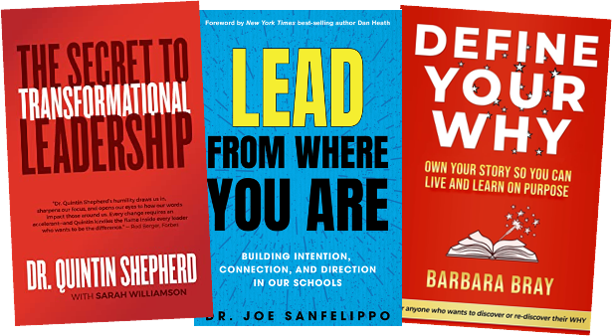
    Quintin Shepherd and Sarah Williamson have launched a learning community to explore a whole new language of leadership on K12Leaders based on their book The Secret to Transformational Leadership . This is a unique combination of a book group and online course focused on finding, nurturing, and implementing an authentic leadership style that helps leaders build connection with whatever community they serve. Within this nine-part, self-paced book study, you will:

    • Explore each chapter through videos, supplemental readings, a review of main points, reflection activities, and more. 
    • Gain practical strategies for adopting a new language of leadership. 
    • Hear from Quintin and other education leaders who believe that if the way we approach leadership can help others think differently, ultimately we can create a ripple effect of empathy, compassion, kindness, and a sense of purpose for our life’s work. 

    Quintin will also offer live online discussion opportunities to go even deeper into this unique model. Sign up today so you don’t miss the next one!


    Lead from Where You Are: Future Ready’s Summer Reading Group is live on K12Leaders!

    Join Shannon McClintock Miller and author Joe Sanfelippo for the third annual Future Ready Summer Book Club to read Lead from Where You Are: Building Intention, Connection and Direction in Our Schools . where we will embark on an inspiring journey that will undoubtedly reinvigorate your passion and empower you to make a meaningful impact in your professional life.

    Throughout the summer, we will gather virtually for weekly discussions, providing an opportunity for deep exploration and thoughtful reflection. Our aim is to foster a vibrant community where collaboration and shared learning flourish.

    “Lead from Where You Are” explores the profound concept of finding joy and value in our daily work. 

    Join Shannon McClintock Miller and author Joe Sanfelippo for the third annual Future Ready Summer Book Club to read Lead from Where You Are: Building Intention, Connection and Direction in Our Schools . where we will embark on an inspiring journey that will undoubtedly reinvigorate your passion and empower you to make a meaningful impact in your professional life.

    Throughout the summer, we will gather virtually for weekly discussions, providing an opportunity for deep exploration and thoughtful reflection. Our aim is to foster a vibrant community where collaboration and shared learning flourish.

    “Lead from Where You Are” explores the profound concept of finding joy and value in our daily work.


    Take the summer to Define your WHY!

    Author Barbara Bray is a digital pioneer, founder of My eCoach, and host of the Rethinking Learning Podcast. Throughout Define Your WHY she guides you through a motivational and personal journey filled with thoughtful exercises and resources to help get the most out of each chapter, and to help you finish with a stronger sense of purpose and identity. This is a great read before heading back to school next year!

    cover define your why

    Do you ever feel like you’re going through the motions to get through the day? Do you continue to do what you do because you have always done it that way? You may not even have considered that you can change what you’re doing AND have more joyful experiences.

    Define Your WHY  shares stories and involves you in activities to get to know YOU better so you have a more meaningful life where you can live and learn on purpose. This book is for anyone who wants to discover or re-discover their WHY so they can grow their purpose. 

  • Know Your Audience

    Know Your Audience

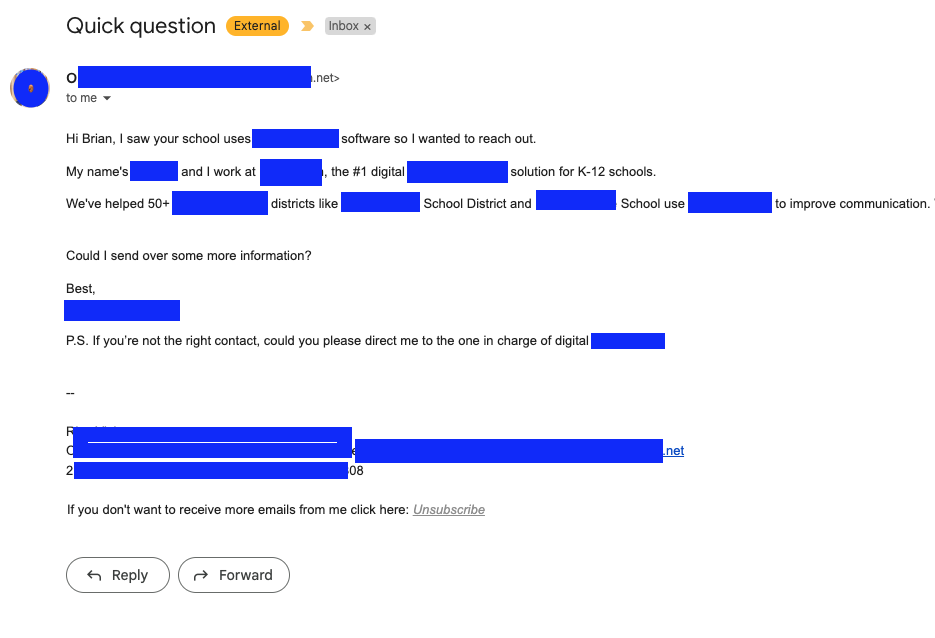
    Recently, I was wading through my email during what is yet another crazy time of the school year. (When I think about it, is there a time of year that isn’t crazy?). It seems no matter how many marketing and sales emails I hit the ‘unsubscribe’ button on, there are more messages waiting in line to take their place. This is one I received TWICE this week:

    My name is not Brian.

    I’m sure many K12Leaders receive unsolicited marketing and sales inquiries all the time… As part of their job, vendors are required to generate new leads and hopefully turn them into customers. I get it. I’ve seen some outlandish tactics from vendor representatives over the years, all ranging from funny to failure; from praise… to guilt.

    95% of the time, I ignore and unsubscribe. However, there are times I write back to the sender. For example, I will write back:

    • When a former (or current!) vendor reaches out. Staying in touch with current programs is important, so I try to respond when I can. Past vendor relationships can be tricky, all depending on how the breakup happened. However, sending me an email soliciting business without any background knowledge of our district is a real turn-off. Representatives should know whether we are current or former customers, and have a good idea as to why we left.
    • On a 4th email, I will always write back. At this point, the sender should know how their approach is not welcome or professional. Our job is to serve students. I can’t do that if I am wading through endless emails. Being relentless as a salesperson does not translate to our thinking you’ll be relentless in your customer service.
    • You are hilarious. I will answer you and tell you how funny you are, and how you stood out. Those emails make my day. Vendors who understand the sheer volume we receive and try to stand out in a positive way make a better impression. They are a breath of fresh air.
    • You have contacted me on LinkedIn. There are a few (very few) individuals whom I have connected with on LinkedIn. We chat about the industry or what’s new in education. If the topic turns to their company/product at some point, I am more willing to listen, and will schedule a time to chat. However, this can backfire. Do not contact me initially on LinkedIn and my work email at the same time.

    It’s important to remember that in all areas of education, we are networked. We all have our circles of colleagues both in and out of our school, district, state and country. Good news travels fast… however, bad news travels faster. Sales and marketing strategies should keep this fact front and center when it comes to choosing tactics and best practices.

    Sales are based on reputation. I can’t speak for all K12Leaders, but thought I’d share some free advice:

    Don’t Be A Vendor

    • Get the name, school and district right. I’d rather receive a generic email than one containing the wrong information.
    • Make sure what you are offering fits your recipient. Don’t offer WiFi solutions to teachers; mailing lists to tech directors; math programming to food service managers.
    • More does not equal Better. Receiving multiple unsolicited email requests is not endearing.
    • Mention schools and/or districts you are working with if they are nearby. Most decision-makers are networked and will ask around before working with a new provider.
    • Beware the busy times: start/end of the year, testing windows, before/after school breaks, etc…
    • Know when budgeting season is. We just set our budget for 24-25. Not all of our contracts run July-July, but many do.
    • If you don’t hear back, do not take it personally. Don’t resort to language designed to guilt or shame the recipient into responding.

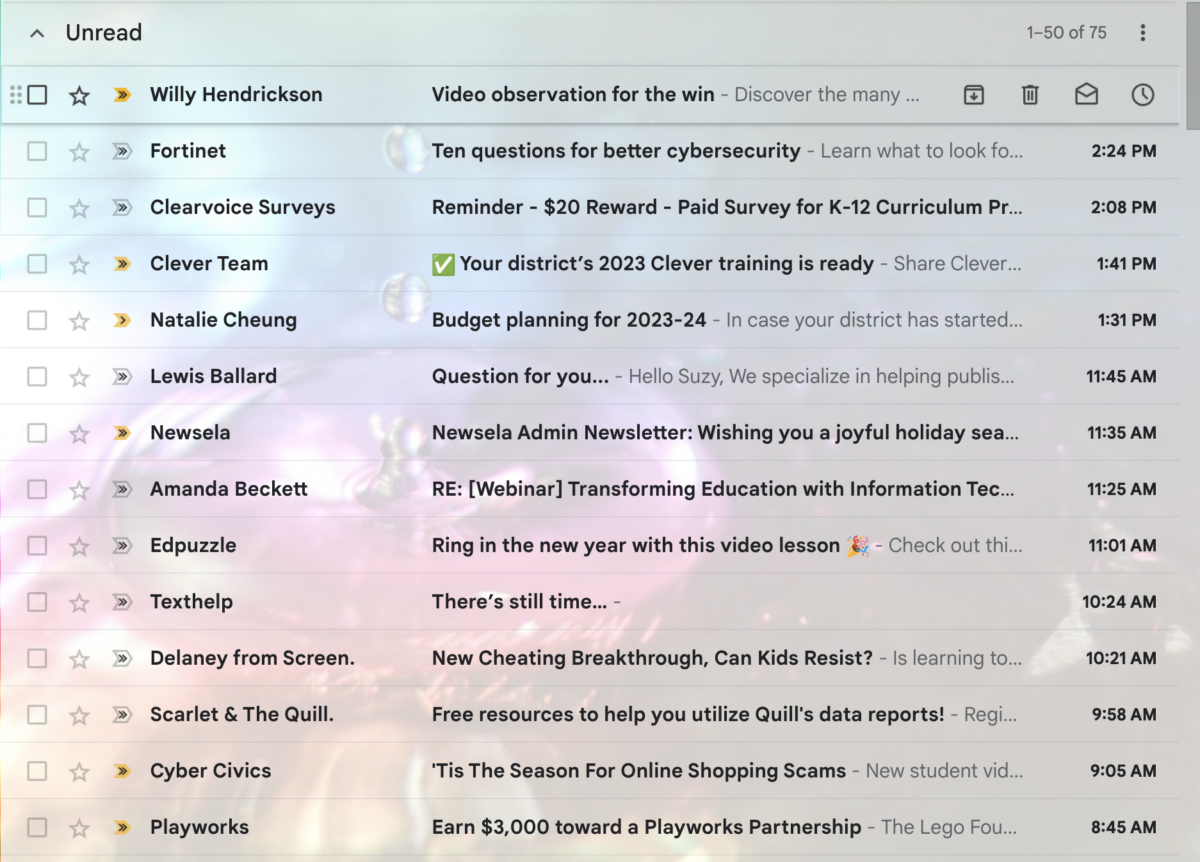
    What are your thoughts? Does your inbox look like mine? There are some important messages here I need to (and do) read. However, it is very easy to miss them when mixed in with others I don’t.

    What insight would you add to strengthen the relationships between K12 providers and K12 education?

    At K12Leaders, we have done a lot of work to position vendors as solution providers, or even better – as Solution Partners . We believe the relationship between those inside and outside of schools can be mutually beneficial, and we encourage connections on K12Leaders to facilitate good conversation. If you would like to learn better ways to connect with prospective customers in education by becoming a K12Leaders Solution Partner, be sure to reach out to mike@k12leaders.com, or drop a comment below.