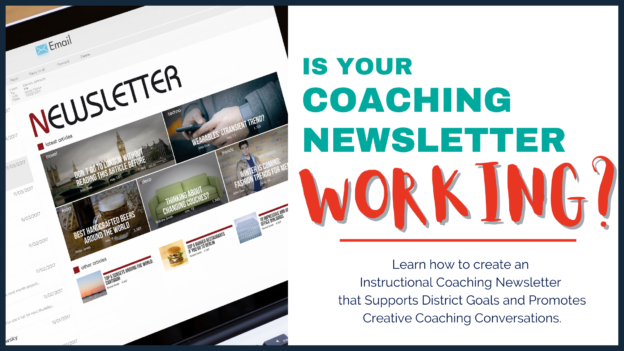
The point that I argue, (and I would love to get your thoughts on this topic) is that the Instructional Coaching Newsletter is not a vehicle from which the Coach should be sharing the latest and greatest in edtech.
I also argue that the point of the newsletter is to promote both District and Building goals in an attempt to not only support mandated programs but to provide assistance to teachers who are being tasked with completing those goals.
I hope you have a chance to check out my latest video on this subject and if you have a moment … leave a comment on this post. I’d love to hear your thoughts on the topic.
For most of us, it’s that time of year again…. Back to School time! I’ll bet you are gearing up for another school year… Or, perhaps you’re just starting off in education, or in a new district. Perhaps you’ve moved to another field related to education, or you’ve left altogether. As a district, perhaps you’ve ramped up your mentoring or training or orientation programming. Perhaps you found ways to recruit the best and the brightest to fill openings in your schools.
No matter what we’ve experienced individually, be aware many eyes will be on K12 education in the coming months. By now, The Great Resignation is common terminology, and increased numbers of professionals leaving (or gone already) mirrors other industries. This “Education Emigration” is more than concerning. As Carl Hooker shared in one post from his Forward to Different – A Blog Series on How School Will Operate After the Big Quit,
“The Great Resignation, or “Big Quit”, is happening across multiple industries. Education has been in the cross-hairs of this movement for the past several years, but now the pandemic has amplified it.”.
Indeed, we are seeing unprecedented numbers leaving K12 education. Whether moving on to an early retirement, corporate education opportunities, or away from education altogether, we understand. The pandemic was a game-changer in many ways. We don’t blame you if things didn’t work out.
However, we cannot stand at the rails blowing kisses and wishing our departing colleagues well when there is still a ship to sail. Though many have left, a multitude more are still here, with new shipmates arriving daily. Smart, educated, devoted, talented, flexible, organized, adaptable educators ARE STILL HERE . We must find ways to retain them, lest we lose them, too. Teachers are highly sought after. Their skill-set is valuable in all industries, so believe me when I tell you MANY teachers are in a position to leave. To change lanes. To switch districts. To reinvent themselves. What concerns me more is a recent survey done by K12Leaders.com where author Michael Bronder shares:
“88% of respondents report that they would give less than 1 month notice if they found another job…. While 4 weeks notice may seem more than reasonable outside of education, educators are in the habit of announcing career moves well ahead of time. Retirements are deliberate and well-planned, and both teachers and administrators generally announce intentions to move-on in the spring before summer break. That over 10% of respondents say that they would “leave immediately” is unheard of.”
Teacher retention cannot rely on optimism alone. Hope is not a strategy. We need concrete ways to appreciate, support, defend, develop and hold fast to these professionals we work so hard to hire. Are you a district or school leader looking to support rock stars? Let me offer some advice, suggestions and resources from some colleagues I think can help.
Have you heard of Amber Harper? She is a Kindergarten teacher, author of Hacking Teacher Burnout and CEO of The Burned In Teacher. Her specialty is supporting those struggling with the burdens associated with teaching, especially through the Covid pandemic aftermath. I attended an online webinar with Amber and was instantly drawn to her energy and dedication to helping teachers. I reached out to her about writing this article and to thank her for the important work she is doing.
I particularly love this quote from one of Amber’s blog posts:
“There are certainly many factors that can be happening around us that can make teaching life very hard and unpleasant. But, there are also many things that we can do both internally and externally to pull ourselves out of this cycle of depression and burnout. If you want or need support, the The Burned-In Teacher Podcast Facebook Group is ready and willing to give you that support. We’re here for you. No matter what.”
Imagine if a school district shared out Amber’s work as a source of support; recognizing that we all could use strategies to Burn-In, instead of Burn-Out!!?? If you visit Amber’s website, or Facebook group, be sure to check out her free workshop. She is an engaging presenter who gets right to the point and wants to improve education for teachers and students alike. These are “DO NOW” tips and strategies!
Lucky am I to have known Jennifer Sabatini Fraone since we were in grade school…. I have followed her contributions for years at Boston College as Director of Corporate Partnerships in their Center for Work & Family have found many parallel connections to our work in K12 education. She recently provided resources for me to share with you:
“Living through the past two years of the pandemic has led to a lot of soul-searching and introspection about how people are living their lives and how their career fits into that plan. Employees are looking not only at their compensation, title and benefits but they are seeking employment that connects to a mission and purpose that is meaningful for them, and a community that recognizes and appreciates their work and contributions. They also seek a culture of trust, empathy, flexibility and support. Workplaces in all sectors need to evolve to meet this moment or they will be more likely to lose current talent and struggle with attracting new candidates.”
As Jennifer said, this is definitely a hot topic that is getting more attention. Here are a few other articles she shared with me. Again, I believe some of these can be great to share in mentoring and onboarding programs as a springboard to productive conversations.
Interesting 威而鋼
2zwW4rCvX64hcdn5W1L9Cmv2Mmv63f2xxH_t04&si=8000000005721354&pi=72d40aaf-3db8-4c5b-94ca-2288656232d0″> BC Video about using mentorship to retain math teachers
My brilliant friend Charity Preston from The Organized Classroom understands the challenges of being a teacher, and creates systems and processes to make our role in education a bit easier.
“ Being proactive versus reactive can mean the difference between being miserable in the classroom on a daily basis, or looking at the big picture to frame a positive mindset. Taking proactive steps will lead you to feeling a greater sense of job satisfaction for the future. If you are having more stressful days than satisfactory ones, perhaps it’s time to reflect on your mindset. It’s the one thing we ALWAYS have control over. Believe it or not, those feelings will transfer to your students too. They can sense when you are struggling. Classroom environment and behavior management really takes a hit when the teacher is not on his or her A-game .”
Charity is right. Sometimes improvements to organization or classroom systems can alleviate stress in the school house, for the benefit of students and teachers. Even the most tenured faculty can benefit from fresh eyes observing their age-old systems. Read more of Charity’s work on a proactive approach on her blog here: https://organizedclassroom.com/proactive-teachers-vs-reactive-teachers/
Finally, I am going to go out on a limb here and compare education to baseball. Yes….. Baseball.
Have you heard of the Savannah Bananas ? I have watched endless videos and read many articles about the team who plays Summer League College Baseball and Banana Ball in historic Grayson Stadium. Go ahead and watch the video for the pure enjoyment (it is baseball season, after all!) Then, I want you to WATCH THE VIDEO AGAIN , and substitute the following terms you hear:
Now… Take it easy there…. Don’t take my suggestion to the extreme and think I’m saying we all have to dress like bananas to fix education. Deep down… you KNOW what I’m saying.
Work as a TEAM
Look for NEW ways to achieve goals
Breathe LIFE into the learning environment
Create a workplace where teachers HOPE to be hired
Make kids WANT to come to school
How can something as traditional as EDUCATION change for the good of all our students as well as for those who choose education as a career path? I don’t have all the answers, but I bet ALL of us can come up with some together!
Yes, the education industry is unique. But being unique does not protect us from what happens when work demands outweigh personal wellness. Like the rings of a tree, we will see the scars of this pandemic for years to come. Persevering through this post apocalyptic time with a proactive, realistic view is integral to our students’ future growth.
This year, I’m excited to have a seat on a panel submission for SXSWEdu. The session is titled, “Inclusive Community in Post-Pandemic EdTech” and Community Voting is open August 9 – 21, 2022.
The SXSW PanelPicker process helps determine which sessions are chosen for the event. Your help with voting and even leaving a comment is very helpful.
To vote, you’ll need to create a free account or log in with an existing account.
Here is the official description and panelist information for your consideration:
Inclusive Community in Post-Pandemic EdTech
How do you create a learning community that best engages educators and/or students? In this session, we will explore the changes to virtual and in-person learning communities in education since 2020. Panelists will share unique perspectives from diverse learning gatherings facilitated by academic institutions and education technology companies. We will also share ways to ensure inclusive community membership given challenges of accessibility and virtual environments.
Clara Galan, Community Engagement Lead, Adobe
Jessica Mara, Sr. Manager, Global eCommerce Community, Lenovo Education
Monica Burns, CEO and Founder, Curriculum & EdTech, Class Tech Tips
Judit Llavina, Senior Program Success Manager at Mentor Collective, Barcelona, Spain
Thank you for your support!
I would love to support your SXSWEdu panels if you have them, too.
As a K12 educator, you know that social media can be a complicated space. You want to reach out to colleagues and collaborate, but you don’t want to risk undue criticism from your learning community. That’s where K12Leaders.com comes in! We create a safe, professional space for educators, staff, and administrators to share and network with one another. Here, you can ask sincere questions and find new points of view from other districts. So come on in and join the conversation!
Traditional social media is a complicated space for K12 educators, and this has became all-too-clear over the last 2 years while schools and teachers struggled to communicate with families and students. Still, while many stakeholders expect teachers, principals, and superintendents to have a public presence on Facebook, Twitter, or LinkedIn, it is often tricky for educators to know what to share and how to avoid undue criticism. Even in less politically charged times, how might a teacher or principal reach out to colleagues with a sincere question when that question might be misread by a parent in their district? How can educators collaborate within their own school, or look for new points of view from other districts? K12Leaders.com creates a safe, professional space for educators, staff, and administrators to share, network, and collaborate.
What educators need in a social media platform.
Privacy- Educators need to ensure their personal information is protected, and will not be “sold” or misused.
Focus- With information overload as a major concern, having a space that’s dedicated to K12 education helps ensure online engagement is both enjoyable and productive.
Community- Finding specific groups and discussion forums is essential for everyone in the schoolhouse. Sharing ideas within a local educational community, or more broadly across district or state lines, is a key part of learning and growing as an educator. And, even more? Knowing you are participating in a community that has shared values and principles often makes it easier for people to be more candid and honest in their interactions.
Flexibility- Being able to post and share content in multiple formats just makes it easier for educators to get involved. Having the option to share short posts, discussions, advice, multi-media, long-form blogs, events, and polls helps ensure everyone can have a voice in the discussion.
Professional Advancement- We know from a survey we conducted this winter that 2 of the largest stresses on teachers this past year were the ongoing requirements for professional learning coupled with perceived limits on their professional advancement. Helping make that connection between an educator’s hard-work and opportunities for career advancement can be a significant motivator for engagement.
What social media platforms are safe and appropriate for K12 educators to use professionally?
Twitteris widely considered to be one of the most popular social media platforms among educators. Not only is it a great way to connect with other professionals, but it also provides a wealth of resources and information. Twitter is also generally considered to be fairly safe and appropriate for K12 educators to use professionally. Of course, as with any social media platform, there are some downsides associated with Twitter.
In a 2017 survey conducted by Rutgers University, educators cited a number of concerns. The top concerns included personal privacy, information overload, and the character limit. Privacy was by far the most common concern, with nearly 60% of respondents expressing some level of worry about how their personal information was being used. Information overload was also a significant issue, with 42% of respondents saying they felt bombarded by the constant stream of Tweets. And finally, the 140-character limit (now 280) was seen as a hindrance by 38% of those surveyed.
Another downside for some educators is the fact that many students are on Twitter as well. This can be great if a teacher is posting homework reminders and upcoming fundraisers, but if a teacher is seeking advice for classroom management, they may not want to do so in front of those same students.
LinkedInis often thought of as the social media platform for professionals, and for good reason. LinkedIn is an excellent platform for business professionals to connect with other corporate connections in their field, share resources, and build their professional network. LinkedIn also has a number of groups specifically for educators, where members can discuss best practices, exchange resources, and find job opportunities.
However, LinkedIn’s focus on business and corporate users means it doesn’t have the specific features that would make it a valuable resource for educators. Groups and Learning are two areas where LinkedIn falls short for educators. LinkedIn Groups are typically focused on business topics, and don’t offer the same kind of support and discussion that can be found in education-focused groups on other social networking sites. Similarly, LinkedIn Learning is geared towards helping users develop job-related skills, and doesn’t offer the same kind of resources that would be useful for educators. As a result, LinkedIn is not as well-suited for educators as it could be. To top it off, educators find themselves to be continuous targets of solution providers who send unsolicited, direct messages about purchasing products.
Facebook’sstrength comes from its roots as a way to stay connected with friends. With the vast number of parents on the platform, however, it is often a struggle for K12 teachers and staff to manage their connections, and it’s very easy for any post to become a lightning rod for controversy. While the site has robust group functions, it doesn’t have the breadth of professional offerings that LinkedIn does. For example, Facebook groups can be great for organizing volunteers or sharing resources among colleagues, but they lack features like dedicated project spaces and collaboration tools that are essential for effective collaboration. As a result, Facebook is often seen as more of a personal social platform, and LinkedIn is seen as the better option for corporate networking.
Facebook comes with the added challenge of navigating many distractions. Notifications, messages, suggested content and advertisements of a non-educational nature can quickly derail the original purpose of a visit. It’s like going to Wal-Mart with the intention of buying masking tape, and coming out an hour later with 3 bags full of merchandise.
K12Leadersis a social media platform created specifically for K12 educators. It provides a safe and secure environment for members to connect with each other and share resources. K12Leaders also offers a range of tools and features allowing educators to collaborate and communicate effectively. As a result, K12Leaders is an ideal platform for K12 educators to use professionally.
While each of the traditional social media platforms have developed a following among K12 educators, none have really addressed their specific professional needs. K12Leaders is designed specifically to support educators, and to help them connect, learn, and develop professionally. We know education is a social activity; and just like a classroom, having a safe space focused on learning and collaboration is often the most effective environment.
One of the many ways K12Leaders creates an effective environment is to actively discourage “trolling” and spam by requiring multiple online reference points like current employer, role, and other social profiles. They then manually verify not just who wants to join the community, but also what role they play in supporting education. It is quickly becoming a robust Education Network
K12Leaders fills a much-needed niche in the social networking world for educators. With its secure platform and focus on professional collaboration, it is the perfect place for educators to connect with one another and share ideas. If you are dedicated to improving K12 education, visit K12Leaders.com and see if it’s a good fit for you.
This week on Ask the Tech Coach, we welcomed friends from MassCue on to discuss their upcoming Google Certified Coaching cohort. Personally, I am looking forward to being a part of this group as I take the journey into the world of GCC.
I’m always looking for great guests for upcoming shows. If you would like to join me for a future episode, please let me know. I’d love to feature something you are doing or highlight your Instructional Coaching program.
Imagine you traveled to a country where the people didn’t speak English. How would you communicate with others about your basic needs like a place to stay, your meals, and what parts of the city are safe? Would you panic or feel scared? What would you need to feel safe? How could others who speak the local language help and support you to make you feel safe? This is how language learners often feel in your classroom. English learners in Kuwait’s private schools often lack confidence in their ability to communicate in English and immigrants around the world face similar obstacles.
Newcomer students may also be coming from a traumatic situation if they’re a newcomer or recently resettled. Your role as a teacher in making sure they feel safe is vital if they’re going to succeed in your classroom. If they’ve been uprooted from their homes due to war or a natural disaster, they lack a sense of belonging because they were forced to leave their homes. They may have gaps in their education due to displacement or are unfamiliar with the local language. We know that all students need to feel a sense of belonging at school and “(w)hile a sense of belonging is necessary for all students to succeed in school, students from immigrant and refugee backgrounds are particularly affected.” What do we mean by belonging? Naashia Mohamed explains,
Students’ sense of belonging refers to the feelings of being accepted by teachers, peers, and any other individuals at school, and feeling like they are part of the school community. When students feel that they are a part of a school community, they are more likely to perform better academically and are more motivated to learn. Studies also show that the feelings of security, identity, and community associated with a sense of belonging affect students’ psychological well-being and social development.
When students feel that they are a part of a school community, they are more likely to perform better academically and are more motivated to learn.
Dr. Ilene Winokur
It’s important to establish a safe environment that begins with trust and respectful relationships from the first day of class. All students need to believe they are treated fairly, so if accommodations are made for some students, including language learners, their peers need to be aware of the reasons you are scaffolding their lessons. In addition, there are several steps you can take to ensure all of your students feel a sense of belonging like greeting them at the door every day or as they come on the screen. Another step is making sure you pronounce their names correctly. Sometimes students who are new will be shy about correcting their teacher so explain that it’s important to you. After all, it’s part of their identity.
Another way to increase your students’ sense of belonging is by creating an environment of caring, collaboration, respect, empathy, and compassion among your students. Modeling this whether you’re inside your classroom or with your students or colleagues will go a long way to showing your students the way. We need to make sure our students don’t feel like the other. In an article for the Haas Institute for a Fair and Inclusive Society (Berkeley), john a. powell and Stephen Menendian (2016) define “othering” as a
set of dynamics, processes, and structures that engender marginality and persistent inequality across any of the full range of human differences based on group identities. Dimensions of othering include but are not limited to, religion, sex, race, ethnicity, socioeconomic status (class), disability, sexual orientation, and skin tone. (p. 14)
You might be saying to yourself, ‘How do I handle differentiated lessons or accommodations for my students? Won’t that make them feel different and othered?’ Truthfully, it won’t if you handle it correctly. If your students know you have their best interests at heart because you’ve shown them you care about how they’re progressing in your class, they won’t focus on how you’re delivering the lesson. Also, they will champion your efforts to ensure their success if you explain to them, from the beginning of the year, that each student has different needs, strengths, and areas that need improvement. Your job is to help them reach the stated outcomes by supporting their efforts, celebrating their successes, and giving them focused feedback to support their progress.
My experience teaching English in Kuwait at the grade 3 level and pre-college intensive courses spans 25 years. Within that time, I have tried numerous methods to support my students’ English language acquisition while overcoming their lack of confidence and negative self-talk (lack of self-belonging) about learning the language. My action research shows a direct link between the achievement of language and content objectives through project-based learning (PBL). The best resource for PBL is the Buck Institute for Education: PBL Works
Students work on a project over an extended period of time – from a week up to a semester – that engages them in solving a real-world problem or answering a complex question. They demonstrate their knowledge and skills by creating a public product or presentation for a real audience.
As a result, students develop deep content knowledge as well as critical thinking, collaboration, creativity, and communication skills. Project-Based Learning unleashes contagious, creative energy among students and teachers.
Project-Based Learning unleashes contagious, creative energy among students and teachers.
Dr. Ilene Winokur
PBL is authentic learning that is meaningful to students. They make connections to their interests, background knowledge, and learn the language throughout the process. Writing, reading, listening, and speaking are all necessary components of the projects. They are making meaning and connections to the learning because it’s meaningful to them.
According to PBL Works,
English Language Learners are one of the groups that tend to be looked over when thinking about who is “ready” to do PBL. But all students are ready if armed with appropriate scaffolding by their teacher. In fact, if we look at learning in terms of growth, EL students are likely to show huge success due to how immersive PBL is in communication skills and critical thinking.
Projects can be tailored to any and all subjects. When using this method with language learners, scaffolding is a must. Planning by the teacher must be intentional and well-thought-out. PBL mentions several scaffolding strategies for successful PBL planning with language learners. I have summarized them here:
Research must be accessible and students shouldn’t be left on their own to search. They should be guided to look for podcasts, leveled books, short articles, etc. that can be chunked into smaller bits. Model the search and research process the first time they are assigned a project.
Provide background vocabulary of Keywords to support them. Building schema around the topic gives students valuable context before beginning the project. This supports their confidence and efficacy when they encounter words or phrases they’re unfamiliar with. Help them make connections to their prior knowledge.
Depending on the student’s level of language fluency, provide visuals for instructions such as pictures, gifs, or icons. Videos using Screencastify to record your instructions give the student a way to view them multiple times or stop at certain points.
Set the stage from the beginning of the year by teaching collaboration to all of your students. Don’t assume they know how to work together. This is where empathy and sharing of ideas and resources through teamwork support their feeling of personal belonging. Collaboration creates respect for others and helps them embrace differences.
Teachers should be actively involved in interacting with students as they work in groups. Asking tiered questions that guide students towards the next short-term goal is essential. Keep anecdotal notes of student progress and let them know you value what they’re doing.
Post project progress timelines, keywords, and related resources on a bulletin board and keep adding to it for the duration of the project. This will provide ongoing support to students who might not work as quickly as others.
You may be wondering how PBL Works recommends assessing students working on projects. They have created a set of research-based rubrics with four main areas: Critical Thinking, Collaboration, Self-Directed Learning, and Complex Communication. The rubrics act as a guide for giving focused feedback to students about their progress in each area from Beginning, Emerging, Developing, to Demonstrating. When using these rubrics, they recommend teachers modify them based on local context.
Learning a new language in an academic environment is daunting, so creating ways to integrate feelings of belonging (validation, acceptance, feeling valued, having agency) while conquering the language and content objectives will go a long way toward successful achievement of those goals. Project-based learning that is planned for and implemented well can help students accomplish it all.
Ilene’s Bio:
Dr. Ilene Winokur has lived in Kuwait since 1984 and is a professional development specialist supporting teachers globally including refugee teachers. Ilene has been active in learning innovation for over 35 years, is an expert in professional development, and is passionate about narratives related to belonging. Prior to retiring in 2019, she was a teacher and administrator at the elementary and pre-college levels for 25 years. Her blog, podcast, and book focus on the importance of feeling a sense of belonging.
Forget Tutoring — What kind of gigs are there for school administrators and leaders?
Teachers can sell lesson plans or administer standardized tests for a little extra $$$. But what about curriculum directors, superintendents, and the many other folks necessary to make schools run smoothly? Can they find after-school gigs too?
Teachers have it easy. Just kidding! Their jobs are hard, and they don’t get paid enough. Many turn to gig work to make ends meet. Teachers can tutor, administer standardized tests, sell lesson plans and printables, coach student teams, or teach online or at a community college. But, these options don’t always work for administrators. After all, most administrators don’t have lesson plans to sell!
So how can you make money after school as an administrator?
The primary way that school administrators can earn money outside of work hours is through consulting. Consulting allows administrators to remain in their field of expertise. There’s no need to pick up hours on Uber or Lyft, or post on Teachers Pay Teachers. As a consultant, you can be the expert in…well… whatever you’re an expert in. You have more control over your hours, and over your pay.
Consulting as an administrator allows you to open new doors and expand new opportunities. You can grow your network and your influence at the same time. Consulting can help you expand your resume and establish a personal brand. Besides, it’s just fun! As much as you love your day job, consulting adds a new twist to your day. It lets you explore new career avenues without quitting your day job.
What kind of consulting gigs can school administrators get?
With consulting, the world is your oyster. You just need to start with your personal area of expertise. What is your brand, and what are you good at? Are you an expert in Middle-school program development? Have you developed a strategy for resource allocation that saved your district thousands of dollars? Do you know all about classroom design or teacher microphone acoustics?
How do I balance the side work with my regular job?
The truth is, we all spend more time “after hours” on our main job. This might come in the form of answering emails, doing research, or presenting to a school board. While it’s not an easy balance, in today’s day and age, you can do much of your consulting and side work remotely and off the clock. Being cognizant and open about your time in your main job and side work is the key to that balance. The idea of “double-dipping” is frowned upon in most districts, so taking personal time for side work while maintaining a high standard in your primary role is the goal.
Still not sure where to start? Here are some possibilities:
Strategy
Management
Hiring and Recruiting
Fundraising
Education Law and Board Governance
School Program Development
Resource Allocation
Curriculum Development
Special needs education
Accelerated learning
Reading and writing strategies
Technology
Ed-tech
Communications, PR, Social Media, and Marketing
Whatever your niche, there’s someone out there who wishes they knew what you know. Maybe they’re posting in the Edugigging Community on K-12 Leaders, or maybe you’ll have to put up a website and blaze your own trail.
I am thrilled to be the harbinger of happy news: You don’t have to have a book on the shelves at Waldenbooks to be an author.
You are curious, observant, thoughtful and insightful. You collect ideas, facts, opinions and quotes. You share strategies, reflect deeply, seek feedback and believe in livelong learning.
If you write a book, an article, a blog post or a letter, you are an author. Write a haiku, an editorial or a speech? Yes. You are an author. Here at K12Leaders, we are here to amplify your message and engage our audience…
So, WE are curious…
What makes your writing worth reading??
As authors, we learn to answer that question every day, with every piece we publish. We write, edit, read, reflect…. write, edit, read, reflect…. write, read, edit and write and edit some more….
We would LOVE to see you grow as an author here… on K12Leaders… with us. Your voice matters.
How can K12L help amplify your voice as an author?
Polls: Submit a question you are curious about with a few answer choices. We will run the poll, strip out the personal information and let you run with the results. Share your findings on K12Leaders with others.
Surveys: Everyone wants to know what those in education are thinking. We have the capabilities to send surveys out through our channels. Draft a survey and we can help hone your design. Then? Use those insights to author a post of your own to illuminate those results.
Editing: Posts chosen for amplification on K12Leaders will receive editorial review and feedback. We will help you focus your message and make your writing worth reading!
Social Promotion: As K12Leaders’ social influence expands, so will yours! We will share posts out via Twitter, Facebook, LinkedIn, Pinterest, Instagram, and of course on our K12Leaders.com website.
Curious to learn more? Are you ready to share your story?
Your language-teaching mission, should you choose to accept it, is to encourage students’ creativity and writing skills, as well as lessening their anxiety about making mistakes, by using quickwrites.
This is a repost of a blog that was originally posted on www.lessonimpossible.com. Lesson: Impossible is a blog for language teachers and a podcast for all teachers, K-12. Resources mentioned below are available for download (free!) on the original post.
Have you ever given students ten minutes to write, only to realize that they’ve only written three lines? It’s not that they’re being uncompliant, they just “don’t have any ideas”, or, for many students with negative language-learning experiences, they are scared to write anything if it’s not perfect. This is where getting into the habit of doing a “quickwrite” is useful!
I love starting a class with a quickwrite, especially if we’re not starting with a sharing circle. It eases us into the day, and gets us in that French mindset. It’s also a great reminder for students, because I repeat it again and again, that it’s about communication and not about being exact! If students don’t know a word, they don’t stop and look it up, they just put it in English between brackets or virgules, and look it up or ask after the quickwrite is done. The whole idea is fluidity of thought, not worrying about mistakes, and realizing how much you actually know when you’re pushed for time!
If we’re going to be talking about specific content, it’s also a great way to get the students thinking about ideas. For example, I do a technology unit, and there are A LOT of great discussion questions: where measure of privacy should we expect? how should we treat robots when AI inevitably become sentient? Is the use of parental controls fair? And on and on. For the students who don’t like spontaneous discussions, and need time to ruminate before speaking, putting it all down in a quickwrite is a way to put them at ease.
So what are some good quickwrite prompts?
An ethical conundrum or serious question (see above)
Put up an interesting photo or meme, ask students to describe it (adjectives!) or create a story around it (tenses!)
Watch the first three minutes of a short film, have students finish the story. Then, when it’s over, watch the rest of the film and compare in small groups how their own stories were similar or different. Most of the time, students’ stories are equally as good or better!
Do a quickdraw first where students draw a picture. Then, after exchanging the drawings with a partner, describe or narrate the other person’s drawing
It’s not technically a quickwrite, but something similar that I love doing is the Telephone Pictionary game. It’s always fun, quick, and makes for a great opening to class filled with laughter.
Also similar are other ways of generating visual ideas for students to inspire each other (and have some kinetic fun!). For example, students can make shapes or mini-scenes with pipe-cleaners (thanks Vanessa Drew for this idea!), found objects in the class, or even with play-doh. You’d be surprised how much senior students get into this, having not had the opportunity to play around like this since elementary school!
Pull three to five unit vocab words from a hat that students need to use in a story
Literally anything that gets them writing!
What do we do with them when the ten (or however many minutes you choose) are up?
A question prompt can be a lead-in to a discussion, and it lets students know where the gaps in their vocabulary are so they can look up words before they start talking
Students can be given time to edit and then reflect on areas they need improvement on
If you gave students explicit instructions of what to include (for example, they need to use as many transition words as possible and they are allowed to use a list of transition words if they need it) you can have a competition where they count them and you see who had the most of whatever it was
Exchange with another student for them just to read or for them to edit or give feedback
SUMMATIVE FEEDBACK FOR/FROM ME
Often, I’ll have students focus on one thing only and I’ll give them feedback only on that one thing. This is good for me, because I don’t need to do a lot of marking, just looking at one aspect of students’ writing. They are less nervous because I don’t care about anything else they’re writing (this can be hard because when I see an error that is unrelated to the one thing I said I would look for I just really, really, really want to correct it. However, I refrain, because I want students to trust me and not feel constantly judged). I will ask students to highlight or underline that one thing, for example adjectives, and then I can also see that they know what they are supposed to be doing (if they also highlight adverbs, then we need to revisit definitions!) and then give feedback just on those things. IF I have time, I’ll also respond to their writing itself, like commenting on the story, but this is just a ‘quickmark’ for me!
If there is a concept that students are struggling with, having TWO highlighter colors can be a great communication between you and the student. For example, they highlight or underline in yellow all the adjective uses that they are confident in, but highlight or underline in green all the adjective uses they think might be wrong. That way you see where the common issues are, but also where students think their issues are! This also gives them permission to make mistakes even on the things you’re looking for. If they’ve been scared to use the adjective “vieux” because they’re unsure where it goes or how it changes, now’s the time to go for it! (This is a true story for me… I still prefer “agé” so I can think less about it!)
For this purpose, I have students do their quickwrites in a journal that they use just for my class. A lined student notebook will get half-filled over a semester with quickwrites and other activities. Some students keep the journal over a few years of French and it’s really cool to see that long term progression! Once I’ve looked at the quickwrite I will put a sticker or a stamp (I have a large collection of stamps). This way if there’s no corrections to be made, but I don’t have time to personally respond with a sentence, students still know that I’ve looked at it!
I even will use quickwrites prior to the writing sections on tests where there is a long writing component. Students get draft paper to get all their ideas out first, then they write on the official test paper. In these assessments I use a rubric that we’ve used to self-assess our previous quickwrites so that it’s not unfamiliar. (See original post for an example where students choose one writing prompt to respond to. They are all types of prompts that we have practiced in class).
How do you use quickwrites in your classes? How long do you usually give students? Feel free to comment!