I loved this online event. It was held Friday, November 4th, hosted by Melody McAllister and Rachelle Dené Poth on their Thrive in EDU / Thrive O’Clock live video cast where I was a panel member. I was able to chat with other awesome educators like Sarah Thomas from EduMatch, Jon Corippo from Eduprotocols, and both John Walter and Andrea Cook from Leanlab Education.
What did we talk about? Twitter! Well….. sort of. If you don’t live under a social media rock, then you know know Twitter is going through some changes. What does this mean for educators? Those of us in K12 education have many choices when it comes to connecting with others online. Tune in to the recording to hear more about what everyone was/is thinking!
….and then #ContinueTheConversation here and THRIVE at K12Leaders!
What does it mean to be Coachable??? You hear that term around athletics quite a bit, but what does it actually mean? How can you apply it to yourself and your classroom?
All good questions! Let’s look a little deeper and unpack what this really means:
Being coachable, or coachability, means you are capable of being taught and trained to do something better. You can accept criticism, take advice and be willing to change in order to make yourself better. It is an individual’s desire and willingness to seek and be open to constructive feedback in order to increase performance. Being coachable is a skill that needs to be developed, honed, refined and built on. It is something that comes from the culture of the team, squad, or classroom.
That’s right….the classroom!!!!
What does being coachable mean in the classroom? I see the classroom no differently than I see the football field, baseball diamond or pool (sports that I have coached). It has just taken me a few years to step away from that environment to realize the similarities. When you step back, it is no different than the music department preparing for a concert, musical or play. All these specialties require the same type of culture or climate. In the classroom, we call it being teachable. Coachable and teachable are interchangeable terms.
So, how do you become coachable? How do you promote coachability in the classroom? John Wooden once said, “A coach is someone who can give correction without resentment.” When you are in front of the students, you need be sure you can give feedback in a manner that students can accept and receive it. The difference between feedback and criticism is how it is received. You need to make connections with students before they can feel safe enough to accept feedback in a constructive manner.
Remember, being coachable is up to the athlete, or student, not the coach!
What are the traits of becoming coachable (or teachable)? Here are a few that come to mind. This is by no means an exhaustive list.
Listening to what is said, not necessarily how it is said.
Understanding that they (the coach or teacher) really want to see you succeed.
Make eye contact. Don’t roll eyes or ignore the feedback
Be open and honest with yourself and coach/teacher
Ask for feedback. More than just asking if this is ok?
Be prepared. Be ready.
What will you gain from being coachable? You will see greater success. You will have better relationships with everyone. You will accelerate your learning. And, above all, you will find yourself in a better state of mind. Less stress. Less pressure. More success!!!
As you look at your class this year, I want you to be able to look at your class and create a culture of openness, understanding and relationships. This will be beneficial to everyone and allow you to be the teacher that you always wanted to be.
Careers in K12 education can be very isolating. How ironic given how many colleagues we have, students we work with and families we support. However, each of those relationships are guided by the structure of the school day. Teachers and administrators are “always on” and this is why professional conferences are such a draw. The chance to get out of the schoolhouse for a day or two, talk with other educators and learn more diminishes isolation and increases engagement. Attending events gives everyone a chance to take a breath, discover new ideas, and recharge batteries to better serve students, schools, and communities.
Fortunately, there is no lack of events to attend. From international conferences to local meet-ups, the possibilities are endless! On the flip side, finding and keeping track of those opportunities is understandably challenging…
With the sheer volume and variety of conferences, professional development, and webinars each year, is it any wonder why it takes significant effort just to remember when “what” is where ?.
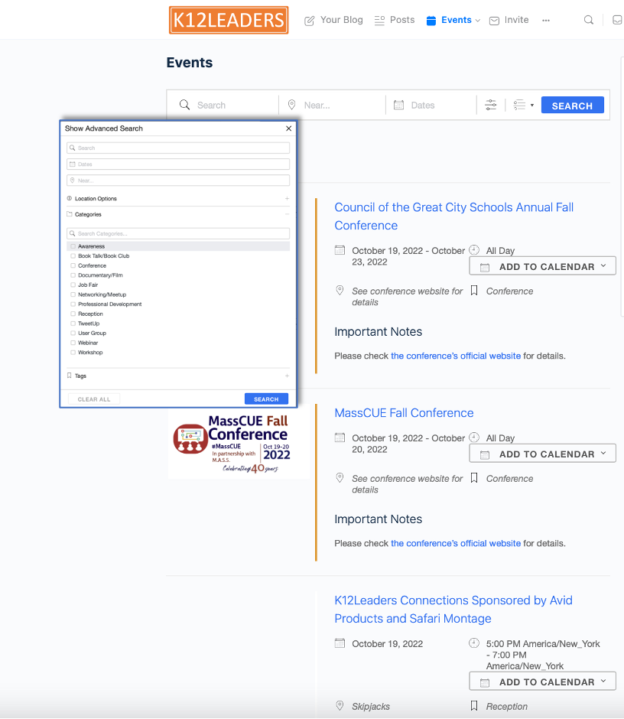
These challenges led K12Leaders.com to develop a searchable Master National K12 Event Calendar. K12Leader Members are welcome to submit an event- whether regional or national conferences, association events, webinars, or meet-ups. The K12Leaders editorial staff will review, publish and help promote it.
Are you thinking “That’s great!”?? We agree, but have even more ideas to share! At most conferences, attendees are asked to download and register on an app for a limited time. After learning to use the app, finding information and making connections, the event ends and the app is deleted until next time. Those in-person connections made during the conference? They may be on social media, or on business cards, or added to phone contacts. As K12Leaders grows, we are working hard to improve the ways those in K12 connect and continue the conversation in and out of the schoolhouse. A new feature on K12Leaders is a QR Code embedded in the app. With only 3 clicks, a member can access the “Connect with Me” feature. Codes can be easily shared with anyone, making it simple to stay connected long after the event ends.
Our members may have also noticed the new ability to see what events our members have created and are attending in the upcoming year. Listed on a member’s profile under Events is now both “My Events” and “Events I’m Attending”; affording everyone the opportunity to connect before, during and after an event. We are excited how this feature will strengthen relationships and bring conversations to a new level.
Say goodbye to Education Isolation! We hope these free offerings for K12 educators, staff and administrators continue to make it easier for our members to collaborate with each other, and find the energy we all need to stay focused必利勁 on our students’ success!
Three Things I Wish I Knew about ADHD While I Was Still Teaching
October is ADHD Awareness Month and according to ADDitude Magazine, a leading resource on all things ADHD, just under 14% of adolescents are diagnosed with ADHD. So I did some quick math and figured out that out of the roughly 2,000 adolescents who have sat in my classrooms over my career, about 250 of them were diagnosed with ADHD. It wasn’t until I recently experienced for myself just how all-consuming ADHD is that I couldn’t help but worry that I had contributed to my students’ struggles out of a sheer misunderstanding of what ADHD is and how it affects individuals. I also couldn’t help but wonder how I would have changed my classroom culture and instruction if I knew then what I know now.
This post could have easily been titled “Three Hundred Things I Wish I Knew…” but I’m fairly sure there’s a character limit, so here are my top three.
1) Kids with ADHD have an interest-based nervous system. They physically cannot control their brain to focus on command because of their brain’s wiring NOT because of lack of desire, disrespect, or laziness.
Perhaps my favorite informative quote I’ve come across while researching ADHD is this one: Attention deficit is a misnomer. ADHD doesn’t deplete attention. It scatters attention unevenly, and activates focus only under certain circumstances. How many times have teachers of students with ADHD thought or said “Well, if he can focus on video games or soccer practice, then he can focus in my class.” I admit to being guilty of having that thought more than once. How can a child who sits for hours building complicated Lego projects and following pages of step by step directions not be able to focus long enough to brush their teeth?!
This inability to focus, the hallmark of ADHD symptoms, is due to an interest-based nervous system rather than the priority-based nervous system of neurotypical brains. Helping a student with an interest-based nervous system focus in class won’t happen with threats, but could happen by creating a competition around your content or allowing the student to explore an area of your content that they are genuinely interested in. The simple switch in understanding from “this child won’t focus” to “this child can’t focus right now” would have completely changed the way I interacted with my ADHD students.
2) ADHD looks different in everyone.
ADHD is complex. It manifests itself differently in every person so the inattentive student with their head on the desk and the hyperactive student doing laps around the classroom may both have an ADHD diagnosis. This is why it’s important to ask questions about the individual student’s symptoms and behaviors. Beyond reading the required accommodations on the 504 or intervention plan, I regrettably admit to never seeking out extra information as much as I could have and should have about the specific diagnosis and what works best for that particular kid. It turns out that something as simple as chewing gum can positively impact concentration. Had I known this was an effective, albeit lesser known, intervention while in the classroom, I would have doled out pieces of chewing gum like I did pencils. (Check your school’s policy on gum-chewing before you hand out gum to students! As an alternative, doodling has also been shown to improve concentration.)
Kids know what works and what doesn’t work for them, even young ones. If teachers had one-on-one, frank conversations with their ADHD learners about what works best, they would not only learn how to better accommodate that child, but they’d also show the student that they cared which goes a loooong way with kids. The 504 plan and intervention plans are a good (and required) place to start, but conversations with individual students and parents may yield greater results and I only wish I had had more conversations when I had the chance.
3) So many of the interventions and accommodations for ADHD would benefit ALL kids!
About 6 million children in the US have an ADHD diagnosis, but what about those that go undiagnosed? Getting a medical diagnosis and certain treatments that require a medical diagnosis is a complicated, lengthy, expensive, time-consuming, often frustrating process. Many children will go undiagnosed because of this and therefore lose out on potentially life-changing academic and behavioral services. Pair this with the uptick in child and adolescent anxiety and depression, hormonal changes in adolescents, and the general drama that exists in school and you can start to see how all students could benefit from a widespread change in classroom culture and instruction.
Knowing this while still in the classroom would have motivated me to change the layout of my classroom from pin-straight rows of desks to flexible seating, incorporating frequent brain and body breaks into daily routines instead of bell-to-bell instruction, allowing students to design their own learning experiences to focus on areas of the curriculum that most interested them instead of one size fits all…the list could go on and on.
Students with ADHD have so much to offer: they are among the most creative, emotionally intelligent, thoughtful, introspective kids in your class, yet many struggle to thrive in the typical, overly-regimented environment that many schools rely on for safety and order. It’s time for schools and teachers to widen their thinking so that ALL students are able to thrive and that starts with learning more about ADHD.
Perhaps one of the biggest challenges of any work-from-home job is how to not be working. It becomes too easy to have one foot in the office at all times. I learned the lesson of unplugging in the most unlikely of circumstances: teaching online during the COVID-19 pandemic.
In the fall of 2020, I saw my virtual student enrollment soar from a pre-pandemic level of 90 students to 300+ enrollments. I was also trying to support my coworkers and just generally navigate living, and parenting, during unprecedented times.
Prior to the pandemic, I prided myself on my quick response times and my inbox-zero mentality. I worked on and off most of the day and usually late into the night. While busy seasons sometimes got my schedule off kilter, the catch as catch can method worked most of the time.
However, by the end of September 2020, it became clear that inbox zero would be a distant memory. I also rarely got all submitted assignments graded. I remember days when I would see 3-4 assignments turned in in the time that it took me to grade one. This rocked my online world for a few weeks.
However, I noticed a few phenomena. First, nothing crashed if I logged out and went home at 5pm, leaving some assignments for the morning. Second, when I did not respond to an email in five minutes or less, students, and parents, often did their own troubleshooting and figured out the issue without my help. Both were such obvious epiphanies.
Learn from my experience; don’t wait for a world-altering event to force focus. I have maintained my more relaxed mentality even as life has hit a new normal. While I keep my email at hand during my office hours and strive to reply in under five minutes, I mute work emails during off times. My geography helps me to take this to an even deeper level when my family takes off on a hike beyond the reach of cell phone service. There is something rejuvenating about spending time near trees, water, and beyond the reach of technology.
My time in the office, I would dare say, is more productive and passionate because of the time I spend away. My mind is clearer and my work is more focused because my time has a focus.
Editor’s Note: If you have other ideas on how to separate work from certain days or times in your life, reach out to Betsy and others on K12Leaders. Self-Care is not just a buzzword. It is necessary for us to bring our best selves to the job at hand. Between all of us, we can share doable suggestions!
In today’s world, one can argue that hi犀利士 story is the most important subject area for the 21st century student to master. That’s easy for me to say and defend- I’ve taught and supervised history courses in New Jersey high schools for nearly two decades. I have a natural interest in learning more about these time periods, as do most other history teachers. However, that cannot be said for many high school students who are- quite literally- forced to sit through daily history instruction, which for many students may be the worst part of their school day. This reality saddens me and it is one that I am determined to reverse.
I quite often hear adults remark that they hated history when they were in high school, but love it as adults. The past practice of lecture-based teaching and rote memorization assessment helped create a bad experience for history students (cue images the interactions between Jeff Spicoli and Mr. Hand). But, gratefully, times have changed, and we are seeing a shift in the way history is taught and assessed. Much of that shift is due to the focus on increasing student engagement. Engagement may be the key to permanently moving history to thumbs-up status and for students to finally realize the benefit of the content. It is now widely accepted that increased engagement positively impacts student achievement. Programs such as Brown University’s Choices Program and Stanford History Education Group’s Reading Like a Historian aim to shift the content to a more hands-on, skills-based approach in order to better engage students. However, incorporating these programs into your existing curriculum could be time-consuming or costly. So, I aim to give you four ways to immediately increase engagement in your secondary history classrooms with the end goal of making history as interesting to students as it is to their teachers.
Quick Fix #1: Focus on the End Game
History gains new content by the minute, yet the school year is finite. With this reality, teachers must decide which content is most important for their students to master state standards and leave the class with essential knowledge. This is difficult for many history teachers who may feel constantly rushed or that they are doing a disservice to their students by leaving key figures or events out of their instruction. I ask teachers who struggle with abridging content to ask themselves this question: Is this piece of information critical to my students’ understanding of the overall topic? Imagine a lesson on battles as part of a unit on World War II. One teacher has his students independently fill out a chart listing twenty major battles of the war, their dates, locations, and victors during a 45-minute class period. Let’s compare it to another teacher who, in the same amount of class time, gives the students a completed chart of the seven most significant battles of WWII and asks the students to work in pairs to investigate why these battles are considered most significant to the war’s outcome and to rank the battles from most to least significant. A simple switch in instruction, where the breadth of content was decreased, changed engagement entirely. While the first lesson exposed students to the names of twenty World War II battles, the second lesson required students to investigate, dialogue, reason, and debate. The students in the latter teacher’s class undoubtedly experienced a more engaging, hands-on lesson.
To those teachers who are hesitant about abridging content, I urge you to try a different approach to content-heavy instruction. Decide what the most important details are- which details help meet your ultimate goal- and deliver them to the class, then offer students enrichment lessons. Post additional readings on your class website, hold an enrichment session after school for interested students, or keep a list of recommended readings on your classroom bulletin board.
Quick Fix #2: Facilitate Frequent Class Discussions
Using discussion as a method of instruction and assessment is an efficient use of class time. Discussions are a great way to engage students with content, assess for understanding, and improve speaking and listening skills. To use discussion as a method of instruction, give the students a reading, a set of documents, or short video to examine along with focus questions before the discussion begins. Student preparation around these focus questions is an important part of facilitating an effective class discussion.
To those worried about students slacking off, dominating the discussion time, or the discussion going off-topic in a negative way, set rules and review them with the students before opening the discussion. Using a rubric, frequently reviewing rules for discussion, and using facilitation techniques will keep the discussion on track. Some teachers also find success in setting up small group discussions before facilitating a whole-class discussion. Just like most things in life, discussions will get better with practice. Your students will become more comfortable expressing their ideas and you will find it easier to facilitate discussion as they become a regular part of the class.
Quick Fix #3: Incorporate Social-Emotional Learning into Lessons through Primary Source Analysis
A great way to study the past and engage with the content while developing social-emotional skills is to examine primary sources. Primary sources give students firsthand accounts of the time period they are studying and help students to contextualize the events of the era. They help students realize that history is not just a story about the past, but that it is filled with real people who had feelings, dreams, and setbacks just like them. Primary sources help take these figures out of the history books and make them come alive while also helping students gain a sense of empathy for those figures of the past.
What is more engaging for students learning about the Civil Rights Movement: reading pages from a textbook about the movement, or studying firsthand accounts from the people who actually lived through the movement paired with photographs from the era? Examining the photograph of Elizabeth Eckford integrating Central High School while Hazel Bryan scream at her and reading Elizabeth’s account of that day is a powerful teaching tool. Photographs are simple primary source with the ability to spark questions about the era, as well as about human behavior; students can contemplate not only “what” is happening in this picture, but “why” it is happening. Asking students to imagine how those teenagers pictured felt the moment that photograph was taken evokes not only a potent history lesson, but also a powerful life lesson. The goal of developing students’ social-emotional skills, in this case their sense of historical empathy, is to transfer that empathy to their everyday lives.
Quick Fix #4: Connect the Past with the Present
Just when you thought you could pare down your lesson on Populism, the 2016 Presidential Election happened! We all know the adage “history repeats itself,” and what a great time to bring this phrase into our classrooms. Ask students to decide if this phrase is, in fact, true by comparing current events with events of the past. This is a great technique to pair with the three previously suggested strategies. Craft a question that aligns with your end game, have students prepare their answer to the question using primary source evidence (provided by you or researched by the students themselves) from the past and present, and facilitate a class discussion where students discuss their findings. Connecting the past with the present helps students realize that history is alive.
Teachers should feel empowered to take these suggestions and tailor them to fit their students’ needs. For educators who are hesitant about changing their instruction, I advise you to start small. Try one strategy and see how it works, and do not hesitate to ask your students or a colleague for feedback.
I’ll admit, if I look at the school year and what is ahead, I could self-ignite an internal stress that could keep me awake for days. A few years back, I started breaking a school year down using the marathon analogy. It is not a sprint! Marathons give us check-points. Marathoners have strategically-placed water stations to replenish fluids and know exactly where they are during the race. A marathon runner paces themselves to know exactly how they are feeling at each point during the race.
In school, don’t we do similar things? As a school, are your “PROCESSES” allowing for a smooth marathon to take shape from September to June? Incremental growth, daily improvement at something, “small wins” allow for us to keep the jogging going. Keep one foot in front of the other, keep moving forward.
I give the children moments during the year, about five or six, where I tell them where we are in the marathon. The 6 mile, 13 mile, 18 mile, 24 (end of May) and the end of the race where we cross the finish line. Marathoners take that accomplishment with such regard. They know how hard it was and how hard they worked to train to complete the marathon. Remember, I did not say win! The marathon is about effort, hard work and how it pays off. It is about trying to improve on your best time. It is intrinsic motivation. Growth mindset at its core.
Boys and girls, look what you’ve done! Look at what you’ve accomplished over the course of the year! You worked so hard and improved so much! Again, not about who are our highest performers or lowest performers. It’s about our processes as educators and how we take children on a learning marathon to get better each day! Once we stop looking at the grade on top of the paper and understand the importance of the effort that is put into the work, growth can occur. Taking ownership as educators and leaders to not only grasp, but to exemplify how students can reap the benefits of the nutrients that mistakes have will be a game changer for all of us.
A couple tips to start the school year marathon off the right way;
Be clear with your messaging – Stay with it. The year is a journey, a marathon and not a sprint. Talk about it as much as you can and to whomever will listen.
Create checkpoints during the year tied to your calendar. Where are we in the marathon and what are you noticing. TELL EVERYONE what you see. Your voice matters.
ALWAYS REWARD THE EFFORT AND ENERGY FROM EVERYONE INVOLVED.
If the “Marathon” is well organized with the proper mindset going in, you will exceed your own expectations. Translation – “If you take care of the little things, the big things will take care of themselves”.
This past week, we received a message from our child’s teacher that we needed to sign the 4th Grade Grading/Behavior policy form. As we looked through the contract we noticed the following section about late work:
This raised all sorts of questions in our minds as parents and the practicality of using an academic measure (like grades) to penalize a behavioral issue (turning work in late). Before we go any further, I want to say that my daughter’s teacher is extremely supportive of the students in her class and will give them many reminders to turn in late work. This policy is a DISTRICT policy, not her belief.
I decided to post this question on Twitter to see what the teaching universe would have to say and well…it kicked up quite the hornet’s nest. As of this post, it has 185 comments and counting. (check out the full thread here, but be warned…)
As the comments and suggestions grew in the thread, battle lines were being drawn. It became clear to me that this is another institutional norm in education that we might want to re-consider when going “Forward to Different“, thus this post. What follows are summaries of the main arguments both FOR and AGAINST doing this followed by some options for helping students with their executive functioning/time management skills without punishing their grades.
The arguments FOR deducting a grade for late work
It teaches them responsibility and self-discipline. At some points the students need to learn the consequences of their actions and what better way to do this than hitting them where it hurts the most; their grade. Are their other ways we can “grade” behavior, sure, but those don’t affect the kid as much as seeing their “A” go to a “B” because they were a day late on the assignment.
There are deadlines and consequences in the real world. When you are late turning in work, your boss gets mad and sends you an angry email. Do it enough times, and you could get demoted or even fired. If you don’t turn in your taxes on time, you pay a penalty. If you don’t pay your bills on time, you could be without electricity. The real world has deadlines with often harsh penalties. Using grades teaches this to kids while their frontal lobes are developing.
If they turn it in late, they could be copying the answers from someone else. The longer it takes for them to turn something in, the more likely they could ask a friend for the answers to the work. Then we aren’t grading them on their true knowledge as they just borrowed it from someone else. Thus the penalty for tardiness of turning it in.
Not doing this teaches kids it’s ok to be a slacker. If you don’t have any penalties or consequences for late work, students can turn stuff in all the way through graduation (and even after). All this teaches them is they can blow past deadlines with no repercussions, which isn’t true in life. It encourages procrastination in students.
It makes the work more important. Without penalties for missed deadlines, it means the work isn’t that important. Not having these deductions lessens the importance of the work itself. If the student never turns in the work, then how can teachers access them on the skill? Students with great study habits can become lazy when they realize doing the work on time isn’t really that important.
Teachers have a lot of work to grade and need a deadline. This mostly applies to secondary teachers who can often have up to 180 students a day pass through their classroom door. Having hard and fast deadlines makes grading all those papers much more manageable. Allowing kids to turn in work whenever they please makes the process much more cumbersome and hard to manage on the teacher-grading side of things.
The arguments AGAINST deducting grades for late work
Grades should be used to show mastery of learning. This was by far the most mentioned response to my tweet. In a “perfect world”, we are using grades to measure the growth and mastery of student learning. Adding in “timeliness” to the equation skews that measure.
As a parent, if I see my daughter is getting a failing grade in math, I might hire a math tutor to help her. However, what if she is actually fine with math but can’t turn anything in on time. I got the tutor for the grade but in actually I should get her a tutor to teach her time management skills.
Responsibility and executive functioning should be graded separately than academic growth. Utilize a separate “graded” section that covers soft skills so we can also measure growth on that front. Having two separate “measured” sections of the report card give much more information to the student and parent in terms of what areas need improvement. Maybe you are doing high quality work in Language Arts and deserve the “A” but you turn in every paper late (which authors do all the time – btw) which results in you getting a “C” in time management. That is more effective than blending the two together.
This doesn’t address the behavior. In fact, in some instances, it might increase it and negatively affect their self-esteem. Students that habitually turn in late work may give up because their grades are tanking. Address the behavior and come up with strategies to help fix it rather than just docking their grade across the board.
Schools should exist for learning, NOT just for preparing kids for employment or higher ed. In theory, schools shouldn’t exist just so we can make sure kids get good grades in college or that they turn in their work to their bosses on time. Using lack of time management to punish grades shifts the focus from academic growth to “playing the game of school.” This opens up a whole other discussion about grading, but I’ll save that for a future post.
The system rewards organization over knowledge and understanding. This creates a mis-interpretation of mastery. It rewards students who finish their home work on time, which assumes that they must have a better understanding of the academic concept. However, if you are disorganized, yet understand the concept well, it doesn’t matter in the grade book.
Punishing kids for late work via grades can cause lasting damage/anxiety to a student. In the thread, several adults shared stories about the anxiety this caused them during school and later in life. While some say “kids just need to suck it up and get the work done on time” that’s really a one-size-fits-all approach that doesn’t differentiate for students. Damaging self-esteem and raising unnecessary anxiety shouldn’t be the goal or outcome when it comes to learning (or late work).
This policy isn’t equitable or inclusive. It fails to take into account students’ home life, their own learning preferences, commute time, access to technology and parental support. Perhaps a student has to work extra hours at home to make ends meet or there is not where they can go to sit and focus. This assumes that all students have a great, supportive home life, when in reality, many of our underserved communities do not.
Possible alternatives to point deductions for late work
Instead of punishing for late work, give bonus points for turning work in early or on time. If it’s a big project and you get it done early, perhaps a little point bump is in order. This is a fine line as you don’t want students rushing through their work, but it shifts the focus from a negative (punishment) to a positive (reward). One issue with this option is it still means the grade doesn’t accurately reflect their learning.
Use this as an opportunity to teach them how to dialogue and communicate. When you are late with a bill or rent, do you just not pay it? No, you reach out to the company to ask for an extension or explain your situation. Life happens and it’s happening to these kids at home as well. Encourage them to have open communication when it appears they are going to miss their deadline. Many teachers on the thread mentioned they would often forgive some late work if the student talked to them about it first.
Teach the students to reflect on their own time management. When a student does turn in an assignment late, this is an opportunity to talk with them about time management. Have them reflect (written, video, audio recording) about why they turned the work in late and what they could do better next time. Sometimes, it might be extenuating circumstances, but usually it was just them getting distracting with something else that commanded their attention. Reflecting on the issue helps them notice their own behavior more so than just docking points off a grade.
Allot time during the week for students to finish up late work. In elementary school there is often a “Fun Friday” where students have time to work on passion projects or play games that teach intrapersonal skills. Taking this concrete experience away from a student in elementary can have more of an impact than a grade which is more abstract. One commenter mentioned her 3rd grade son missed his Fun Friday once and never turned in a late assignment again. However, now that he’s in 8th grade, which has a points penalty policy, he just gives up and doesn’t care about getting his work done.
In secondary schools, many students have a “home room” or “advisory” period to complete missing work and ask for support. Providing this additional time might be the thing a struggling student needs to focus on mastery of the skill rather than just rushing to turn something in on time.
Have a “late slip” for work not turned in on time. When a student misses a deadline, give them a late slip. The late slip has to be taken home and signed/acknowledged to encourage discussion around why the work was late. At that point, work must be turned in with the signed late slip, but no points are removed for academic mastery.
Conclusion
It’s clear to me that this is a hot-button issue in education with no “perfect solution.” I truly understand both sides of the argument here. After reading the (now) 228 responses on this thread I can tell people have severe emotional attachment to penalizing or not penalizing students for late work. To me, it really comes down to this question: What is best for kids and how can we teach them to be their best selves as adults?
Can we teach them time management and executive functioning skills without penalizing grades? YES.
Will it take more work, time and energy by the teacher and parent? YES. At least at the beginning as we front-load students with the skills to manage their time best.
We have to remember that sometimes, what is right isn’t always what is easiest. I think that’s the case here. I appreciate all that contributed to this important dialogue and hope that if nothing else, this sparks a conversation on your campus or district about late work policies. We can’t get better if we aren’t open to the idea of change.
If you are a new teacher who has just been hired by a school district at the last minute, then you may be feeling a little overwhelmed right now. Don’t worry – you are not alone! Every year, thousands of teachers are hired in this way. It can be challenging to adjust to a new job and a new school district so quickly, but with some preparation and organization, you can make the transition relatively smooth. In this blog post, we will provide some tips for not only surviving, but thriving as a new teacher hired at the last minute.
Find a Mentor- One of the most important things you can do as a new teacher is to find a mentor. A mentor is an experienced teacher who can provide guidance and support as you transition into your new role. If possible, try to connect with a mentor before the school year begins. That way, you will have someone to turn to when you have questions or need advice. Many school districts will match you with a mentor or guide. In best case scenarios, this mentor has experience helping new teachers, is familiar with your new role, and is easy to connect with. If you experience some disconnect, reach out to your principal or the Mentor Coordinator for guidance.
If you haven’t been matched with a mentor in your school or district, here are some easy steps you can take:
Ask- Your curriculum director, department lead, or principal should all be familiar with the concept of mentoring. If you’re feeling alone or a bit back-on-your-heels, your first stop should be with your supervisors.
Search online- you can also find mentors online (like right here in our New to Education Group on K12Leaders!!) or on other social media sites.
Go Back to School- Try reaching back out to your certification program. Most schools of education are more than happy to stay engaged with their alumni, and this is a great way for them to do that!
Head to the Library (or Amazon) – There are a number of great books on the topic, including “The Modern Mentor” (disclaimer, I’m the co-author) and “The First Year Matters” by Carol Radford
Build your Community- Another valuable tip for new teachers is to build community, both inside and outside of your school. When you feel connected to the people around you, it can make the transition into a new job much easier. Get to know your colleagues and try to find ways to connect with them on a personal level. Reach out to your students before the first day of school in some way – whether that is by email or by a social media post showing your excitement!
Despite some of the risks, many teachers find valuable communities through Facebook, Twitter, and LinkedIn. And K12Leaders is designed <specifically> for educators to make those connections without some of the hassles that come along with those other sites. You can read more about the social media landscape for educators in Michael Bronder’s post “Safe and Professional Social Media for K12Educators in 2022.”
Preparing your classroom – is another task to take on before the school year begins. If you are hired at the last minute, there is a good chance you will not have the time, energy or budget to make your classroom “Pinterest Perfect“. Remember, the classroom is a community for all learners and should grow organically with that in mind. Let your students help to create their own surroundings. Teacher-created materials can be beautiful and helpful, but student-created materials will be more meaningful. Don’t worry about how your classroom is decorated, even if you were hired at the last minute. The environment will evolve over time while you focus on more important elements.
Plan- Another essential tip is to get organized and create a plan for the first few weeks of school. When it comes to building up your own confidence, nothing helps quite as much as feeling prepared and in control. Talk to your mentor or another experienced teacher about what to expect and what resources are available to you. Then, create a schedule and plan for how you will use your time each day. Your school or district will have a library of lesson plans in a variety of forms… they may be collected in shelves of plastic binders, or they may have a curriculum management platform or learning management system like Canvas or Edsby that makes it easier to structure your classes and sections.
Stay focused on your students- we are back in the classroom this year because we know relationships with our students are essential to effective learning. While you’re likely to be under pressure to cover content quickly, you will find that much more effective once you’ve developed some understanding and trust with your students.
Those first few weeks are ALL ABOUT building a classroom community. If you rush right into content without building relationships, you will have to try twice as hard to do so later in the year. Don’t skimp on community-building ideas in your plans!
Keep in mind that you are not alone! Many new teachers feel overwhelmed at first, but with some preparation and organization, you will be able to thrive in your new role. If you need help or support, reach out to your mentor or another experienced teacher nearby. Join a site like K12Leaders.com to connect with other educators. With some hard work and dedication, you will be able to successfully transition into your new role and have a rewarding year.
Self-Care is Essential- Finally, try to remember to take care of yourself both mentally and physically. You are entering in to a demanding profession and it is important to maintain a healthy work-life balance. No matter how many hours you have available to get work done, there will never be enough. Carve out time for meals, sleep, personal connections, exercise and relaxing.
Don’t fall into that mind-set that “self-care” is all about massages and meditation… Often the most effective regimes involve things that require some self-discipline such as exercising when you don’t want to, reading and continuing your own learning when you’re tired, socializing with colleagues when you’ve already “had enough” for the week. The better you take care of yourself, the better you can take care of your students.
Do you have any tips for new teachers who are hired at the last minute? Share them in the comments below, or join our New to Education Group on K12Leaders and share with us there!
As I enter my 24th year in education, I have been reflecting on all the different starts to the school year I’ve had. You know, those few days before the kids get back where we try to cram in all the latest state mandates or blood-born pathogen talks? As a teacher, I always felt a mixture of overwhelmed and excited to get my students in the classroom. As an administrator, I also felt overwhelmed and excited to prepare professional learning that gets my staff pumped to start the school year.
It’s a tough balancing act. Teachers want to be in their classrooms. Administrators have fires to put out. But somehow we must cram it into the 3-8 days before students enter our buildings. In my current role, I get to travel all over the country to be a part of “Start of School” activities. I’ve seen a lot of good and some bad when it comes to what staff are asked to accomplish. The approaches I outline below are my take on what I have found educators respond to best.
1. Allot time for classroom prep at the beginning
I’m going to start the list with what I think is the easiest to accomplish. Schedule a day or two at the beginning where teachers have some time in their classroom before the required meetings/trainings take place. One year, due to a new state evaluation plan, we had all staff attend two days of training before they had time in their classroom. Needless to say, that didn’t go well.
Most staff came back before their contract to work on their rooms, cutting their summer (and much needed recharge time) short. As the training happened in the largest building (the high school), most staff didn’t have a chance to pop into their classroom for any last minute adjustments. On top of that, most schools have a “meet the teacher” type event a couple of days before the students arrive, adding pressure on teachers to make their classrooms ready early. By flipping the schedule and granting teachers a couple of contract days dedicated to their classroom, you’ll find they are much more relaxed and engaged in whatever training you have to offer.
2. Make it a celebration
Sometimes it’s hard to celebrate during a “required training event” or a back to school planning meeting. This doesn’t have to be the case. Little touches like bringing in breakfast/lunch and having music playing can give staff a little more energy as they walk into the building. Some schools add themes and costumes to increase the fun and engagement of staff gathering together.
At my former district, Eanes ISD, we gathered all the staff together for a fun-filled convocation event that involved music, student performances, and “roll-call” from each school. The first few years, roll call involved staff cheering loudly when their school was mentioned. However, over the years, it turned into a competition as schools coordinated costumes, dance moves, and battle cries to show pride in their campus. These kick-off events are an opportunity to set the tone for the year and really build a sense of cohesive culture with all the staff.
3. Give staff choices
This should be the case with any professional learning, but especially at the beginning of the year. Staff dread reading an itinerary of all the places they have to be before the school year gets started. This month, I visited two different districts in Texas and Indiana who gave their staff choices about which sessions they wanted to attend. I even gave them the power to decide how my keynote would end.
Taking this concept of choice a step further, some of the offerings could be online and done in their own time. This way if they need some time to work on last minute classroom items, they can do that and still participate in the learning later. We moved most of our required trainings to an online video quizzing platform rather than forcing staff to sit through 6 hours of “legalese”. We also gave them through the month of September to complete these rather than try and finish them all before kids enter their doorway.
4. The gift of time
When I deliver keynotes, one of the activities I do is a “Would you rather” type game. Staff either stand or sit to identify which of the two items on the screen they most associate with. It’s a fun game and meant to get them moving, but one particular prompt always leaves me floored.
When I ask them if they would rather have more time or more money, the majority of educators choose time. I’ve said it before, but we are facing a “time famine” in education. You can make more money, but you can’t make more time. As leaders organize start of school activities, be thoughtful of a teacher’s time. Do they have time to prep their classroom? Do they have time to stop and reflect? Do they have time to take an “adult lunch” to bond with their colleagues?
After the school year starts, try to be aware that the students aren’t the only ones struggling with the start of school. I’ve always been a fan of starting school mid-week if possible. Have 2-3 days to get everyone back in the routine before going to the first full 5-day week. Or just move to a 4-day week all year like this Texas district.
5. Check in with staff
Administrators should try and be present for staff. That sounds like a small ask, but there are seemingly endless meetings and emails that need to get done. That said, take a break from that and walk your campus. Pop into classrooms and check on your teachers. Do they need some last minute copies? Maybe their favorite piece of chocolate or a coffee?
Stopping by to say hi, check stress levels, and being actively supportive will reduce staff anxiety. Once the year gets going and students enter the fray, be sure to walk the halls regularly. Whenever possible, administrators should try and step into the classroom to give teachers some small breaks, especially at the beginning of the year. It’s amazing what 5-10 minutes of “adult quiet time” can do to alleviate teacher stress.
6. Strategic abandonment of past initiatives
Every year, school leaders pick a word or theme to focus on during the school year. “Creativity” or “Risk-taking” can be great themes when supported with the right message and materials. However, just adding a new initiative every year to be different can be overwhelming. Some years, staff have to learn a new grade book system, a new curriculum adoption and adhere to a new state mandate. Throwing another thing on their plate fails to recognize teacher capacity and stress levels.
This is especially apparent at the beginning of the school year. Rather than give teachers “one more thing” to learn or focus on, take a few things off their plate. Maybe delay on implementing that new learning management system right away. Instead of introducing a new theme, have one carry over from the previous year. Addition by subtraction is a real thing when it comes to staff mental health.
7. Try an “inbox diet”
There are many important messages that need to go out at the beginning of the year. Staffing changes, enrollment updates, last minute meetings, and more can pile up a teacher’s inbox. Not to mention the parent emails looking for clarifications or information that they couldn’t find on a website.
Having an ever-growing inbox number of unread emails can subtly increase anxiety and stress. This is not the time to spam them with a cute TikTok hacks or a list of funny memes to share with their students. It will get lost in the shuffle. Instead, try and keep email communication to a minimum. Coordinate information from counselors, nurses, executive assistants, HR, and others so that teachers aren’t bombarded with 20+ messages filled with “administrivia”.
Also, encourage staff to turn off their email when they go home. Let the community know that teachers won’t be checking email from 6pm to 7am so they don’t expect an immediate follow-up. While there are always exceptions to this rule (like an emergency), allowing time to disconnect from school and recharge at home lays the foundation for a less stressful start to the year.
8. Little surprises go a long way
I’m not talking about the “Surprise! We have an emergency faculty meeting!” on this one. As a leader, I would yearly send out a pre-survey to my team to see their likes and dislikes. This could be a list favorite sodas, snacks, songs, etc. I would then use this data to bring them little “treats” that I know they like throughout the year.
It’s a small thing, but it can have a great impact on morale and motivation by adding a little personal touch to the gifts you give.
9. Have consistent messaging that motivates
One of the highest honors I have is being invited to be the opening speaker for a school year (see video here). It is so important to have staff excited and pumped to try new things and leave with a sense of purpose. However, the wrong opening speaker can send the wrong message to staff.
One year, we had a well-known speaker come in to tell our staff that our grading practices were wrong and needed to change. Hearing this message 2 days before the start of school was poor timing (especially without follow-through). Another time, we did a mock “active shooter” drill which left some staff in tears and others ready to quit right on the spot. While these messages may be necessary, timing is important.
If you bring me in to talk to your staff about taking risks and embracing failure, I would expect that you would celebrate this throughout the year. Have a plan to align with your opening message with leadership. With follow-through and support, an opening message can be the beginning of a positive snowball effect. Teachers leave feeling motivated and leadership supports that throughout the year to keep the momentum going.
Some of the items in this list are easy to do and many schools have already implemented them as best practices. It’s important for all staff to maintain good self-care as they enter into the daily roller coaster that is working with pre-adult humans. Starting the school year off on the right foot means staff are less likely to experience the dreaded late fall/early spring burn-out. Offering continual support by reducing initiatives, giving the gift of time and being present is an impactful way for a leader to keep their staff happy and energized.