Author: The Breakdown K12Leaders

  • An alarming number of educators are jumping ship Laura Ascione on February 27, 2024 at 9:40 am

    eSchool News Read More

    Key points:

    Educators plan to change careers due to feelings of burnout, lack of support

    Teacher burnout persists, but solutions are emerging

    Survey highlights troubling teacher morale issues

    For more news on teacher well-being, visit eSN’s SEL & Well-Being site

    While finding their work meaningful, a majority of education professionals experience burnout above the national average, according to a recent study. In fact, more than 20 percent plan to switch to a related field and more than 30 percent look to change careers altogether. 

    Soliant, a healthcare and educational staffing company, published the report to help the industry better understand and address educator burnout, staffing challenges, and opportunities facing U.S. schools. 

    The survey draws from the insight and sentiment of more than 400 educational professionals. Respondents include teachers, special education teachers, school-based counselors, speech-language pathologists, occupational therapists and more.  

    Among key findings:  

    Most education professionals feel they make meaningful contributions, yet 68 percent struggle with burnout.  

    More than half plan to make a career change, with 22 percent planning to switch to a related field and more than 30 percent planning to switch to a different career altogether. 

    Seventy-five percent of respondents believe their workload has been impacted by staffing shortages and 70 percent state the industry’s workforce has yet to recover from the COVID-19 pandemic. 

    In an open-ended response, survey participants provided further insight into factors contributing to burnout and potential career changes. Respondents cited long hours, mental health/stress, heavy caseloads and being asked to do tasks outside their duties.  

    As one respondent noted, “I feel that too much is required of educators today and there is a lack of support that is needed. The pandemic just propelled some things. I think that education has been headed in the wrong direction for quite some time because of the lack of support and the increase in workload.” 

    “In U.S. schools, workforce challenges are a widespread and enduring issue that is taking its toll on educational professionals,” said Lesley Slaughter, senior vice president at Soliant. “However, through a proactive and innovative approach to staffing, I am confident we can keep these professionals in the roles where they have reported finding fulfillment in their work.”   

    Based on input from respondents and Soliant’s experience, these issues may be mitigated by addressing areas such as compensation and benefits, providing professionals with more supportive work environments, greater autonomy and continuing education opportunities. 

    This press release originally appeared online.


  • Should I use a personal loan to pay for my child’s private school? on February 27, 2024 at 3:47 am

    k-12 education – Yahoo Search Results Read More

    If you’ve considered sending your child to a private K-12 institution and have gotten immediate…

    (Feed generated with FetchRSS) 

  • Oklahoma Officials Under Fire over Nonbinary Teen’s Death Following School Fight Beth Hawkins on February 23, 2024 at 7:03 pm

    The 74 Read More

    On Feb. 7, a 16-year-old nonbinary student at Owasso High School in Oklahoma was involved in an altercation in a girls’ bathroom. On Feb. 8, Nex Benedict, who used they/them pronouns and whose family claims roots in the Choctaw Nation, was pronounced dead at a local hospital. 

    Nearly two weeks later, after a flurry of social media posts from small LGBTQ publications, the U.S. edition of The Independent published an interview with Sue Benedict, Nex’s mother, who said Nex had endured months of bullying at school over their gender identity. Benedict said Nex told her they and another transgender student had been in a fight in the bathroom with three older girls and that Nex hit their head on the floor. 

    Within 24 hours of the interview’s publication, numerous news outlets had begun sifting through an avalanche of often contradictory statements from school officials, law enforcement and the Benedicts’ friends and neighbors.

    Get stories like these delivered straight to your inbox. Sign up for The 74 Newsletter

    While the facts will likely take a long time to establish, advocates say one thing is clear: The legislative assault on LGBTQ rights in Oklahoma over the last two years — including the 2022 passage of a bathroom bill that forced Nex into a space considered unsafe for trans youth — has left students to fend for themselves in schools that feel increasingly hostile. 

    Benedict said she was called to the school the afternoon of Feb. 7 and told that Nex had been suspended for two weeks. There were visible bruises and scratches on the teen’s face and head. Benedict drove to a hospital, where she asked for help filing a police report. The school should have called both an ambulance and the police, she said.  

    In a statement issued after the news story’s appearance, the Owasso Public Schools said Nex had been examined by the school nurse and that Benedict had been advised to have them examined at a medical facility. The other students did not need care. District policy is to inform parents of students involved in fights that they have the option of filing a police report, the statement added.

    Officials with the Owasso Police Department this week said preliminary autopsy results showed Nex did not die as a result of “trauma,” yet also said in a search warrant filed Wednesday that they “suspect foul play.” A police spokesperson told NBC that the department had video from a camera in the school hallway showing Nex before and after the incident. There was no word at the time of publication about what the video showed.

    On Wednesday, U.S. Secretary of Education Miguel Cardona decried the incident on social media, calling for safer schools.  

    I can’t put into words the grief that I feel for Nex, their family, and their community. As an educator and father, I’m devastated. Violence has no place in school. It is our responsibility to protect all students by creating spaces where they feel safe to be their true selves.

    — Secretary Miguel Cardona (@SecCardona) February 21, 2024

    The teen’s death is the latest in a string of incidents in Oklahoma, which over the last two years has enacted at least four laws restricting the rights of LGBTQ youth. The 2022 bathroom law requires students to use the restroom that corresponds to the sex they were assigned at birth, mandates that schools discipline those who don’t comply and reduces state funding by 5% the following fiscal year for any district that does not impose consequences. 

    In 2022, Chaya Raichik, who runs the far-right X account Libs of TikTok, posted a video of one of Nex’s teachers expressing support for LGBTQ students. “If your parents don’t love and accept you for who you are this Christmas, f***,” former eighth-grade teacher Tyler Wrynn said in his own TikTok post. “I’m your parents now. I’m proud of you.” The teacher resigned after his post became a flashpoint among some parents because of its pro-LGBTQ stance. 

    In August, Superintendent of Education Ryan Walters came under criticism for retweeting a Libs of TikTok post about a Tulsa librarian that was blamed for a bomb threat against the elementary school where she worked. Last month, he appointed Raichik to a state committee tasked with screening school library materials for “pornographic” and “woke” content — a move he said was part of an effort to “make schools safer.” Raichik this week accused “leftists” of politicizing Nex’s death.

    Related

    Ryan Walters: How a Beloved Teacher Became Oklahoma’s Top Culture Warrior

    According to the Williams Institute at UCLA, there are about 2,000 transgender youth in Oklahoma. 

    Whether exactly what transpired in the Owasso High School bathroom may never be determined, Nex’s death has fueled the ongoing debate over the impact a wave of “hostile” laws has had on queer students’ safety and schools’ willingness or ability to protect them, says Cait Smith, the director of LGBTQI+ policy at the Center for American Progress. Of the 667 bills introduced throughout the country in 2023 seeking to curtail rights based on sexual orientation or gender identity, 63% specifically targeted young people, she says. 

    “There is a larger concern here, a larger trend that we have to be talking about,” says Smith. “We often call these hostile school climate bills. Schools in states where they have these laws passing [are] having to deal with policies that make it harder for them to create schools that are safe and affirming — let alone schools that allow students to thrive and feel comfortable enough to love school and do well at school.”

    Though the U.S. Supreme Court in 2021 declined to take up a case that found students are entitled to use the restroom that matches their identity, trans bathroom use has continued to face challenges in legislatures and courts. At least seven bills restricting trans bathroom access passed last year, Smith says. Five of them were school-specific.

    Supporters of bathroom bans say they are needed to protect cisgender girls and women from assault by trans people. 

    GLSEN

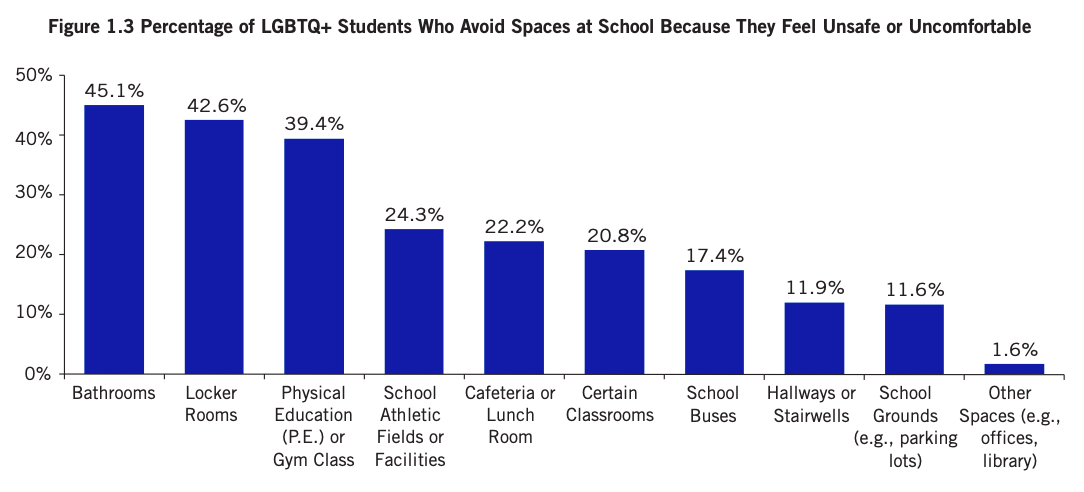
    LGBTQ students’ fears of poorly monitored school spaces such as locker rooms, stairwells and lunchrooms predate the current ideological firestorm. In a survey of LGBTQ youth experiences conducted in 2021 — just as the wave of anti-LGBTQ legislation was beginning to sweep statehouses — the advocacy group GLSEN found that 68% of queer students felt unsafe at school. Bathrooms topped the list of places they avoid, with 45% saying they feared using the restroom. 

    Related

    Data Show LGBTQ Students Report Bullying and Attacks from Kids — and Teachers

    The American Medical Association has linked a lack of bathroom access to increased mental and physical health issues among transgender youth and adults. Nearly 6 in 10 avoid using public restrooms out of fear, and 14% say they have been assaulted in bathrooms.

    In Oklahoma, the number of students who reported hearing negative remarks from teachers about sexual orientation doubled between 2019 and 2021, to 69%. The number who said they heard pejorative comments from adults about trans people rose from 46% to 80% during the same time period. Only 1% reported not hearing slurs from classmates.

    Fourteen percent reported being physically assaulted in school because of their sexual orientation and 13% over their gender expression. More than half said they did not report the harassment or violence to school administrators, whom only 16% of LGBTQ students perceive as supportive. Only 6% believe their school’s anti-bullying policies include sexual orientation and gender identity. 

    The ACLU of Oklahoma has sued state officials and four school districts, charging the bathroom law is discriminatory and violates students’ educational rights. The case is pending in federal court. 


  • Why visible leadership is so important in K12 education Matthew X. Joseph on February 26, 2024 at 1:54 pm

    District Administration Read More

    Leadership guides the course toward success for students, educators, and communities in the complicated education roadmap. Visible leadership is not just an administrative function but a transformative force within schools.

    As assistant superintendent of teaching and learning in New Bedford Public Schools, I want to be in schools daily and collaborate with leaders and educators. Not always in a supervisory capacity, but one focused on collaboration and learning.

    The more I learn, the more impactful I can be in my supervision and feedback. Being a visible leader is significant in fostering trust, driving innovation, enhancing communication, nurturing collaboration, and ultimately, shaping the future of our schools and students.

    Building trust and credibility

    The bedrock of visible leadership lies in the establishment of trust and credibility. Visible leaders cultivate trust through transparency, accessibility, and integrity in their actions and decisions. Through open communication, genuine engagement, and a commitment to ethical conduct, visible leaders create an environment where trust flourishes.

    When stakeholders witness leaders who lead with honesty and integrity, they are likelier to place their confidence in the school’s direction and leadership. Moreover, visible leaders exemplify accountability, taking responsibility for their actions and decisions, further solidifying trust and credibility within the school community.

    Visible leaders uniquely inspire unwavering commitment and engagement among their staff, students, and parents. By articulating a compelling vision for the school’s future, setting high expectations, and fostering a culture of shared responsibility and ownership, visible leaders ignite passion and dedication within the school community.

    DA’s “Talking Out of School” Podcast is now live! Join the District Administration editorial team and special guests every Wednesday as they discuss their experiences, strategies and forecasts for K12 education.

    The entire school community thrives when educators feel empowered and valued, students feel supported and motivated, and parents feel invested in their children’s education. Visible leaders lead by example, demonstrating their dedication to the mission and vision of the school, thereby inspiring others to align their efforts toward common goals.

    Driving change and innovation

    In the dynamic landscape of education, adaptability, and innovation are indispensable qualities. Visible leaders are pivotal in driving change and fostering innovation within their schools. By embracing new ideas, challenging the status quo, and empowering educators to take risks and explore new approaches, visible leaders create an environment where innovation thrives.

    When leaders exhibit a growth mindset and a willingness to embrace change, they inspire their staff to push boundaries, think creatively, and strive for excellence. Visible leaders foster a culture that encourages experimentation, celebrates successes, and learns from failures, driving continuous improvement and innovation.

    Enhancing communication and collaboration

    Effective communication and collaboration are the cornerstones of visible leadership within educational settings. Visible leaders prioritize open and transparent communication, ensuring all stakeholders are informed, heard, and valued. By fostering a culture of collaboration and teamwork, visible leaders break down silos, promote shared goals, and empower their staff to work together towards common objectives.

    When educators, students, and parents feel connected and supported, they are more likely to contribute positively to the school community and work together to achieve shared goals. Visible leaders actively solicit feedback, listen to concerns, and promptly address issues, fostering a culture of trust and collaboration within the school community.

    In times of adversity or crisis, visible leadership becomes even more critical. Visible leaders provide stability, reassurance, and guidance to their school community during challenging times. By remaining calm, composed, and decisive, visible leaders inspire confidence and resilience in their staff, students, and parents.

    Whether it’s navigating budget cuts, addressing safety concerns, or managing a public relations crisis, visible leaders lead by example, demonstrating grace under pressure and a commitment to putting the needs of their school community first. Moreover, visible leaders prioritize the well-being of their staff and students, ensuring that support services are readily available and that everyone feels safe and supported during challenging times.

    Creating a culture

    Visible leaders play a pivotal role in shaping the culture of their school. By embodying the values of inclusivity, equity, and continuous improvement, visible leaders set the tone for a positive and supportive work environment.

    By modeling desired behaviors, recognizing and celebrating achievements, and fostering a culture of respect and collaboration, visible leaders create a school culture where every member feels valued, respected, and empowered to succeed. Visible leaders promote professional growth and development, providing opportunities for staff to enhance their skills and pursue their passions, fostering a culture of continuous learning and improvement within the school community.

    While visible leadership offers numerous benefits, it has its challenges. School leaders may need help with obstacles such as resistance to change, limited resources, or competing priorities. However, by prioritizing visibility, building relationships, and seeking stakeholder input, leaders can overcome these obstacles and foster a culture of visible leadership within their schools.

    By investing in professional development, providing support and mentorship to staff, and leading by example, school leaders can create a culture where visible leadership is valued and embraced by all school community members. Moreover, visible leaders actively seek out opportunities for collaboration and partnership, leveraging the strengths and resources of the broader community to overcome challenges and achieve shared goals.

    I have experienced the positive impact of being a visible leader and collaborated with many others who share this sentiment. Visible leadership serves as a guiding light in our journey toward educational excellence.

    For more strategies, click here for seven ways to implement this . Visible leaders create a school environment where students thrive, educators excel, and parents are engaged. As school leaders, we lead with visibility, integrity, and compassion, guiding our schools toward a future of excellence and success.

    By embodying the principles of visible leadership, we can illuminate the path towards a brighter future for our schools and students, ensuring that every child receives the education they deserve.

    The post Why visible leadership is so important in K12 education appeared first on District Administration.


  • Crunch the Numbers—New Data on Student Tech Use; Chromebook Predictions; And the Impact of Pandemic Relief Funds Kevin Hogan on February 26, 2024 at 2:00 pm

    eSchool News Read More

    Qustodio today released their 5th Annual Report, offering valuable insights into children’s digital habits across 2023. “Born connected: The rise of the AI generation”, reveals the app use and technology habits of children aged 4-18, detailing trends in screen time, social media and communications, mobile gaming, online entertainment, learning tools, and for the first time in the report’s history, use of artificial intelligence tools.

    Qustodio’s report, involving over 400,000 families and schools, studies the popularity of apps and platforms used by children around the world, with further insights into habits in major world markets, including the US, UK, France, Spain, and Australia. In addition to revealing children’s favorite apps and platforms of 2023, the study also investigates the time invested over the year, detailing children’s screen time on popular apps such as TikTok, YouTube, Roblox, and Snapchat.

    The extensive report also features surveys and interviews with families actively involved in their children’s digital wellbeing, giving insight into how parents and guardians navigate parenting in an increasingly online world and the tools they use to keep their children safe as technology, the internet, and artificial intelligence evolve at a rapid pace.

    Some of the key findings from 2023’s report include:

    TikTok continued to captivate with children spending a global average of 112 minutes daily on the app – up from 107 in 2022. UK kids were particularly fond of the bottomless scroll as they racked up 127 mins/day.

    Although YouTube is still the world’s top streaming app, children spent 60% more time on TikTok. 

    Children watched 27% more video content in 2023 than in the previous year – hitting a world average of 57 minutes per day.

    Despite a tumultuous 2023 – and a name change – Twitter/X saw a 27% boost in popularity among children.

    Gaming took a dip in 2023 with children spending 8% less time on mobile games than in 2022. Despite this, Roblox is where children spent the most time – across all app categories – with a global average of 130 minutes invested daily.

    Although WhatsApp remains the king of communication apps, kids spent the most time on Snapchat with a world average of 74 mins/day.

    Australian kids led the way with AI experimentation with 24% using OpenAI – compared with a global average of 19.6%

    “This year has been yet another of innovation and exploring new horizons, as families learn to adapt to new AI technologies and the changing landscape of social media,” says Eduardo Cruz, Qustodio CEO and co-founder. “ The next few years will be a chance for parents, educators, and children to come together and understand how we strike a healthy digital balance, reaping the rewards technology brings while also keeping the youngest in society safe from online harm.”

    To see the full report on children’s digital habits across 2023, and how they have evolved since 2019, visit the Qustodio website.

    CTL, a global cloud computing solution leader for education and enterprise, released its annual predictions today. Based on trends observed in its markets, CTL executives provided an advanced look at what to expect in 2024 for Chromebook and ChromeOS device technologies and market trends.

    “Recently, the leaders at CTL got together to discuss the top trends we’re experiencing and excited about as we transition to 2024. We’ve published a few of our top opinions of what we see as new and next for Chromebook cloud computing. It’s going to be a great year,” said Erik Stromquist, CEO of CTL.

    The predictions addressed in CTL’s article include:

    Chromebook technology-based trends

    Sustainability concerns will drive innovations in Chromebook manufacturing and deployment, including designing for sustainability, enabling device self-repair programs, innovative device rental programs, and suppliers conforming to manufacturers’ sustainability requirements.

    New 5G capabilities will come online, bringing easier, faster, anywhere, anytime connectivity to computing devices for K-12 and other industries like healthcare as they begin to augment traditional wireless solutions and help bridge the digital divide.

    New tools are needed in cybersecurity to fight AI attacks with AI protection.

    ChromeOS EdTech market trends

    Schools will replace their aging fleet of Chromebooks this year to future-proof their tech to offer the performance required to leverage new toolsets like generative AI.

    Schools will extend their ChromeOS devices to teachers, staff, and administrators, taking advantage of their investment in Google Workspace and leveraging the anticipated new power of Chromebook Plus.

    Funding for student Chromebooks will get creative with city-district partnerships, innovative leasing programs, and other post-pandemic funding models.

    Chromebooks will be increasingly adopted worldwide in 2024, with new markets coming online with government tenders in Asia, Latin America, and Africa.

    Complete predictions, including details and executive quotes, are available in the article “ CTL’s Chromebook and ChromeOS Trends for 2024 ” on CTL’s website.

    This week, national non-profit SchoolHouse Connection released “Overlooked and Almost Out of Time,” a report showing the impact and reach of pandemic-era relief funds for students experiencing homelessness, as well as the challenges that are preventing schools from using these funds at a time of heightened need.

    Congress provided the funds, known as the American Rescue Plan – Homeless Children and Youth (ARP-HCY) funds, through a bipartisan amendment to the American Rescue Plan Act, in March 2021. ARP-HCY funds must be obligated by September 2024.

    “ARP-HCY funds are changing lives – even saving lives. But the limited timeframe for using the funds, combined with administrative restrictions, have created barriers to using funds. Now time is running out,” said Barbara Duffield, Executive Director of SchoolHouse Connection. “Urgent action is needed so that we don’t miss this historic opportunity to help students break the cycle of homelessness through education. We urge Congress to extend the ARP-HCY obligation deadline for one more year, and we implore all education agencies to prioritize ARP-HCY funds.”

    The report is based on a survey of more than 1,400 school district homeless liaisons from across all 50 states and the District of Columbia, as well as on analyses of federal data. The report found:

    Child and youth homelessness has increased since the pandemic, creating a greater need for targeted support for students experiencing homelessness.

    The number of school districts receiving dedicated funding to support students experiencing homelessness has more than doubled as a result of ARP-HCY funding, reaching over half of all school districts nationwide.

    School district homeless liaisons report many positive impacts of ARP-HCY funds, including increased school stability, identification, and attendance.

    Still, despite these positive impacts, the report found:

    One quarter of school district homeless liaisons express concerns about meeting spending deadlines due to administrative hurdles and limited time. An additional 25% of liaisons were unaware they received ARP-HCY funds, potentially making it difficult to meet spending deadlines.

    Even though liaisons are legally responsible for identifying and supporting students experiencing homelessness, they are often excluded from key decisions about use of funding.

    Public schools are a critical source of help for children and youth experiencing homelessness, offering stability, services, and the education necessary to permanently escape homelessness and secure a brighter future. Yet homelessness creates barriers to education – many of which can be directly removed with ARP-HCY funds (for example, transportation, store cards to meet basic needs, and short-term emergency motel stays).

    In addition to administrative barriers getting in the way of effectively using ARP-HCY funds, educational agencies have prioritized spending the $122 billion in ARP Elementary and Secondary School Emergency Relief funds at the expense of a focus on ARP-HCY dollars. SchoolHouse Connection’s analysis shows that states have spent ARP ESSER nearly 50% faster than ARP-HCY funds, despite the fact that ARP-HCY funds are less than 1% of ARP ESSER funds.

    The report lays out recommendations for Congress, the U.S. Department of Education, state and local education leaders, and state legislatures. “While the pandemic is officially over, the crisis of homelessness is unabated and growing. Leadership and action is needed at every level — federal, state, and local – to ensure that these funds are used effectively now and sustained into the future,” Duffield said.

    A link to the report, including methodology, can be found here .
     

  • Missouri AG issues cease and desist letters to 3 area school districts Matt Zalaznick on February 26, 2024 at 2:09 pm

    District Administration Read More

    Missouri Attorney General Andrew Bailey has issued cease and desist letters to three St. Louis County school districts.

    Bailey said he has received reports that the Lindbergh, Parkway and Webster Groves school districts have been discriminating against students and staff based on their religion or race.

    Bailey accused the Webster Groves School District of having race-based criteria for employees and applicants, saying, “If these reports are true, Webster Groves is discriminating on the basis of race in direct violation of both state and federal law. Racial discrimination is illegal in the United States.”

    Read more from First Alert 4.

    The post Missouri AG issues cease and desist letters to 3 area school districts appeared first on District Administration.


  • Wisconsin could use concealed carry fees to help fund school safety office

    District Administration Read More

    Bipartisan bills would use funding from concealed carry licenses to keep up staffing within Wisconsin’s Office of School Safety.

    Wisconsin created the school safety office in 2018 in the aftermath of the mass shooting at Marjory Stoneman Douglas High School in Parkland, Florida.

    Today, the office oversees regional teams that respond to crises. It also gives out grants and training so districts can improve security, and staffs a 24/7 hotline to field tips about threats, bullying and mental health crises.

    Read more from Wisconsin Public Radio.

    The post Wisconsin could use concealed carry fees to help fund school safety office appeared first on District Administration.


  • Emergency planning: 9 tough questions you need to answer

    District Administration Read More

    As we head deeper into 2024, fears concerning school safety are running exceptionally high among parents. According to a poll of parents taken at the start of the school year, 38% say they fear for their child’s safety at school. Although this is lower than the 44% of parents who said the same immediately following last year’s Uvalde school shooting, it is still the highest level of concern reported since Columbine, more than two decades ago.

    School leaders and district administrators are on the front lines of keeping students and staff safe, and as we have seen far too often, tragedy can strike anywhere. Leaders are therefore tasked not only with preparing for the unthinkable—they must also be ready to address parents’ fears and answer their valid questions regarding emergency preparedness planning.

    9 questions you need to answer

    Parents are turning to leaders for information regarding school response plans for active violence. But you should also have answers ready regarding emergency responses to extreme weather events, fires, police activity, and more. And it should go without saying that those answers must reflect actual plans in place.

    Here are the tough questions that parents want answered :

    1. What are your emergency plans for different scenarios? Since sharing response details is viewed by experts as bad practice, you should not reveal specific plan measures. But you do have the responsibility to let parents know that plans exist, that they are regularly reviewed and updated, and that security experts have signed off on them.

    2. What type of emergency training does your staff receive? You should be able to say that the school is prepared for all types of emergencies and that all staff members are regularly trained in these measures.

    3. What is your schedule of drills? The scheduling of drills is something you should share with parents. They can then help reinforce learnings with their children and continue safety conversations outside of school. They can also help to reduce any anxieties around the drills.

    4. How are before- and after-school activities addressed? As children spend more time on campus for sports, extracurriculars, and events, you should be able to tell parents that your security plans and procedures cover off-hours activities.

    Listen to DA : ‘Talking Out of School’ podcast launches with our first guest, Randi Weingarten

    5. Where should I plan to reconnect with my children if the school is evacuated? It is essential to include evacuation procedures in all information packets for parents, including where reunification will occur.

    6. How do I securely access the school? Again, this is information that every parent should receive. Security-informed parents will respect that schools require robust security procedures to govern access to facilities.

    7. How will the school alert parents in case of an emergency? Make sure to explain how you plan to manage notifications in an emergency. Parents may want to opt-in to alerts if the school offers different tiers of alert urgency.

    8. What information will you provide to students around safety? Information about emergency procedures can be confusing and upsetting to students, especially younger ones, and parents often want to discuss these issues at home. Consider what you will share with students and make sure parents know what is available and when it is given to their children.

    9. How is personal information handled? Data security is a critical aspect of the broader security conversation. Be ready to explain what personal information is stored, where it is stored, and how it is used.

    Parents today have legitimate questions about their children’s safety at school. We must provide them with clear, accurate and reliable answers. In doing so, we demonstrate our ability to meet our greatest responsibility as school administrators and leaders — to protect the safety of those entrusted to our care.

    The post Emergency planning: 9 tough questions you need to answer appeared first on District Administration.


  • Philadelphia hopes year-round schooling can catch kids up to grade level – will it make a difference?

    Education – The Conversation Read More

    Year-round schooling can assist low-income parents in need of child care. kali9/E+ Collection via Getty Images

    Upon becoming mayor of Philadelphia, Cherelle Parker announced that she will establish a working group on full-day and year-round schooling – an idea she had supported while campaigning. The group will develop a strategy to keep Philadelphia public schools open for longer hours during the week, from 7:30 a.m. to 6 p.m., as well as over the summer, and to provide “meaningful, instructive out-of-school programming and job opportunities for students.”

    Below, education expert Daniel H. Robinson answers five questions about year-round schooling in Philadelphia.

    What do we know about the mayor’s plan?

    Parker is proposing to keep Philadelphia public school buildings open longer hours and more days throughout the year. According to Superintendent Tony Watlington’s Accelerate Philly strategic plan, a year-round and extended-day school calendar will be piloted in up to 10 schools, with the goal of increasing student academic achievement. It does not state how many days or hours will be added to the 180 days Philadelphia currently requires.

    This is different from what’s commonly known as year-round schooling, which doesn’t add extra school days but simply moves the existing days around so that there are multiple short breaks instead of a long summer break. For example, students might have 45 school days followed by 15 days of break, or 60 school days followed by 20 days of break.

    The Philadelphia school district plan aligns with a recommendation made over 40 years ago, in 1983, in the Nation at Risk report commissioned by the Department of Education. The report suggested that the school year should be increased to 200 to 220 days.

    How prevalent is year-round schooling?

    The length of the school day and year varies around the world. Japan and Australia have school for almost the entire year, while the U.S. has school for only about nine months. In contrast, countries like Finland, Iceland and Ireland have shorter school days and years than the U.S. France has a longer school year but similar total hours per year as the U.S. French students get a two-hour lunch and do not attend school on Wednesdays.

    In Philadelphia, some charter schools have added a summer extension program. But they still maintain traditional school hours during the school year.

    Several states are participating in an initiative this year called the Time Collaborative. This three-year initiative involves 40 schools that will add 300 hours to their existing school calendar by having either longer days, longer school years or both.

    Can the mayor legally do this?

    The current minimum number of days that Pennsylvania schools are required to be open is 180 – similar to most other states. Districts can decide when they start and finish. The Philadelphia mayor can certainly extend the school day and the school hours since she appoints the school board members, who in turn control who is hired or fired as superintendent. And, most importantly, the new superintendent is supportive of the mayor’s plan.

    A more important question is: Should the mayor do this?

    Parker has said that she wants to catch kids up academically to grade level. Only about 15% of fourth graders in Philadelphia public schools score at or above the proficient level on standardized reading tests, according to the National Center for Education Statistics.

    But what are the additional costs? In addition to possible increased student and teacher fatigue and stress, the main cost is money. Keeping schools open and staffed longer requires more dollars.

    Despite the hope that longer school days or years will lead to gains in student achievement, there’s little evidence that they will.

    If Philly does in fact adopt a longer school day or year, even with just 10 schools on a voluntary basis, it could prove difficult to evaluate the effects.

    Foremost among these challenges is selection bias. Schools that have support to opt in are likely different from schools that do not.

    A better evaluation plan would be to first solicit applications for the pilot program from the more than 200 Philadelphia schools. Then, from those schools who volunteer to participate, randomly choose 10 for the pilot and then, at the end of the school year, measure the outcomes and compare them to the schools that weren’t chosen.

    What are the potential gains?

    The Accelerate Philly plan cites a 2023 study, which suggests that “summer and after-school programming can be effective in accelerating learning.”

    Adding additional hours for before-school and after-school enrichment, and for more days during the school year, supports parents by providing free and convenient child care. It makes it easier for them to drop off and pick up kids on their way to and from work.

    It also provides kids a safe and supportive environment for more hours. Keeping kids at school longer during the day and for more days during the year can lower juvenile crime. More time in school can mean less time on the streets.

    There is still no decision on whether student participation will be mandatory. If it is not, some kids who might benefit may not get their parents’ consent to go to school earlier, stay longer and go for more days over the summer.

    What hurdles might year-round schooling face in Philly?

    Funding will be a big hurdle. Keeping school buildings open longer requires more energy. Many Philly public schools do not have adequate air conditioning to be open throughout the hot summer months.

    More importantly, this plan requires more personnel – particularly teachers who can stay more hours. A January 2024 report from Penn State University’s Center for Evaluation and Education Policy Analysis found that Philadelphia teachers are leaving the profession at “relatively high attrition rates” – considerably higher than the rest of Pennsylvania. More Philadelphia teachers are quitting or retiring than those who are being newly trained, according to the report.

    It is not clear yet how the teachers union would react to year-round schooling throughout the district or how all the additional hours and programming would fit into the annual operating budget.

    Daniel H. Robinson does not work for, consult, own shares in or receive funding from any company or organization that would benefit from this article, and has disclosed no relevant affiliations beyond their academic appointment.