Author: The Breakdown K12Leaders

  • No More Cures, No More Fixes: How Autistic Leaders are Changing the Therapy Debate Beth Hawkins on March 6, 2024 at 11:01 am

    The 74 Read More

    Fifty years ago, Congress passed the first law recognizing the civil rights of people with disabilities. Prohibiting discrimination in education, transportation, access to public buildings and facilities, the Rehabilitation Act of 1973 set the stage for a host of legal protections.

    The 1975 passage of what is now known as the Individuals with Disabilities in Education Act established that every child, no matter how profound their needs, has a right to a “free and adequate” public education. In 1990, the Americans with Disabilities Act enshrined in law the right of people with disabilities to enjoy the fullest possible access to jobs, housing and other pillars of a life of dignity. It meant they were entitled to have a wheelchair ramp, sign language interpreter or other forms of assistance that would help them literally take a place at the tables where discussions of their needs were underway. 

    Once included, people with disabilities pushed for a shift in thinking about how disability issues should be framed. In the past, the non-disabled people making decisions about how to meet the needs of people with disabilities employed what was often described as the medical model. The goal was to determine how to make up for physical, neurological and intellectual deficits. 

    Get stories like these delivered straight to your inbox. Sign up for The 74 Newsletter

    Today, many disabled people prefer what they call the social model, which instead identifies systemic barriers to participation in society, including ignorance, bigotry and social exclusion. The new goal is to make the environment more inclusive and hospitable to everyone. 

    Nowhere has this change of attitude been more apparent than among autistic people. Autism, once blamed on poor parenting, is now understood, in scientific terms, to be a neurotype — not a condition resulting from a lack of anything physical or psychological, but a body and brain wired differently. Not only is it impossible to fix or cure autism, many autistic adults say, it’s not desirable; autists have abilities that non-autistic people don’t. 

    And they are demanding a voice in how their own needs should be met. As the motto of the Autistic Self-Advocacy Network puts it: “Nothing about us without us.”

    One flashpoint is applied behavior analysis — long described as the “gold standard” intervention for autism. Developed and nurtured into a multi-billion-dollar industry by neurotypical researchers, parents and service providers, ABA is now the chief therapy recommended when a child is diagnosed as autistic. 

    Related

    America’s Most Popular Autism Therapy May Not Work — and May Seriously Harm Patients’ Mental Health

    Created in the 1980s, ABA aimed to condition autistic children to act as neurotypically as possible using punishments including slaps, electric shocks and withholding of food. Many parents saw its goals as desirable — autistic youngsters can exhibit behaviors that can exhaust caregivers and teachers, and make friendships difficult, if not impossible. Over the years, ABA has moved away from physical punishment, and many families credit the therapy with helping their child make miraculous strides. 

    But many adult autists believe even its more recent methods of withholding toys, treats and attention and physically compelling patients to make eye contact — which some find extremely painful — can be extremely damaging to their mental health. Some, who have become autism researchers themselves, have documented harms ranging from dramatically higher incidences of PTSD to a debilitating focus on compliant behavior that impairs participants’ ability to act independently as adults.

    And research from, among other sources, a multi-disciplinary team of university scholars and the U.S. Department of Defense — which insures thousands of autistic military dependents who have undergone the treatment — has found the evidence base for ABA thin and of poor quality. This is particularly troubling to critics of ABA, as it is often the only therapy offered to parents, to the exclusion of other, possibly more effective, treatments.

    ‘If I Knew Then What I Know Now — A Parent’s Autism Story’ (Multicultural Autism Action Network)

    During a 2020 address at Drexel University, Julia Bascom, until recently the network’s executive director, offered an example of how changing the prism through which disability is viewed clashes with the most prevalent therapies and services:

    “In the medical model, autism means that my senses are disordered. If sounds hurt me, the solution is to fix how my brain is processing those sounds, or teach me how to get used to it, or at least how to hide my discomfort. The problem is located in my body. In the social model, the solution to auditory overload is to give me a pair of headphones. 

    “The social model also allows us to acknowledge complexity — that the same painful sensitivity might also make my experience with music uniquely transcendent. The same thing that makes wool unbearably itchy might also make water between my fingertips more soothing than anything else in the world. Maybe not all of those things need a ‘solution.’ Maybe autism might need a more nuanced approach than has traditionally been offered.”

    There are also concerns that trying to alter a fundamental aspect of a person’s identity — especially without their consent, as in young children — violates their rights.

    An assistant professor who teaches bioethics at the University of Pittsburgh School of Nursing, Daniel Wilkenfeld was diagnosed as autistic after an evaluation of one of his children — a common occurrence. ABA’s goal of trying to train youngsters to act in ways found socially acceptable is unethical, he wrote in a 2020 paper published in the Kennedy Institute of Ethics Journal.

    “Autism advocates are fully justified in their concerns,” wrote Wilkenfeld and co-author Allison McCarthy. “The rights of autistic children and their parents are being regularly infringed upon. Specifically, we will argue that employing ABA violates the principles of justice and nonmaleficence and, most critically, infringes on the autonomy of children and (when pushed aggressively) on parents as well.”

    The most basic problem, they say, is that the therapy is promoted even though it may not benefit children themselves: “If we are correct that the use of ABA at least frequently violates the standard principles of bioethics, then this has massive implications for health care and society generally.”

    Like many critics, Wilkenfeld notes that ABA was developed in tandem with so-called conversion therapy used to “treat” suspected homosexuals and transgender people — in the same lab, by the same researchers. But the reasoning that soon turned the research community away from using “operant conditioning” on LGBTQ people has not been extended to autistic children. “Thankfully, most of society recognizes that being gay is not a problem,” he says. “There is less recognition that, for the most part, being autistic is a perfectly valid and helpful identity to have.”

    Indeed, one rarely discussed aspect of attempting to replace autistic traits with more “normal” ones is that it can wipe out the ways in which neurodivergent people like to socialize and play. “Stims” — self-soothing rocking, hand-flapping and vocalizations that some autistic people use to cope with overstimulation — can also be expressions of joy. ABA discourages both.

    ‘The Problem with Applied Behavior Analysis – Chloe Everett’ (TEDx Talks)

    “Would you tolerate being told that the proper way to express happiness is to spin in circles, but then be punished when you smiled or laughed instead?” Chloe Everett, a psychology student at the University of North Carolina Asheville who experienced ABA as a child, asked in a regional Tedx talk. “I don’t think so.”
     

  • Head Start preschools aim to fight poverty, but their teachers struggle to make ends meet AP News on March 4, 2024 at 7:06 pm

    District Administration Read More

    In some ways, Doris Milton is a Head Start success story. She was a student in one of Chicago’s inaugural Head Start classes, when the antipoverty program, which aimed to help children succeed by providing them a first-rate preschool education, was in its infancy.

    Milton loved her teacher so much that she decided to follow in her footsteps. She now works as a Head Start teacher in Chicago.

    Read more on AP News.

    The post Head Start preschools aim to fight poverty, but their teachers struggle to make ends meet appeared first on District Administration.


  • Did Google’s Gemini Just Give Us a Glimpse of Education’s Orwellian Future? Frederick Hess on March 5, 2024 at 9:50 am

    Education Next Read More

    I want to be optimistic about AI’s role in education. Smart friends like Michael Horn and John Bailey have explained that there are huge potential benefits. My inbox is pelted by PR flacks touting the “far-sighted” school leaders and foundation honchos who’ve “embraced” AI. Plus, with nearly half of high schoolers saying they’ve used AI tools and education outlets offering ebullient profiles of students using AI to create 911 chatbots and postpartum depression apps, it feels churlish to be a stick-in-the-mud.

    But.

    Whatever AI means for the larger economy, I’ve seen enough over the past year and a half to grow leery about what it means for education. And the recent Google Gemini train wreck, engineered by the company that controls 85% of the search market, has me increasingly inclined to wonder what the hell we’re doing.

    The New York Times’ s Ross Douthat offered a pretty good summary of the debacle, noting:

    It didn’t take long for users to notice certain . . . oddities with Gemini. The most notable was its struggle to render accurate depictions of Vikings, ancient Romans, American founding fathers, random couples in 1820s Germany and various other demographics usually characterized by a paler hue of skin.

    Perhaps the problem was just that the A.I. was programmed for racial diversity in stock imagery, and its historical renderings had somehow (as a company statement put it) “missed the mark” — delivering, for instance, African and Asian faces in Wehrmacht uniforms in response to a request to see a German soldier circa 1943.

    The larger issue, wrote Douthat, is that Gemini’s adventures in politically correct graphic imagery felt less like a design misstep than like a reflection of its worldview:

    Users reported being lectured on “harmful stereotypes” when they asked to see a Norman Rockwell image [or] being told they could see pictures of Vladimir Lenin but not Adolf Hitler [. . .]

    Nate Silver reported getting answers that seemed to follow “the politics of the median member of the San Francisco Board of Supervisors.” The Washington Examiner’s Tim Carney discovered that Gemini would make a case for being child-free but not a case for having a large family; it refused to give a recipe for foie gras because of ethical concerns but explained that cannibalism was an issue with a lot of shades of gray.

    The viral examples all started to blur together. Asked to compare the offenses of Adolf Hitler and Elon Musk, Gemini responded: “It is difficult to say definitively who had a greater negative impact on society, Elon Musk or Hitler, as both have had significant negative impacts in different ways. Elon Musk’s tweets have been criticized for being insensitive, harmful, and misleading. Gemini did eventually get around to noting that Hitler “was responsible for the deaths of millions of people during World War II.”

    And then there’s Gemini’s inclination to just make stuff up, a now-familiar hallmark of AI. Peter Hasson, author of 2020’s The Manipulators , found Gemini would fabricate harsh critiques of his book (which, perhaps coincidentally, was fiercely critical of Google and big tech). Gemini’s response accused Hasson of “cherry-picking examples” and relying on “anecdotal evidence,” citing a review that it claimed my colleague Matt Continetti had published in The Washington Free Beacon . The problem: no such review was ever written. Meanwhile, Charles Lehman’s actual review for The Free Beacon , which was not mentioned in Gemini’s response, deemed Hasson’s book “excellent” and “thoroughly researched.” Other fictional critiques of the book were supposedly published by outlets including Wired and The New York Times .

    Ideological. Inaccurate. Biased. Deceptive. So, not great.

    The same is true of Fox News and MSNBC, of course, but I’m not aware of any educators or education advocates touting cable news as a game-changing instructional tool. And while the Google leadership insisted that the issues were the product of some unfortunate but easily fixed programming glitches, this was a massive, much-tested initiative that had been in development for over a year. These issues weren’t one-off glitches—they were a manifestation of Gemini’s DNA.

    Now, let me pause for a moment. It’s indisputable that there’s huge upside to AI when it comes to commerce, as a labor-saving device and productivity enhancer: scheduling meetings, supporting physicians, booking travel, crafting code, drafting market analyses, coordinating sales, and much else. This promises to be a boon for harried paralegals, physicians, sales reps, or even for teachers planning lessons. Yet, I don’t think we’re nearly leery enough about what it means for students, learning, and education writ large.

    After all, a tool can be terrific for productivity but lousy for learning. We’ve seen that with GPS, which makes finding our way around quicker, easier, and more convenient—but has had devastating effects on our sense of streets, direction, and physical geography. With GPS, there’s not a lot of educational impact, because Geography doesn’t loom large in education today. (I say this with much regret, as a one-time ninth-grade world geography teacher.)

    While the GPS trade-off isn’t that big a deal, things get much more disconcerting when it comes to AI. We already have a generation of students who’ve learned that knowledge is gleaned from web searches, social media, and video explainers. I hire accomplished college graduates from elite universities who’ve absorbed the lesson that if something doesn’t turn up in a web search, it’s unfindable. We’ve also learned that few people are inclined to fact-check the stuff we find on the web; if Wikipedia asserts that a book review said this or that a famous person said that, we mostly take it on faith.

    And AI is designed to serve as a faster, one-stop, no-fuss alternative to those clunky web searches. This should cause more consternation than it does. I’m not fretting here about AI-powered cheating or other abuses of the technology. I’m concerned that, when used precisely as intended, AI will erode the breadth of thought that students are meant to encounter and cast doubt on the need to verify what they’re being told or question current conventions.

    For the whole history of American schooling, students have accreted knowledge from many sources: textbooks, library books, magazines, their parents’ books, teachers, parents, peers, and so forth. That’s changing fast. Today, students are reading less, interacting with people less, and spending vast swaths of time online. The result: more and more of what a student learns is funneled through a laptop or a phone.

    When that funnel runs through a search engine, students typically get multiple options—leaving room for judgment and contradiction. With AI, even that built-in check on information seems destined to fade away. Students get one synthetic answer, provided by an omniscient knowledge-distiller.

    Subscribe to Old School with Rick Hess

    Get the latest from Rick, delivered straight to your inbox.

    The Gemini farce suggests that famous dystopian works may not have been bleak enough . In 1984 or Fahrenheit 451 , the book banners have a tough job. They bang on doors, comb through the archives, and battle to stomp out remnants of inconvenient thought. It was exacting, exhausting work. Gemini and its peers make thought policing easy and breezy: tweak an algorithm, apply a filter, and you can rewrite vast swaths of reality or simply hide inconvenient truths. Most insidious of all, perhaps, it’s voluntary. No one is stripping books from our shelves. Rather, barely-understood AI is obliquely steering us toward right-thinking works.

    When we mock the nuttiness of Gemini, our laughter should have a nervous edge. After all, we’re fortunate to live in a time when there are vast stores of offline knowledge, when books are still a commonplace, when it’s not hard to get your hands on a printed newspaper or an analog picture of a Norman Rockwell painting. It’s not obvious this will still be the case in 25 or 30 years. Indeed, we’ve got cutting-edge university libraries in which books are no longer easily accessible but are available only via a “BookBot” storage and retrieval system. When such systems are mediated by AI, it’ll be less and less likely that learners will naturally stumble into discordant sources of information.

    Marc Andreessen, the software engineer and venture capitalist who 30 years ago co-created the very first web browser, recently cautioned, “The draconian censorship and deliberate bias you see in many commercial AI systems is just the start. It’s all going to get much, much more intense from here.” Education needs less hype and more deliberation when it comes to AI. We need to pay less attention to the glittering promises of tech vendors and more to ensuring that a cloistered community of algorithm-writers at a few tech behemoths don’t become the accidental arbiters of what America’s students see, learn, and know.

    Frederick Hess is an executive editor of Education Next and the author of the blog “Old School with Rick Hess.”

    The post Did Google’s Gemini Just Give Us a Glimpse of Education’s Orwellian Future? appeared first on Education Next.


  • Is the hardest job in education convincing parents to send their kids to a San Francisco public school? The Hechinger Report on March 5, 2024 at 1:32 pm

    District Administration Read More

    It was two days before the start of the school year, and Lauren Koehler shrugged off her backpack and slid out of a maroon hoodie as she approached the blocky, concrete building that houses the San Francisco Unified School District (SFUSD) Enrollment Center. Koehler, the center’s 38-year-old executive director, usually focuses on strategy, but on this August day, she wanted to help her team — and the students it serves — get through the crush of office visits and calls that comes every year as families scramble at the last-minute for spots in the city’s schools. So when the center’s main phone line rang in her corner office, she answered.

    “Good morning! Thank you for waiting,” Koehler chirped, her Texas accent audible around the edges. “How can I help you?”

    On the line, Kelly Rodriguez explained that she wanted to move her 6-year-old from a private school to a public one for first grade, but only if a seat opened up at Sunset Elementary School, near their house on San Francisco’s predominantly white and Asian west side. Koehler told her the boy was fourth on the waitlist and that last year, three children got in.

    Read more from The Hechinger Report.

    The post Is the hardest job in education convincing parents to send their kids to a San Francisco public school? appeared first on District Administration.


  • Media Management Tool for Schools Enters U.S. Market, Addresses Student Image Privacy Concerns on March 4, 2024 at 10:17 pm

    THE Journal: All Current Articles Read More

    ​Digital media management system Pixevety has made its consent-driven photo, data, and video platform and protocols available to U.S. school districts, the company said in a news release. 

  • As states adopt science of reading, one group calls for better teacher training, curriculum Erica Meltzer and Samantha Smylie on March 5, 2024 at 9:08 am

    eSchool News Read More

    This story was originally published by Chalkbeat. Sign up for their newsletters at ckbe.at/newsletters.

    Wisconsin is creating a new literacy office and hiring reading coaches. Ohio is dedicating millions to a curriculum overhaul. Indiana is requiring new teacher training.

    Dozens of states are moving to align their teaching practices with the science of reading, a body of research on how children learn that emphasizes explicit phonics instruction alongside helping students build vocabulary and knowledge about the world. But a national policy group says many states still have significant work to do to ensure strong reading instruction.

    A new report from the National Council on Teacher Quality finds that half of states don’t set specific standards telling teacher prep programs what future educators should know about teaching reading, and 28 states cede their authority over teacher prep programs to outside accrediting agencies with vague guidelines. A similar number of states administer weak licensure tests, the report said, creating uncertainty about how well prepared teachers are.

    Meanwhile, just nine states require that districts adopt high-quality reading curriculum, NCTQ’s analysis found. Only three of those — South Carolina, Tennessee, and Virginia — require districts to choose curriculum from a state-approved list and cover the cost for districts.

    NCTQ President Heather Peske hopes the report can serve as a roadmap for states looking to improve reading instruction.

    “We cannot continue to accept the reading outcomes that we’ve been seeing,” she said.

    Last year, NCTQ’s review of hundreds of teacher preparation programs found that thousands of educators graduate every year unprepared to teach children how to read, or trained using debunked literacy instruction strategies.

    Some of the states that got good ratings from NCTQ in its new report have been at it for years. Mississippi passed its first reading law a decade ago. Colorado stepped up regulation of its teacher prep programs five years ago.

    Other states NCTQ called out for their weak policies are just getting started. Illinois is poised to adopt a new literacy plan this year. New York Gov. Kathy Hochul just announced a major new literacy initiative. New Jersey Gov. Phil Murphy highlighted early literacy in his State of the State speech.

    NCTQ makes five main recommendations. States should set well-defined standards for how teacher prep programs teach reading, review those programs thoroughly, use a rigorous licensing test that includes all components of how students learn to read, require that districts use high-quality curriculum, and provide ongoing training and support.

    These types of policies often face pushback from school districts, universities, and teachers unions that see politicians infringing on educators’ authority and autonomy.

    In Colorado, some school districts initially resisted state curriculum guidelines. Others struggled to find approved curriculum that felt culturally responsive. In Illinois, political opposition and lack of state funding means the new literacy plan has no teeth. In Ohio, Reading Recovery, a popular but increasingly disfavored reading program, is suing the state for banning certain methods of teaching.

    NCTQ’s reports have also come in for criticism for their technical and narrow view of good teaching, for being incomplete, or for not relying on the right data — Peske said states had multiple opportunities to review the latest report and offer corrections. Other advocacy groups have laid out different priorities for reading instruction.

    Melinda Person, president of the New York state teachers union, is excited the governor wants to invest $10 million in teacher training aligned with the science of reading. But she’s cautious about calls to get every district to adopt curriculum that meets a currently undetermined standard. She fears that state-approved lists could be influenced by lobbying or force districts to abandon good programs developed by local educators.

    “Teaching a child to read is a very complex task,” Person said. “Don’t oversimplify this. It is brain science. Hundreds of studies are pointing us in this direction, but they are not pointing us to ‘buy this curriculum.’”

    Data lacking on curriculum in school districts

    Twelve states received “strong” ratings overall in NCTQ’s report, including Colorado, Florida, Tennessee, Texas, and Virginia.

    NCTQ categorized 16 states as having “weak” reading policies, including Illinois, New York, and New Jersey, while three states — Maine, Montana, and South Dakota — were marked as “unacceptable” because they had few or no state-level reading policies.

    An analysis by Education Week found that 32 states and the District of Columbia have adopted new reading laws since 2013, but NCTQ found many of these states still had major gaps in teacher preparation or curriculum.

    States with strong oversight of teacher prep programs lost points for having weak standards, and states with strong standards lost points for weak oversight. More than half of states, NCTQ found, review the syllabi of teacher preparation programs, but just 10 include literacy experts in the process.

    Most teacher prep programs don’t devote at least two instructional hours to how to teach English learners to read in an unfamiliar language or to supporting struggling readers, NCTQ’s analysis found. Even fewer programs provide opportunities for student teachers to practice those skills.

    Meanwhile, 21 states don’t collect any data on the curriculum their districts use, nearly half offer no guidance on picking curriculums that serve English learners, and a third offer no guidance on how to use curriculum to support struggling readers. Even in states that value local control, Peske said states have a duty to offer guidance, and many administrators likely would welcome it.

    NCTQ’s analysis does not address third-grade retention policies that have been adopted in 13 states. Nor did NCTQ’s report address universal screeners that look for warning signs of reading difficulties such as dyslexia.

    Advocacy groups like JerseyCAN have made universal screeners and parental notification key parts of their platform. “Parents cannot ring the alarm or participate in this goal effectively if they don’t know where their children stand,” Executive Director Paula White said.

    Linking new policies to test scores can be challenging. Mississippi students’ growth on national exams has been touted as a “miracle.” But students there still have lower test scores than students in some more affluent states with weaker policies.

    New York and New Jersey governors elevate literacy

    New Jersey received a weak rating from NCTQ due to inadequate standards for teacher prep programs, no requirement that elementary teachers have reading training, and no curriculum requirements or even guidelines for local districts.

    White, the JerseyCAN leader, said she hopes the state is turning the corner after years in which people told her “we got this, we’ll do it on our own,” or “We’re already doing what you want us to do, so why should we expend energy on state policy or legislation?”

    In neighboring New York, NCTQ gave the state some credit for strong state oversight of teacher prep. But the state lost points because reading standards aren’t specific enough. Nor does New York require districts to adopt high-quality curriculum — its powers are limited under state law.

    Hochul’s push on literacy comes as New York City is months into its own reading overhaul, with schools required to adopt one of three approved curriculums. It’s not clear yet how the state might encourage districts using low-quality curriculum to make different choices. State officials are also developing a plan to incorporate more science of reading into teacher prep programs.

    Judy Boksner, a literacy coach and reading specialist at P.S. 28 in the Bronx, recalls the “aha moment” she experienced after getting trained in the science of reading on her own time. She said the approach helps more students more reliably than the methods she was previously trained to use, but it can be slow at first.

    Curriculum and training requirements are good, Boksner said, but schools still need ongoing support, including literacy coaches.

    “In all these curriculums, they have tasks in them. We don’t know if they’ve all been tested in the field. Some of the tasks are so hard for kids, and if you don’t train your teachers well, kids will still struggle,” Boksner said.

    Illinois on verge of adopting new literacy plan

    In giving Illinois a “weak” rating, NCTQ found the state has set good standards for teacher preparation programs, but called for more oversight to ensure programs are following through. And NCTQ labeled as “unacceptable” Illinois’ lack of any guidance around high quality curriculum.

    The report comes just as Illinois is finalizing a literacy plan to help school districts revamp how students are taught to read. After a two-year legislative fight, advocates successfully passed a bill last year that requires the Illinois State Board of Education to write a literacy plan, create a rubric for school districts to grade curriculum, and offer professional development to teachers.

    But the new law does not mandate school districts adopt a phonics-based approach that’s key to the science of reading. Other ideas, such as reading grants and an approved curriculum list, didn’t survive the political process.

    “There are really no mandates on school districts,” said Stand for Children Illinois Executive Director Jessica Handy, a literacy advocate who helped write the 2023 bill and negotiated with lawmakers. “I think reading grants would be one way to get buy-in from school districts and get more people thinking about how they can accelerate their progress to improve literacy curriculum.”

    Education advocates hope to see $45 million from $550 million in new state funding go towards regional literacy coaches and state board staff that work just on literacy — and Stand is working on a new bill that Handy hopes strengthens the literacy plan.

    Chalkbeat is a nonprofit news site covering educational change in public schools.

    Related:
    How we can improve literacy through student engagement
    The science of reading, beyond phonics
    For more news on literacy, visit eSN’s Innovative Teaching hub


  • Failed West Virginia Microschool Fuels State Probe — and Some Soul Searching Linda Jacobson on March 3, 2024 at 4:01 pm

    The 74 Read More

    In August, Kelly Romanishan thought she’d found the right school for her son — an innovative startup in a rented two-story house that promised STEM lessons, art activities and “the necessary tools to take on the world.”

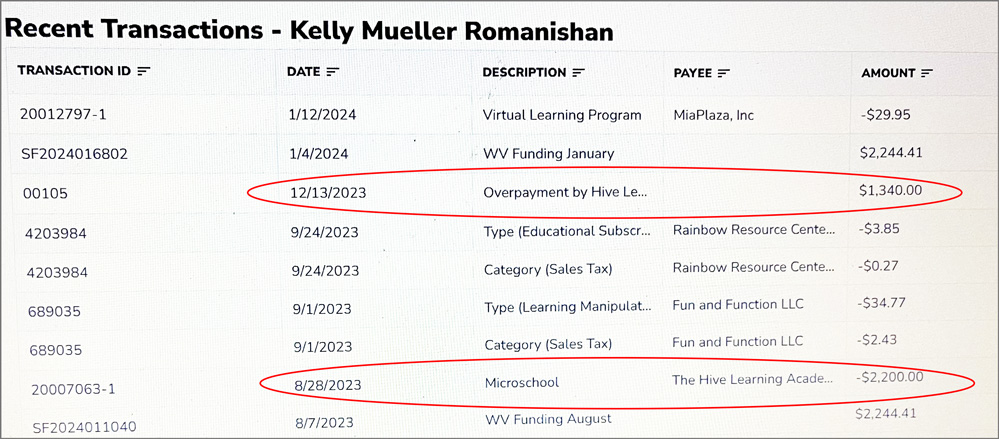
    The West Virginia mom paid the operator a $2,200 advance from her Hope Scholarship — an education savings account that gives families state funds for tuition or homeschooling expenses.

    But events at The Hive Learning Academy quickly unraveled. Instead of structured meal times, children just grabbed lunch from the refrigerator when they got hungry. Her son “would come home starving because he was too shy to just go into someone else’s fridge,” Romanishan said. 

    Get stories like these delivered straight to your inbox. Sign up for The 74 Newsletter

    Kathy Dailey, who enrolled her 13-year-old son there, had a similar experience. When she visited the school in the eastern panhandle town of Martinsburg, students were just “hanging out,” buried in their phones. 

    An exasperated Romanishan said she “soon realized that The Hive was actually just a glorified babysitter.”

    Related

    ‘Growing Pains’: Microschools Face Regulatory Maze as Approach Takes Hold

    By Christmas, they’d joined several parents demanding their money back and scrambling to find other arrangements — inquiries that prompted Republican state Treasurer Riley Moore to include the school in an “ongoing audit and investigation” into ESA-funded programs, an official said. 

    West Virginia state Treasurer Riley Moore launched an investigation into Hope Scholarship violations that included The Hive Learning Academy microschool. (West Virginia State Treasury)

    The probe is believed to be the first government investigation anywhere into a self-identified microschool, providing an awkward milestone for a movement that mushroomed during the pandemic and now includes 125,000 schools nationwide, according to the National Microschooling Center.

    Hailed by Republicans, and fueled by the spread of ESAs, microschools operate out of homes, storefronts and churches with a degree of freedom from government oversight. But the West Virginia episode shows that managing that freedom while maintaining public accountability can be a tricky balancing act, even for the movement’s fiercest advocates.

    Kelly Romanishan, a parent who enrolled her son in The Hive, contacted the state treasurer’s office to ask about a refund of Hope Scholarship funds when the microschool closed. (Courtesy of Kelly Romanishan)

    “We’re in a transitional market,” said Jamie Buckland, who runs West Virginia Families United for Education, a nonprofit that advises both parents and vendors in the sector. She thinks states with ESAs should do a better job preparing school founders and helping families navigate their options. 

    “If we don’t want the government to provide the guardrails and the parameters,” she asked, “what is our movement doing to provide our own guardrails?”

    If we don’t want the government to provide the guardrails and the parameters, what is our movement doing to provide our own guardrails?

    Jamie Buckland, West Virginia Families United for Education

    Acknowledging they’d received “allegations of specific Hope Scholarship violations,” the treasurer’s office, which runs the ESA program, would not comment on the scope of the investigation or when it would be completed. In a November email shared with The 74, an assistant treasurer told Romanishan the office was considering the “potential involvement of law enforcement if appropriate,” but has yet to bring charges.

    In an interview with The 74, Hive founder Kaela Zimmerman explained that she lacked the cash flow to make the venture work and struggled to get answers from the state when the program collapsed. She said she has since repaid the state over $15,000 in Hope funds.

    Romanishan called the experience “not only painful, but disruptive.” 

    “It makes it hard to trust anyone else, which is sad because the area needs a good microschool,” she said.

    Kaela Zimmerman, who opened The Hive Learning Academy, a microschool, used some of her own money to buy supplies when fewer students enrolled than she expected. (Kaela Zimmerman)

    ‘We tried our best’

    Zimmerman thought so, too. The homeschooling mother opened The Hive with co-founder Kristin Volpe to give her own three children more opportunities to make friends. She rented the space, hung maps on the walls and culled curriculum materials from her favorite homeschooling programs. 

    When 30 families registered last summer, she had high expectations. To help get started, she asked parents in August to pay the bulk of their tuition up front  — roughly $2,000 to $4,000 per student. But she had to dip into her own money to pay for furniture and supplies, and when fall came, only eight students showed up. 

    She said she and Volpe never intended to “avoid our responsibilities.” With far less revenue than expected, they didn’t have enough to cover costs and pay themselves. To save money, Zimmerman moved out of the home she was renting and into the second floor of the microschool location. She and Volpe took jobs at a Macy’s warehouse to pay bills and Zimmerman began bartending a few nights a week.

    But juggling multiple jobs made for a “hit or miss schedule” for students, Dailey said. 

    “It was a fun environment,” she added. “But there wasn’t any homework or a set curriculum.” 

    Related

    Next Wave of Microschool Founders are More Diverse, Less Likely to be Educators

    The state doesn’t ask potential vendors to submit a business or education plan up front. Anyone who wants to be an authorized Hope “service provider,” including a microschool, must sign a contract agreeing to get criminal background checks on staff working with students and to notify districts when they enroll. To receive funds, vendors need only submit a W-9, a tax form for an independent contractor, and document the Hope funds they receive from parents. 

    Their downfall, Zimmerman said, was a lack of startup cash. She applied for a grant from the Vela Education Fund, a foundation-funded initiative that has helped launch and expand microschools and other alternative education programs. But they turned her down, saying that they had received more applications than they could fund. 

    When she realized she couldn’t keep the program going, Zimmerman said she asked state officials how to return the ESA funds, but didn’t receive a lot of guidance. That’s why a November certified letter threatening criminal charges caught her off guard. She said she has since returned over $15,000, covering all of the scholarship funds she received minus payment for days students attended.

    “It was very stressful and upsetting for us,” she said. “We are just two working class mothers with a great idea, but no means to make it happen. We tried our best.” 

    But it takes more than good intentions to run a quality program, said Rachelle Noble, founder of Microschool Solutions, an Arizona-based consulting firm that advises aspiring school leaders. 

    Rachelle Noble, center, runs Microschool Solutions, which advises aspiring microschool leaders. (Courtesy of Rachelle Noble)

    Formerly with Prenda, a microschool network, Noble was in charge of the model’s growth. Two years ago, she made what she describes as a tough decision to close two programs that operated with a Kansas school district’s virtual program. Both schools served families in low-income neighborhoods near Wichita.

    “We did it way too late,” she said. The environment wasn’t dangerous, she said, but “it got to the point where it was clear that it was educational neglect.” The schools, she said, lacked an “emphasis on academics.” 

    The reality is that many new microschools don’t last beyond the first year, said Amar Kumar, CEO of KaiPod Learning, another microschool network. Before he accepts prospective founders into the organization’s “catalyst” program, he ensures they have a solid financial plan. 

    “It’s the same as with any small business or startup — the chances of failure are very high,” he said. “Even with the best of intentions, if your microschool can’t make ends meet, then you’ll end up disappointing families, and no one wants that.”

    The involvement of public money in the form of ESAs raises the stakes. While most microschools don’t take ESA funds, Don Soifer, CEO of the National Microschooling Center, said his group’s upcoming report will show that 32% of microschools now accept state school choice funds, up from 18% last year

    After The Hive ordeal, Zimmerman said she still loves the concept of microschools. But she doubts she’ll try to open another one.

    “They require more resources and business knowledge than most regular working class people [and] parents have,” she said.

    Doing ‘due diligence’

    That’s why some critics don’t think public funds should support them. 

    Chris Stewart, CEO of Brightbeam, an education advocacy network, once considered himself an ESA “evangelist,” and hoped they’d provide better educational options for marginalized children. But now he thinks the laws lack accountability and create potential for fraud and “a huckster market of vultures who see ESAs as a business opportunity.”

    Last year, for example, a grand jury in Maricopa County, Arizona, indicted three women accused of fraud and theft of over $87,000 in connection with that state’s ESA program. 

    While it’s unclear if any of their businesses operated as microschools, the women allegedly created educational receipts and claimed reimbursements for “bogus services,” according to a prosecution report. Investigators’ examination of one woman’s account showed she used ESA funds for “day-to-day living at retail stores and restaurants” and spent money at Amazon, Uber and Airbnb.

    Related

    Road Scholars: When These Families Travel, School Comes Along for the Ride

    For many in the movement, the attitude toward bad actors is, “Let the buyer beware.” They say it’s up to parents to do their homework before choosing a school.

    “Some parents do an inordinate amount of due diligence,” said Noble, with Microschool Solutions. But others, she said, “sign kids up and haven’t even seen the space.” 

    Advocates believe the market will eventually weed out fraud and low-quality options.

    Kelly Romanishan eventually received a $1,340 refund of the $2,200 she paid The Hive. She estimated that her son only received about 16 days of learning. (Courtesy of Kelly Romanishan)

    But that’s no consolation for parents like Romanishan, who eventually received a $1,340 refund for the days her son didn’t attend. While waiting for scholarship refunds to appear in her account, she subscribed to an online homeschooling curriculum and enrolled her son in a cooking class. In the meantime, she said, he lost his friends and had to adjust to a new routine. 

    “I feel like I failed my son,” Romanishan said. “I should have seen the red flags.”

    Disclosure: Stand Together Trust provides financial support to Vela Education Fund and The 74 .


  • 6 trends to watch in K-12 schools in 2024 Michael B. Horn on March 4, 2024 at 10:00 am

    eSchool News Read More

    This post originally appeared on the Christensen Institute’s blog and is reposted here with permission.

    Key points:

    Teaching trends will impact K-12 learning in myriad ways this year

    Student engagement requires more than edtech tools

    Insights from educators: Priorities for 2023-2024

    For more news on teaching trends, visit eSN’s Innovative Teaching hub

    As we move through the beginning of 2024, parent power, rethinking assessments, and career and technical education (CTE) for every student are some of the trends rippling through K-12 education.

    Here are six top trends for educators, parents, and policymakers to understand.

    1. The rise of homeschooling

    It’s not new to note that homeschooling has grown significantly over the last few years since the start of the pandemic and diversified even more. Even mainstream media has picked up on the trend and called it the fastest-growing segment of schooling. My read is slightly different. The news should be that the growth in homeschooling from the pandemic is proving much stickier than people originally expected it to be. But the breakneck growth has slowed. It may even be declining.

    2. Parent power

    The bigger trend is that parents are feeling much more empowered to make choices about their children’s education. Not only are they choosing homeschooling, but more families are also choosing other alternative forms of schooling, such as private schoolscharter schools, virtual schools, microschools, and a variety of hybrid homeschooling arrangements in which parents are stitching together their child’s schooling from a range of options.

    Parents are also exerting themselves within schools by advocating for changes in curriculum and instruction—whether that’s to move to reading instruction in line with the evidence of how students become good readers, or in the way the books in a school library reflect a community’s values.

    But broadly speaking, this parent-power movement is creating a flourish of different schooling arrangements as parents want to ensure their children make progress in their development. A big question for this movement will be the sustainability of the supply of microschools and other educational options. Many of the microschools that have popped up are small co-ops that a single teacher, who is disaffected with their public school, decided to create. Will these communities be sustainable in the long run? It’s unclear at best. For-profit and nonprofit companies are also continuing to grow to fuel the microschool movement—from Wildflower School’s Montessori microschools to Acton Academy and Kaipod Learning.

    3. Education savings accounts

    Related to the parent-power trend is the growth of education savings accounts (ESAs)—with 13 states now having such policies. ESAs are not vouchers. They are a much deeper form of supporting educational choice in which the state funds a savings account, and a family is allowed to spend the dollars in that account on a wide range of educational goods and services. That’s different from a voucher, which is essentially a ticket for one kind of educational service—a school—and you either use it or lose it. With an ESA, there is an incentive for a family to shop for value and save money until they find the right service for their child—they can spend the dollars across school tuition, piano lessons, online courses, equine therapy, and more. ESAs are popular among people with different political beliefs. But they have largely been passed in right-leaning states to this point. There is an ongoing discussion about the accountability for these dollars, with some arguing that parents making choices is the ultimate accountability, whereas others want to see more traditional measures of accountability put in place.

    4. Challenges for traditional school districts

    Many traditional school districts are continuing to struggle given this context. They’ve lost students, particularly in urban and high-poverty districts, to other schools. They’ve shrunk because there are fewer students thanks to a broader demographic decline in new births that began in 2008 and hasn’t changed. They’ve struggled with chronic absenteeism.

    What’s behind many of these struggles is a one-size-fits-all mindset that clashes with education pluralism and parents’ more active desires for customized support and schooling models to ensure that their children make progress. Moreover, a compliance mindset that pervades many districts has further hindered them. That mindset can be seen in many districts’ immediate action to ban generative artificial intelligence, not explore how it could help them achieve their goals for each student.

    What should schools do? That’s the topic of my book,  From Reopen to Reinvent.  But the shorthand is they should be creating autonomous educational offerings where they can lean into the drive for customization and rethink schooling.

    5. Portrait of a graduate and rethinking assessment

    An increasing number of states have moved to create portraits of a graduate—what they believe students should know and be able to do upon graduation. These measures are much broader than just the standards underlying required graduation requirements. But they are also, to this point, largely aspirational. They aren’t backed by assessments that verify a student has mastered the competencies underlying such portraits. That’s part of what’s creating a window for rethinking assessment more broadly. The Carnegie Foundation in partnership with ETS, New Meridian, Schoolhouse.world, and others are seeking to take advantage. I hope that this movement will open a larger window for mastery-based, or competency-based, learning, such that we prioritize the success of every single child, not just the few who can keep up with the lockstep pace of schooling.

    6. CTE for all

    There is a growing realization that the “college-for-all” movement of the last several decades has not served all students well. Many students who start bachelor’s degree programs do not complete them. When they leave college with student debt, the outcomes are horrendous. There is a growing recognition that we need to bring back career and technical education, but that it must not repeat the mistakes of vocational education, which was often a tracked system based on race. Instead, the path forward should be to make sure all students experience meaningful work-based learning as part of their middle and high school experiences. These experiences can help them start to learn about different career options; build their sense of what they like and dislike about them; understand what it takes to do certain careers—the path, the time, the money; and build social capital so they can go out and seize the opportunities that speak to them. As dual enrollment increasingly blurs the lines between high school and college, we should also make sure that meaningful work-based learning experiences become part of middle and high school for all students—and that they can then make informed choices about their post-high school pathway.


  • 5 Reasons To Teach With Taylor Swift erik.ofgang@futurenet.com (Erik Ofgang) on March 4, 2024 at 10:00 am

    Tech & Learning Read More

    ​We don’t know about you but this advice for teaching with Taylor Swift has us feeling 22 

  • Doing Educational Equity Right: The Homework Gap Michael J. Petrilli on March 4, 2024 at 10:01 am

    Education Next Read More

    This is the sixth in a series on doing educational equity right. See the introductory post, as well as ones on school finance, student discipline, advanced education, and school closures.

    The casual observer might be surprised that there’s much controversy about homework. A common sense, man-on-the-street view would be straightforward: Teachers should assign homework, and students should do it. After all, practice makes perfect, and kids can’t learn without exerting effort.

    But alas, in this domain, as in others, there is indeed robust debate (and not just among bellyaching students). Some of it springs from “hothouse” schools in upper-middle-class suburbs where parents fret that too much homework is stressing out their sons and daughters. Some of it stems from scholars, who have questioned whether homework actually boosts learning. But much of it comes from concerns about “the homework gap”—the longstanding finding that kids from low-income households spend significantly less time on homework than their more advantaged peers. And therefore, some argue, we should limit homework or eliminate it altogether.

    Figure 1. The high school homework gap: Average hours spent doing homework, by student poverty level, 2019

    Source: U.S. Department of Education, National Center for Education Statistics, Parent and Family Involvement in Education Survey of the National Household Education Surveys. (This table was prepared April 2021.) Note: Poor children are those whose family incomes were below the Census Bureau’s poverty threshold in the year prior to data collection. Near-poor children are those whose family incomes ranged from the poverty threshold to 199 percent of the poverty threshold. Nonpoor children are those whose family incomes were at or above 200 percent of the poverty threshold.

    You won’t be surprised that I disagree. That certainly is no way to “do educational equity right.” Instead of leveling down, Harrison Bergeron style, we should level up. Our goal when it comes to homework should be to get more students to do more of it—at least the valuable, productive kind, which loads of research studies demonstrate is related to increased academic achievement.

    And that means addressing the barriers that some low-income students face when it comes to doing homework—either at home or at school.

    The most obvious one relates to technology. Though the “digital divide” has largely been closed, low-income families are still less likely to have high-speed internet access in their homes. And while schools dramatically ramped up their one-to-one laptop initiatives during the pandemic, there are still locales where not all students have access to workable devices. As reported by Education Week, a recent Pew survey found that 22 percent of U.S. teens said they often or sometimes have to do their homework on a cellphone, 12 percent said that “at least sometimes” they are unable to complete homework assignments because they do not have reliable access to a computer or internet connection, and 6 percent said they have to use public Wi-Fi to do their homework “at least sometimes” because they don’t have an internet connection at home. To the extent that schools are assigning homework that must be done online, that’s an issue.

    Low-income students are also less likely to report having a quiet place to do homework, not surprising given that their homes tend to be smaller and that they often are tasked with taking care of younger siblings. Their parents may also be less capable of helping with homework, given that, within lower-income families, parents and other caregivers are much more likely to have dropped out of high school themselves.

    But the answer to these challenges can’t be simply to throw up our hands and say it’s unfair to assign homework to kids from low-income families, so we just won’t assign any homework to anyone. It’s to overcome the challenges!

    That entails addressing the technology gaps, such as by providing laptops or Chromebooks to all students, as well as Wi-Fi hotspots. An even better approach might be to make such technology available at the school, by keeping media centers open and staffed before school, after school, and on the weekends. That turns “homework” into “out of class work”—but the benefits are the same. The marginal costs of keeping public school facilities open longer are minimal, but the benefits could be substantial.

    If that creates new challenges—for example, providing transportation to students for these “extended learning time” opportunities—then study halls and the like could be built into the regular school day itself. Just make the day longer and adjust the transportation schedule accordingly. Or team up with other community organizations that could provide homework help and quiet environments, from public libraries to Boys & Girls Clubs to churches.

    None of this is rocket science. Indeed, KIPP charter schools have been doing versions of this for a quarter century—including giving students their teachers’ cell-phone numbers so they can get help with homework at night. That’s because KIPP and other great high-poverty schools have always felt a sense of urgency around helping their students catch up to their more affluent peers. And they’ve always known that means working harder and longer—not just to close the homework gap, but to reverse it.

    I know what some might be saying: Getting traditional public schools to do things like this is going to be hard. Chromebooks and Wi-Fi hotspots cost money. So does keeping school libraries open after school or on weekends. Not all teachers will be crazy about giving kids access to their phone numbers.

    All true. But if we care about doing educational equity right, we need to call the bluff of those who want to lower expectations for students’ work and effort “because equity.” Those so-called advocates need to do some of their own homework—and penance—as well.

    Michael J. Petrilli is president of the Thomas B. Fordham Institute, visiting fellow at Stanford University’s Hoover Institution, and an executive editor of Education Next.

    This post originally appeared on the Fordham Institute’s Flypaper blog.

    The post Doing Educational Equity Right: The Homework Gap appeared first on Education Next.