Augmented Reality (AR) and Virtual Reality (VR) have made significant inroads into various industries, and education is no exception. The integration of AR and VR in K12 education has the potential to revolutionize the way students learn and interact with educational content. In this article, we will explore the impact AR and VR will have on K-12 education in terms of pedagogy and content.
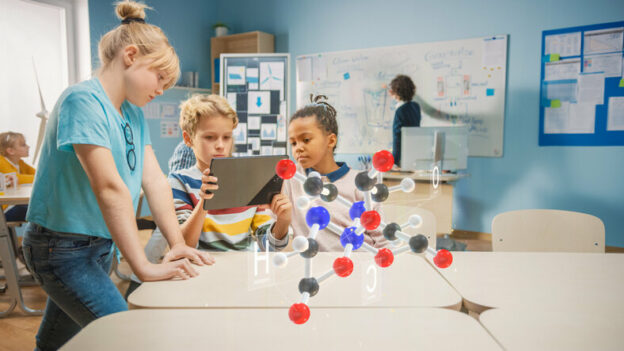
One of the most significant benefits of AR and VR in education is the ability to create immersive learning experiences that engage students and enhance their understanding of complex concepts. With AR, students can see 3D representations of abstract ideas, making them easier to understand. For example, students learning about anatomy can see an overlay of the human body in their textbook, allowing them to see how organs interact in real-time. Conversely, VR creates an entirely immersive experience, allowing students to explore virtual environments and interact with them in a way that feels real.
The use of AR and VR also helps in creating personalized learning experiences . With AR, students can access multimedia content such as videos, animations, and audio in real-time, based on their learning styles and preferences. Meanwhile, VR can create interactive scenarios, such as virtual field trips, simulations, and role-playing exercises tailored to the student’s interests and needs. This creates a more engaging learning experience that will likely increase student motivation and engagement.
One of the primary ways AR and VR will impact K-12 education is in content delivery . With AR and VR, students can experience educational content in a way that feels real and immersive, making it easier for them to understand complex concepts. For example, VR can create virtual field trips that allow students to explore historical sites, visit museums, or even travel to other countries without leaving the classroom. AR, on the other hand, can add interactive elements to textbooks, making the learning experience more engaging and memorable.
Another way in which AR and VR will impact K-12 education is by providing access to a broader range of educational resources . With AR and VR, students can access multimedia content such as videos, animations, and audio, making it easier for them to understand complex concepts. For example, VR can create simulations of historical events, allowing students to see what it was like to live in a different time and place. This opens up new opportunities for students to explore and learn about the world around them.
In conclusion, AR威而鋼 and VR have the potential to revolutionize the way students learn and interact with educational content. By providing students with immersive learning experiences and personalized content, AR and VR can help students understand complex concepts in an engaging and memorable way. Additionally, AR and VR can provide access to a broader range of educational resources, allowing students to explore and learn about the world around them interactively and engagingly. With the integration of AR and VR in K-12 education, students can look forward to a more dynamic and engaging learning experience.
Want to learn more about bringing AR/VR to your classroom, or maybe you want to learn more about the future of this technology? Check out this free professional development program from XRTERRA. https://www.xrterra.com/programs/educators/
FETC 2023 broke some new ground this year! After 40 years in Florida FETC hosted a packed exhibit hall and breakout rooms filled with professional development opportunities in New Orleans. It’s a busy season for education conferences, with TCEA and TASA just weeks away, and FETC kicked it off with leading educators, technologists, and solution providers sharing their perspectives on how to serve the ever evolving world of education.
When I tour exhibit halls I’m often struck by the aggressive nature of many vendors… I understand that. The reps on the floor are often evaluated on how many “leads” they can capture from an event, and that drives behavior. At FETC this year, though, I was able to connect with a number of companies and non-profits who were clearly motivated by something greater than ‘collecting leads.” These mission-driven organizations are interested in supporting educators, students, and parents with solutions that address some fundamental needs in the system. What was refreshing was that each of these organizations opened their conversations with their Mission, and only then got into details about their services or solutions that directly manifest those missions in meaningful ways.
Eradicating Illiteracy- Reading Horizons
I was able to spend some time speaking with Matthew Laamanen, a former AP English teacher, who recently joined Reading Horizons to support their mission to “Eradicate Illiteracy.” Reading Horizons provides reading and writing instruction programs that are primarily used in K-12 education, though they can also be used in adult education and ELL programs. Reading Horizons is based on the groundbreaking work of Charlotte Lockhart, who started Reading Horizons in 1984 as a small business in her home, and since then, it has grown into a leading provider of reading instruction programs for schools, teachers, and parents.
While there are a number of literacy programs on the market, Reading Horizons’ focuses on the Orton-Gillingham approach, which, while originally designed to support dyslexic students, has been extremely effective for all learners. The program is designed to improve reading fluency, comprehension, and spelling through a multi-sensory, explicit phonics approach. Reading Horizons is supporting over 20,000 classrooms, including those in Miami-Dade.
Along with their commercial solutions, such as Reading Horizons Discovery, and Reading Horizons Elevate, they offer a free resource library, The Science of Reading Collective.
Eradicating Suicide- The Cook Center for Human Connection
The Cook Center for Human Connection is a non-profit organization that focuses on mental health and suicide prevention, specifically for youth. Led by another experienced K12 educator-turned-executive, Anne Brown, they provide a variety of methods for achieving this goal, including direct giving, where they fund different programs that go into schools, and direct support through their program called ParentGuidance.org, which helps parents navigate difficult mental health issues their children may be facing, such as depression, anxiety, and cutting. The organization has been providing these services for three years and has been able to reach over 2 million families in about 1500 schools and 300 districts around the country. Primary funding comes from the Cook family, who have designated suicide prevention as one of the pillars of giving for their family foundation. While supporting the organization over the last three years, they started with a $10 million gift to a children’s hospital. The mission of The Cook Center is to provide scalable and technological solutions that are free to families and schools and to empower parents and caregivers to support their children in navigating difficult mental health issues.
Audio Matters- AVID Products
It’s not often that I come across a product company that does a deep-dive on how their offerings impact learning, but that’s just what AVID Products is doing by exploring how audio affects both learning and growth. Building on 70 years of experience developing audio solutions for aerospace and healthcare, AVID has gone in hard on addressing the needs of K12, higher-ed, and lifelong learning. While hinting at some pending technology designed to specifically create more effective learning environments, AVID currently has some of the highest-value head-sets and headphones on the market.
And they’re doing their research on how to better serve education. In a recent white paper, they cite 5 reasons personal audio is an essential component of digital learning plans including- attention and focus, lost academic meaning, testing disparities, diagnostic truth, and function inequality.
Addressing the STEM Participation Gap- Kinderlab Robotics
Robotics was well represented on the exhibit floor at FETC 2023. Many of the solutions focused on the “battle bot” model, and middle-school and older students. It was all very cool stuff, and focused on fun competitions, robotics clubs, and collaborative problem solving, but I only heard about closing the STEM participation gap from one solution provider.
Kinderlab is focusing on much younger learners, and trying to blend creativity with an accessible (and durable) robotics kit designed to engage early-learners before any socialized behaviors begin to dissuade young girls from being interested in technical subjects. Their main product is KIBO, a screen-free robot that children use with wooden blocks to create a sequence of actions for the robot to take. The robot is designed to support coding education, computer science, engineering, and small group collaboration. Kinderlab believes that young children learn better with concrete manipulatives rather than screens. The curriculum is designed to teach children to take responsibility for technology equipment, recognize their peers, and help others. The company also offers add-ons that give the robot additional capabilities and ways to interact with its surroundings. Kinderlab also offers a range of professional development options, including remote professional development, and 2 hours of live professional development with every classroom package they sell.
Wrapping up the Roundup
I’m encouraged by the trend we’re seeing towards more mission-driven solutions. It’s clear that, especially post-covid, educators need organizations that are committed to partnering with their schools and districts to find the resources and innovations educators struggle to develop while focused on the students in front of them. What about you? Where do you see the need for a strong partner in your practice?
Success is a journey, not a destination. The doing is often more important than the outcome.
~Arthur Ashe
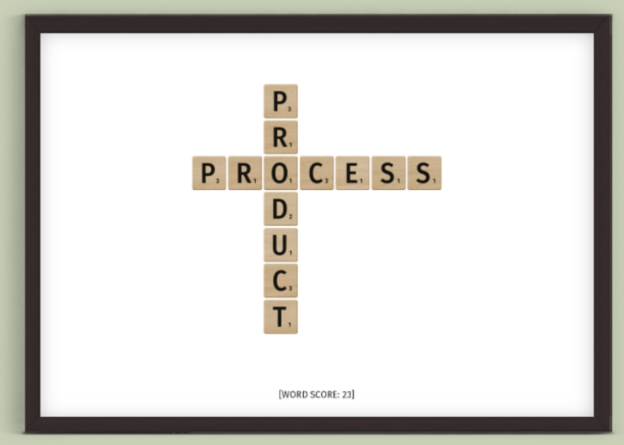
There has been a lot of talk about process over product in education for a while. It really seemed to gain traction during the pandemic when school (and work) were forced to go remote. Many school districts revamped and modified their grading policies during this time. The focus became more on the doing than the done. But what does process over product really mean?
There is a significant difference between process and product. Look at the image. You can see that process relies on student driven discovery while process is teacher led. Process encourages exploration and play while product is compliance and work. Process focuses on the why and the how to do things. Product focuses on the outcomes, like grades. Now, which one sounds more appealing to you? I know that I would rather explore and play.
So, how do you (and I) go about creating learning opportunities that focus on process instead of product? Well, when creating learning opportunities, here are some things to consider to ensure that process is the focus.
Instead of asking what they will make, ask what will they learn?
Instead of having closed ended projects that result in everyone creating the same thing, have something that results in multiple “right” answers.
Provide opportunities to play and explore.
Create interest in the doing and not the result.
What kind of learning opportunity looks at the process versus the product? How about coding assignments, or a webpage, or a video? Give the students some choice in how to demonstrate their learning. Have multiple opportunities that address different interests. Allow students to have time to uncover the content. You do not have to provide explicit explanations for everything. However, if there is something you want them to get, then be explicit about it.
We all have stories — we either click on something that sparks our curiosity, or we search for something we need to learn more about. Or – we chat about a topic at an adult party on a Friday evening. All of a sudden, we start seeing ads for those same topics in areas of our Internet Life! Siri can be an awesome personal assistant, but be sure to keep her in check.
First off – I LOVE Accessibility options on Apple devices. That does not mean that we all need ALLLL of them. So – take a peek on your iPhone… Go to: Settings, then to Accessibility, then to Siri. Unless you require the feature, make sure your “Always Listen for “Hey Siri” is off. Otherwise, Siri can listen even when your iPhone is facing down or covered.
But let’s say… once in a while… you leave your iPhone facing up. Sufficed to say, we “might” forget that Siri is listening. She’s ready to tell you the weather, play you a song or give you directions to head home for the night. As a culture, many of us are willing to accept that privacy breach to make life easier.
But, did you know – Siri is listening to MORE than just your voice, at your command? With every word you speak, you are providing data… and more data…. and even MORE data….
Who can hear your voice? Your ideas? Your questions… Your DATA??
That’s up to you.
Take a minute with your iPhone to double check… Open Settings, then choose Privacy & Security…. then Microphone.
I agree. Quite a list, huh? I’d take a minute and think about which app needs your voice, and which one does not. I challenge you to shut them ALL off, and then purposely add them back in, one by one, as YOU need them.
Don’t be a Data Donator. YOU decide what platforms are allowed access to you, your ideas, your thoughts, your voice and your privacy. Take charge of your privacy.
K12Leaders is here to help perpetuate the idea that HUMAN INTELLIGENCE is far more valuable than Artificial Intelligence. We are SO proud NOT to be on your list of Microphone Security Settings. We don’t want to feed you content, or keep you addicted, or LISTEN TO YOUR VOICE, or waste your valuable time. K12Leaders is here to serve leaders in ALL roles while tapping into the invaluable experience of sitting educators, administrators, solution providers and thought leaders.
Did you change your privacy settings as a result of this article? Do you have more advice than this article offers? What about our friends on Android? Are there more specific instructions to protect them?
Jump in! Continue the conversation! We are SO glad you are here!
K12 pioneer, My eCoach, to merge with K12Leaders creating the largest community and professional development platform for K12 educators, staff, and administrators.
Andover, MA— January 23rd, 2023 — Barbara Bray, Owner/Founder of My eCoach and Michael Bronder, CEO of K12Leaders, today announced the acquisition and merger of My eCoach into K12Leaders (https://K12leaders.com) for undisclosed terms. This agreement expands K12Leaders’ active membership and creates new opportunities for collaboration, networking, and career development for the long-time users of My eCoach.
My eCoach was founded in 2001 by digital pioneer Barbara Bray who built the platform to provide a safe and secure online environment that would provide educators with the tools they needed to improve their instruction, leadership potential, and careers. With that platform, she and her team created coaching and mentoring strategies that were adopted by thousands of schools, 犀利士districts, and educators world-wide. Bray will continue to support her mission through the K12Leaders platform.
K12Leaders was launched in the summer of 2022 by a team of educators with a similar mission… to create a safe online environment for educators, staff, and administrators to collaborate on strategies to improve education. That includes platforms for social networking, career advancement, and professional learning & certifications.
Together, these platforms create a comprehensive suite of tools and a team of experienced educational leaders to better serve the professionals who serve K12 education.
“We’ve known that K12 educators have a hard relationship with social media,” said Bronder. “Our team of educators created K12Leaders as a space where teachers, staff, and administrators can find the tools they need to network and collaborate, while avoiding the downsides of some of the more well-known platforms. Barbara has been on a similar mission throughout her career and has created so many opportunities for coaches and mentors to collaborate and share resources. Working together we’ll be able to advance our shared missions that much better!”
“The My eCoach team searched for an online coaching platform to help educators improve their practice,” said Bray. “There was nothing available at that time, so we created My eCoach as a safe place where educators could network, learn, create, and share online. When I realized that K12Leaders was on a similar mission as My eCoach, I saw the benefits of merging our tools and content into their platform. I’m excited to work together to provide My eCoach members a new platform that allows educators to connect, collaborate, create, and curate in innovative ways.”
###
K12Leaders (https://K12leaders.com) is a social media platform designed exclusively to serve K12 education. K12Leaders differs from more well-known social media sites by specifically supporting the needs of K12 educators, staff, and administrators. That includes career management tools, mentoring and coaching opportunities, event management, and professional networking. Learn more and teach better at K12leaders.com!
Each and every year since 2012, I set out to challenge myself and my readers to a set of bold predictions around the ed tech space. Yes, I usually sprinkle in some pop culture and politics (Oprah running from president in 2020 didn’t happen..maybe the Rock in 2028?) But mostly these center around innovation in and around the classroom learning space.
In reflecting on this past year and previous years, there are times when my predictions hit the mark, like when I guessed that Texas would give up its Pearson testing contract. Others, took time, like when I predicted in 2013 that a device other than iPads would rule the classroom (hello Chromebooks!). Mixed in with the successes are some failures of course, like when I predicted self-driving school buses in 2016 (still a chance!). This year, it’s a mixed bag. Many of these are on the verge of reality while others may never happen. So without further ado, I present to you, my 2023 Bold Predictions :
Artificial Intelligence will make AND break classrooms around the country
I’m going to start out with a bit of layup here. I’ve written about artificial intelligence in past bold predictions (2018 and 2017 here) and in 2019 I even predicted that someone would write a blog or paper with predictive text. With the release of open source tools like ChatGPT, it’s finally at the classroom doorstep. This coming year will be extremely vital to the future of AI in schools. Will we ban it or embrace it? Will we run from it or run towards it? The progressive school leader will see this as an opportunity to create new learning pathways as AI begins to remove some of the lower level tasks like filling out worksheets or writing a short essay about the trade routes of the 13th century. New courses in teaching the AI to work better for us will emerge and be both congratulated and vilified. AI is a part of our collective future, but will it be a part of what our kids learn? That’s a question ChatGPT can’t answer…YET.
VR mobile labs become reality
Virtual reality is still somewhat on the fringe when it comes to education even though I’ve written about it since 2016. The price of getting VR headsets for each student is becoming more reasonable, but issues like long-term eye strain and other health concerns will likely keep a 1-to-1 VR environment from happening anytime in the next several years. However, much like when schools started rolling out their device programs, I can see a future where there are VR mobile labs that teachers can use to immerse students in a certain environment. When Google Expeditions died off in 2021, it means there is a new opportunity for an ed tech company out there willing to make a splash in this space. Or maybe the Metaverse will just take over.
Educators flock to K12Leaders
With Elon Musk’s purchase and repurposing of Twitter, many educators are flocking to different online communities and spaces. Some are heading to Twitter-clone sites like Mastodon in the hopes of re-creating the same experience on that platform. However, much like Twitter, it could face similar changes in the future as almost every social media platform is run for commercial gain by using algorithms to keep you scrolling. Last year, in this column, I wrote about a new platform launching that is solely for educators and those that are educationally adjacent to our space. K12Leaders takes the best parts of Facebook, Twitter, and LinkedIN but is run on Human Intelligence, not AI. Instead of algorithms, there are conversations. As co-founder of the platform, I’m admittedly biased, but for the now 1100+ users, we get to be a part of building a safe social space for educators from the ground up. My BOLD prediction – by the end of the year we’ll have 25,000 users.
Elon Musk tries to become James Halliday
Speaking of Elon, my UnDisruptED co-host Adam Phyall has long been of the theory that Mr. Musk is actually a Bond villain. Taking over transportation, space, satellite internet and social media are just the first steps in his slow take over of the planet. I still have hope for him though as his innovations have led to some great societal changes. My next prediction for him is that he goes full on Ready Player One and creates an Oasis for education. A place where kids from anywhere on the world can connect and learn via some sort of VR mechanism. Will this be the final step towards true equity in education or is it just the next step in global domination for Elon? It’s certainly becoming more and more of fine line between the two lately.
Remote teaching fills in the gaps
As we now enter the post-pandemic phase of education, what can we take away from that experience that will benefit students going forward? Most schools provided some sort of device to their students during the pandemic but some of those are not being utilized as we go “back to normal.” Add to this, an educator shortage that will lead to increased inequity of learning opportunities and you can see that we might have to get creative in the future. How can we fill the gaps in teachers, especially in speciality areas like Computer Science? Remote teaching continues to increase since the pandemic and some companies like Rex Academy have created student-led CS courses that come with an accompanying virtual teacher. Rather than trying to find a teacher to teach a single CS course, schools in the future will outsource those courses to remote options. This will save on payroll and provide more opportunities for students in hard to reach areas. While online learning isn’t ideal for everyone, it might start to close the equity gap based on geographical boundaries.
The “Shopping Mall” School is launched
Remote learning fills in some gaps, but we still have a need for some physical spaces as well to interact and learn. During the Tech & Learning Innovative leader summit in December, teams of innovative educators gathered to brainstorm ideas for what the future school might look like. One team, the Centre for Innovative Learning, came up with an innovative idea that I think will gain some traction as the big box stores and shopping malls give way to Amazon online retail. With several big stores like Toys R’ Us and Sears going out of business in recent years, it leaves some large commercial real estate that could be used for an innovative new school. The movie theater becomes the performing arts center. The food court becomes the culinary arts department. The old Sears becomes the auto repair shop. Aspiring beauticians can utilize the many hair salons and for the entrepreneurial student, why not spin up a kiosk to sell your wares in the middle of the store? This isn’t a new concept for community college (ACC here in Austin did this a decade ago), but the potential for K12 is tremendous. Check out their full pitch deck here and the full Innovation Playbook here.
Cybersecurity becomes cool again
Actually, when was it not cool? Ok, ok, I get it, no one wants to spend hours talking about ransomware and data privacy. However, those companies tasked with helping with filtering and threat detection have taken some major leaps in the past year. One in particular that I’ve been an advisor with (Linewize) has added some major components through the purchase of companies like NetRef, Qustodio, and Smoothwall. Putting all these tools under the same roof make more and more sense for schools trying to stay ahead of the next ransomware attack. As a bonus, schools can use their app tracking database to check on usage of purchased applications to monitor ROI (Return on Investment) and provide targeted professional learning in the future.
Wireless displays make classrooms truly mobile.
The Consumer Electronics Show (CES) is one of my dream conferences that I’ve never attended. I think more educators and those in leadership roles should go if they want to keep an eye on what the future brings in tech. While it’s geared towards consumers, eventually, items that debut here can make their way into the classroom (see: tablets). This year, I was excited to see this LG completely wireless TV display. As more and more classrooms move away from the “Sage on the stage” model with interactive white boards, this could be a nimble solution that truly makes presenting mobile. Currently, schools are paying hundreds in upgrades for displays on wheels, but these still are limited by needing a plug nearby. They also leave behind pretty large footprints as the bottom of the carts have to be fairly large to make sure the monitor doesn’t fall over. With these new LG screens, you could have multiple wireless display screens all over the classroom for a truly immersive experience….once the price becomes reasonable.
Ready, Set, Fail HARDER!
Last year, I launched my 7th book Ready, Set, FAIL! making true on my 2021 prediction that I would write another book. I couldn’t have predicted the underground success that comes when talking about failure, but it has struck a chord with educators and students alike. The truth is, our schools tend to be places where we preach compliance and conformity and less about risk-taking and failure. With this book, there has been increased momentum with schools reflecting on how much they encourage risk versus safety when it comes to creativity. This year, I predict there will be much more to come centered around Ready, Set, FAIL! including an online course and classroom playing cards designed to help students risk, fail, recover, and learn.
The Voyage for Learning sets sail in 2024
In one of the final chapters of my book, I put my BHAG (Big Hairy Audacious Goal) out there for the world to see. Since 2015, I’ve been slowly working with various teams of educators to help create a different concept for the traditional conference. One where experiences and connections take import over sessions and vendor halls. The Voyage for Learning will feature a variety of different land and sea experiences for those in attendance that I can’t reveal until we launch, but stay tuned. This final prediction is that in 2023 you will learn more about what this experience has to offer and why it will be more enriching, fun, and engaging than a traditional mega-conference. Ready, Set, SAIL!
“The world is encountering change. And we’re encouraged to take it seriously. Therefore, let’s prepare children to discover, strengthen, and utilize their PERSONAL POWER through the POWER OF WORDS.”
Bruce Cabell
Instilling the power of resiliency for children’s health and well-being is critical. Lacking strength to persist through everyday challenges in the social, emotional, mental, and academic arenas is concerning and prevalent for school-aged children.
Numerous children are challenged by issues such as bullying, poverty, health, peer pressure, family issues, academic expectations, anxiety or belonging. When these concerns manifest into a continuous uphill battle, children dwell in harmful thoughts, emotions, and behaviors.
Therefore, thoughts and feelings require positive transformation with the support of strong, loving adults.
To provoke change, resilience, and healthy lives, a series of 40 I Have the Power poems were written for children in grades 3 and up. Each poem is sorted under CASEL’s SEL Framework and supports one or more PPs (Personal Pillars) below.
Poems can be utilized individually and in small to large groups as well. One pillar doesn’t carry more weight than the other. Each promotes knowledge, inspiration and/or strategies, as well as building a foundation for the next.
I encourage educators to teach I Have the Power poems to enhance children’s inner strength, knowledge, understanding, and social-emotional well-being. In addition, the Power of Words are essential tools to regulate and heal the human body.
However, engaging children in a discussion about poem’s theme, message, and vocabulary will be critical as well.
Having experienced trauma or not, discussing age-appropriate material or life events through poetry is an avenue to persevere and succeed. The time is now to prepare children for new learning and experiences, as well as the unexpected impacting human life.
Before children begin their journey through each poem, provide time to discuss the power within (inner strength). Ask how personal power can be displayed. Is it through mental or emotional strength such as awareness, determination, courage, empathy, confidence or respect?
Inspire children to share examples of their power in situations at school and home. Have them demonstrate their I Have the Power stance.
Immersing in this unique project, I believe each poem will provide a shoulder to lean on – helping and supporting children to move forward and persevere.
I understand each poem will take root in mind, heart, and spirit – to help children live the successful home and school life they deserve.
And in the end, I know each poem will motivate children to transform into authentic, confident, and resilient human beings.
Therefore, can you stand in my shoes? Do you sense my vision? If so, are you prepared to participate and collaborate in the I Have the Power project? Not sure? Then answer the following questions.
Are you eager to question, challenge or change the status quo? Do you embody the courage and fortitude to liberate children from the same ol’ practices or pedagogies in education? Are you determined to invite children on a transformative journey through the Power of Words? Are you encouraged to engage in life-changing, mind-expanding discussions?
If a tech savvy educator or coach searches online, there will be myriad results for how to provide a school or district with quick on-the-spot tech professional development. These results will appear with a variety of names including, but not limited to, the following:
Toilet Tips
Tinkle Tips
Tuesday Tech Tips
These terms may appear with hashtags…. or not, depending on the search site.
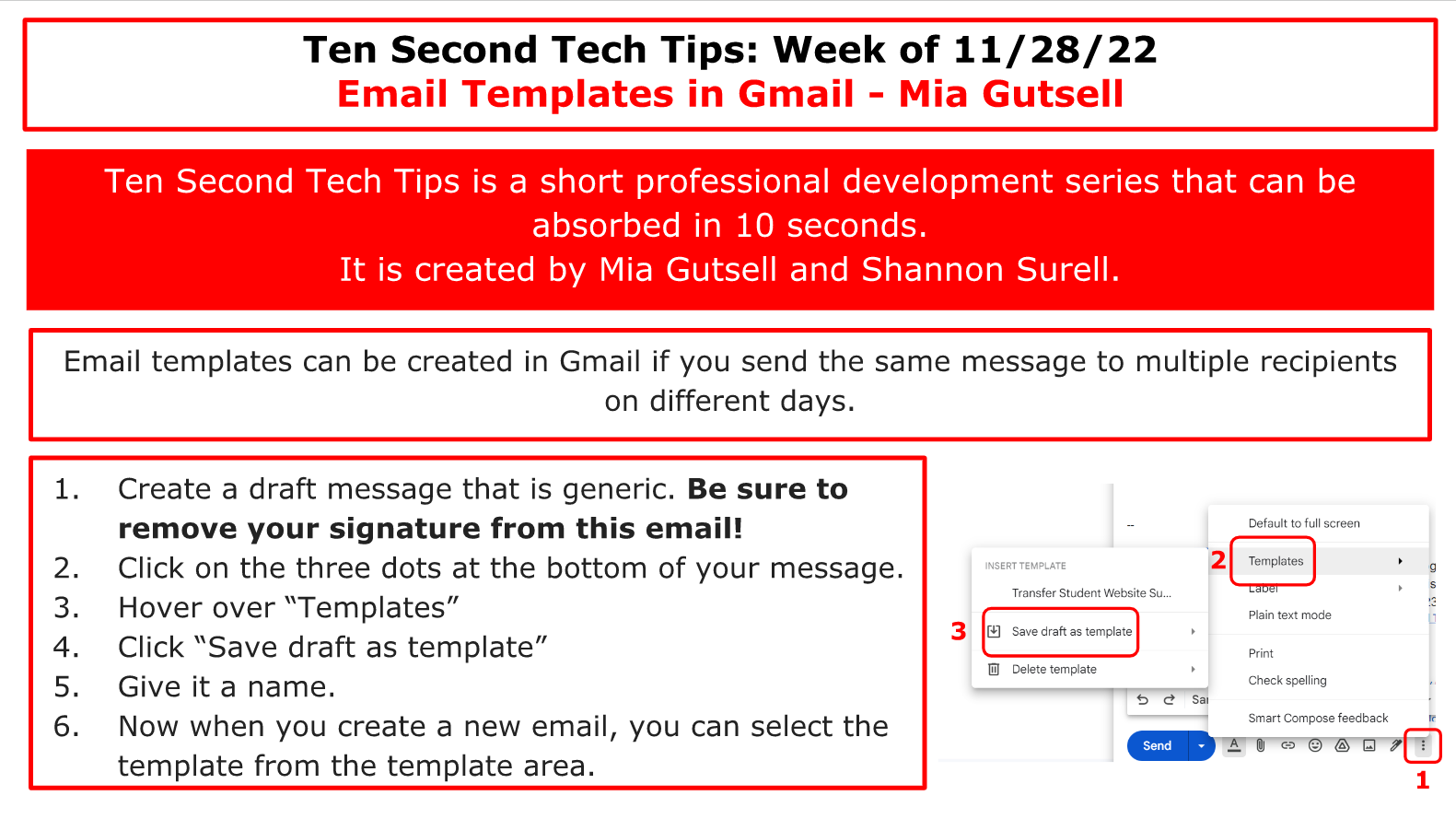
Finally, such an educator may even discover the hashtag “Ten Second Tech Tips “, which I created.
How to best serve one’s school community through this type of professional development is the purpose of this article. This post will cover my personal experiences with this type of professional development, how I created my own flier, as well as guidance on how to adapt this practice for other educational environments.
Tech Tips Initial Encounter
When I was a first year teacher, I covered the maternity leave of another teacher in a public high school in the early 2010’s. I was introduced to this concept by seeing fliers hung in the stalls of the bathroom. The fliers contained information that could be applicable to a variety of content areas. The one that I recollect the most strongly was about appropriate usage of creative commons images when creating content.
I found the fliers most fascinating, but I do not recollect them changing often. This situation does not mean they did not change, but I cannot recollect them being updated by the teacher who initially created them.
After the maternity leave ended, I moved onto other ventures in my career. Eventually, I joined a school district where I could take the lead in implementing this type of professional development.
Personal Professional Development Flier Creation
I currently work in a public elementary school district in Illinois as an instructional technology specialist. As I explain my role to others, I teach students and teachers how to effectively use technology in the classroom.
One of my colleagues decided to implement what she named “Tinkle Tips” in the district in her school. She posted fliers in every bathroom with technology information. Her original goal was to post a new flier every day.
It was at that moment I recollected how such fliers had been used in my first long term position. I decided that I could create such fliers for my own school that would provide helpful reminders for faculty and staff. There were often times I had to remind individuals of the same quick tech tips that would make their lives easier. It was my hope that by creating the fliers, I could give anyone a resource that would prompt their memories.
However, I found I wanted to differentiate myself from my colleague, and I wanted to manage my workload as I was new to the district.
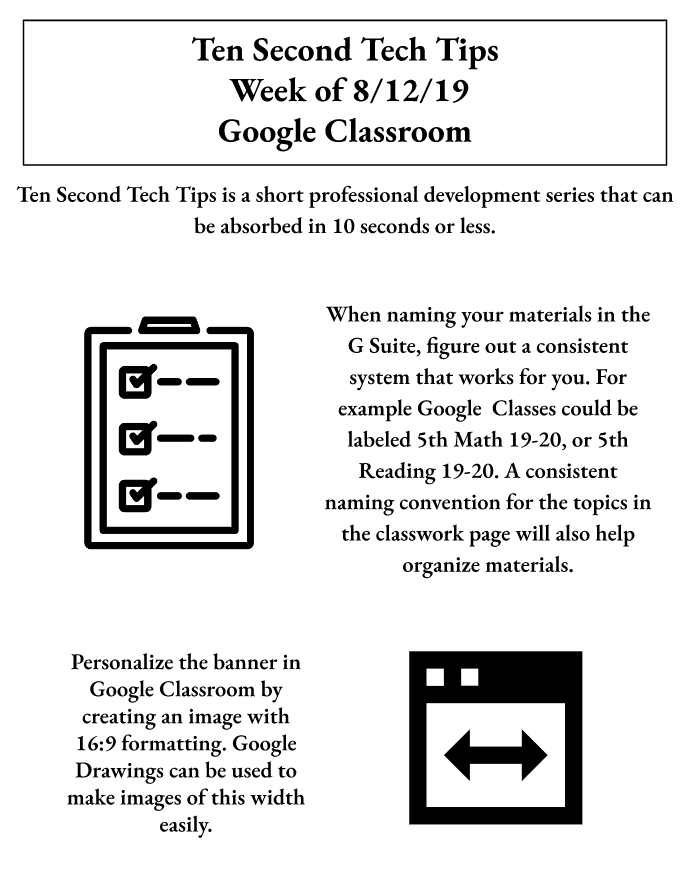
As such, I decided to label my fliers “Ten Second Tech Tips” to make them quick to read since teachers can often feel overwhelmed finding time for a bathroom break before returning to class.
I also decided to only update them once a week so that everyone would have time to absorb the information, but it would also update frequently enough that no one would feel the knowledge was stale.
Thus, began a project that continues to this day.
In the first year I implemented “Ten Second Tech Tips,” I focused on making the fliers visually appealing for print since I was hanging them in the bathrooms of the school. I also wanted to make it easy to print the document each week, and hence made them in portrait format.
I was curious to see how teachers would react. I asked one of my colleagues what she thought, and her reaction was that there was too much text on the fliers. For the remainder of the 2019-2020 school year, I adjusted my approach to focus more on images, and less text.
Then the COVID-19 pandemic took hold in the United States, and schools went in Lockdown in Spring 2020.
Now what? – I thought to myself.
The Digitization of Ten Second Tech Tips
During the 2019-2020 school year, I had posted the Google Slide Deck I used to create “Ten Second Tech Tips” in a Google Classroom, but I wasn’t certain that the document was always being viewed.
Teaching was going to be remote, with teachers still potentially working in the buildings. What would be my digital shared space?
I decided for the 2020-2021 school year to adjust the fliers so that they could work in both digital and physical spaces.
I changed the layout to landscape, but kept the font in a Serif style so that the text would be easy to read when printed.
I also decided to share the fliers with the world through social media, specifically through Twitter.
From that point on, I shared my ideas, or the curated ideas of ed tech leaders, through physical and digital media.
Current Practice
From the 2021-2022 school year on, I switched the text style to a Sans Serif font. This type of font is the easiest to read digitally. I also adjusted the standardized format to the tips so that I could efficiently duplicate the slides as well.
I continue to share the fliers digitally with two major changes.
First, the school newsletter fluctuated in terms of format. Currently, as of the 2022-2023 school year, I share all tech updates, and the “Ten Second Tech Tips” Google Slide Show in a section devoted to communication updates for my school. I now have multiple spaces where my colleagues can view the fliers.
Second, the fliers are created collaboratively with my fellow instructional technology specialists. Due to this situation, my school receives a wider base of knowledge, and I am able to complete other duties even more easily.
Over time, I went from a viewer of these types of fliers to an active creator, and mentor to others who wanted to create such documents.
All of my “Ten Second Tech Tips” can be viewed at www.guidegrowtech.com under the “Ongoing Presentations” section.
Recommended Methods of Creating Short PD Fliers – Questions to Consider
Create the fliers so that they can be accessed both physically and digitally, and have a consistent schedule.
When will the fliers be shared? Once a week, twice a week or once a month?
Where will the physical fliers be posted?
If sharing digital files, how will they be shared?
Create a standardized template that can be adjusted easily.
What kind of layout would be easiest for you to use?
If collaborating with others, make certain to use a tool that allows for shared editing in a draft document before posting it to the final document the whole world can view.
When should the document be updated?
Who will post the final digital version?
Keep in mind the needs and skills of the population being served.
Does your population skew towards early adopters of new technology, or more towards late adopters?
What are items you tend to remind colleagues about continually? These reminders might be a good starting point for your fliers.
Review other educator’s fliers to spark your own inspiration.
What do you like about their fliers?
What do you think would make your fliers approachable for your community?
How can you remix, and give credit to others when sharing knowledge?
Consider the needs of data collection about such professional development, which varies from school district to school district.
How will you know if the fliers are making an impact? Will you interview teachers, or ask for feedback?
If the filers are in a digital form, will you consider the number of views as proof of impact?
It is my hope that this post sparked your own journey in exploring this idea of short professional development via informational fliers.
All of my resources can be found at www.guidegrowtech.com. I hope to help you grow in your knowledge in another topic soon.
Innovative tools are often discussed within teacher circles. While most are tangible and focused on academics, tools of the heart and mind are required for teachers to be successful leaders and healers as well. Teachers are expected to achieve their full potential. However, not easy when obstacles keep them chained and stagnant.
Thus, to help them break free, flourish, and succeed, I suggest every teacher carry and integrate the following… a sword, a wand, and a cup.
All three should work in unison to acquire balance in school and peer relationships. If one is utilized more than the other or one is used carelessly, each becomes useless, and the life of a teacher remains difficult and motionless.
Therefore, let’s begin with the teacher’s SWORD ! It symbolizes the mind and intellect.
With its razor-sharp tip, the sword targets the heart of the matter. If it’s carried and treated properly, teacher thoughts embody truth, action, change, and courage. In addition, the teacher’s stance is firm, direct, reasonable, level-headed, and wise.
Communication is central and a powerful influence for student support and success. And teachers’ words? They’re supported with action! Seeking positive solutions to school conflicts and students’ academic, social, and emotional struggles are first and foremost.
With the sword in one hand, the WAND rises in the other. When it’s embraced, it represents determination, creativity, ambition, and inspiration. The teacher’s passionate energy is high and nothing or no one should distinguish it unless it burns out of control triggering teacher stress, exhaustion, and depression.
Furthermore, the teacher’s wand is contagious. As others sense the teacher’s fiery personality for love of children and their well-being, they yearn to hold a wand of their own. Why? It has an exciting, dramatic, and healing impact on the heart and mind.
In addition, the wand ignites and transforms individuals who are less familiar with its influence. And the magic a teacher’s wand embodies is compelling. It illuminates and moves everyone forward in a confident manner. When the teacher’s sword and wand work simultaneously, people understand they are a dynamic force to reckon with.
With the sword and wand working in harmony, the last element for a teacher is their overflowing CUP . If there’s an energy that’s pure and rooted in a teacher’s aura, it’s their connection and strong feelings of love, joy, and compassion for others.
That’s not to say every teacher is prepared to offer a cup OR has a cup to offer. At times, egos are in charge. Drama, conflict, and competition between teachers are present. What’s occurring is the overpowering ability of their sword and wand. Action and passion have transformed into criticism and judgement. Therefore, both elements must be mastered.
Again, while the teacher’s sword represents the mind, the cup represents the heart. Creativity, empathy, and healing abilities are connected to the teacher’s cup. When flowing freely, love for another is central. But, if th犀利士ere comes a point when the cup is raging with unpredictable emotions, love is difficult to bud and flourish.
The sword, wand, and cup are required to lead, heal, and succeed in the teaching profession. They’ll transform peers and students to be leaders and healers as well.
So, if you’re searching for teachers embracing innovative tools, make sure their repertoire consists of the sword, wand, and cup!
May the new year bring you boundaries that provide caring and clarity.
Not what you were thinking? Think again!
2022 was a showcase in the implications for not having and enforcing clear boundaries. In fact, so was 2021. And 2020.
The attacks on Ukraine.
The assault on the U.S. Capitol.
The global spread of coronavirus.
Choosing confrontation over cooperation continues to be humankind’s favorite mistake to make.
More than a century ago at the outset of the first world war, New England’s poet laureate Robert Frost wrote, “good fences make good neighbors.” His poem describes two New Hampshire farmers walking the length of their common stonewall to repair those places where nature and humankind had broken it down.
In my boyhood home in Northborough we had a stonewall marking the perimeter of our yard, shared in common with the Dennings and Parkers and McLeods. It was (and is) old and weathered, born of the rocky soil of eastern Massachusetts. We were always aware of it, meeting friends there, playing and climbing along its surfaces, and chasing chipmunks running into its nooks and crannies for safety. But we never dismantled it. It seemed true to me then as it does now: good fences do make good neighbors.
This lesson has been on my mind this December as I reflect on the challenges facing global society. It is in vogue to bust through boundaries. Who is going to make me wear a mask? Why should I accept election results I don’t like? How will anyone stop me from invading my neighbor?
Well, of course you can ask and answer these questions, but there are implications for not respecting boundaries in the process. And (more to my point), if you thoughtlessly dismantle boundaries without knowing what you’re undoing, there are even greater ramifications to face in the aftermath.
It’s easy to just plow through what’s in your way. It’s mindless and dangerous, but it’s easy. Honoring and enforcing a boundary is more work. The effort to walk along a common wall – both literally and figuratively – to keep a boundary in place is a deliberate act. It requires intention and understanding of its importance. Everyone involved needs to be committed to its preservation.
“Something there is that doesn’t love a wall, that wants it down,” Frost writes.
He is all pine and I am apple orchard. My apple trees will never get across And eat the cones under his pines, I tell him. He only says, “Good fences make good neighbors.”
There’s something romantic in the notion of breaking down barriers. But boundaries only seem like barriers out of ignorance. They are in place for a reason. They allow human society to function, even with all of our differences. While barriers can be broken for the greater good, boundaries are meant to be kept in place for the same reason.
And so my wish for you in 2023 is boundaries that bring caring and clarity…that offer understanding and cooperation…that provide safety and peace…for all of us.
Walter McKenzie is Senior Director for Member Communities at ASCD, leading its Affiliate, Champions in Education, Connected Community, Professional Interest Community, Student Chapter and Emerging Leader programs.