Blog

  • Licensed Professional Clinical Counselors  – Your Expertise is Needed for My Doctoral Project!

    Licensed Professional Clinical Counselors  – Your Expertise is Needed for My Doctoral Project!

    Hello fellow Licensed Professional Counselors!

    I am in the dissertation phase of my PhD in Counselor Education and Supervision through Capella University. Throughout this program, my interest in advocacy that counselors can engage in has grown significantly and increased my curiosity about the engagement of advocacy in counselors’ roles and barriers to advocacy engagement that may exist. I was interested in the study topic due to my experience working with children living in poverty that were students in a k-12 therapeutic alternative school setting and in a therapeutic ECSE setting through a school district in MN. Additionally, I have friends that have worked in school settings as LPCs through school-based partnerships which increased my interest in learning more about the role of LPCs in school settings across the nation. After moving to New Mexico in 2022, I gained awareness of the impact of living in a rural setting on mental health service availability and the unique needs of the rural population. I hope that this topic interests you to help me complete this study for describing LPCs’ advocacy engagement experiences working with students in rural school settings.

    I am working on a doctoral project, entitled, “GENERIC QUALITATIVE STUDY OF LICENSED PROFESSIONAL CLINICAL COUNSELORS’ EXPERIENCES WITH ADVOCACY ENGAGEMENT.” My research will be overseen by my faculty mentor, Dr. Carrie VanMeter.

    My research examines how clinical counselors working in the school setting will describe their experiences of advocacy engagement in rural areas utilizing the theoretical framework of Ecological Systems Theory for the guided interview questions. The main research question is “How do licensed professional counselors in rural school settings describe their experiences with advocacy engagement?” I will be recruiting clinical counselors that have both outpatient mental health setting and school setting work experience to participate in my study. I would like to conduct my research with participants from each region of the United States by incorporating multiple states with significant rural populations.

    I am requesting permission to engage in the following research activities::

    •  To recruit participants for the study
    •  To post about the research study on the group’s social media page for sharing about the study for recruiting participants

    This project will begin once I have obtained approval from Capella University’s Institutional Review Board (IRB). The IRB will review the adequacy of my plan for protecting participants. They will review data security and confidentiality procedures. A copy of the final letter from the Capella University IRB can be provided to you before any research activities begin. No recruitment will occur prior to IRB approval.

    My anticipated projected start date is August 2023 and I expect that this study will last 6 months.

    I am responsible for the preservation of the privacy of research participants. I will not name the research participants when I write my doctoral paper. I will not describe the participants in such a way that they will be identifiable. I will work to preserve site anonymity when I write my paper. However, I cannot guarantee that the site will remain unknown.

    If you have any concerns about this request or are able to support with participant recruitment, please contact me at the phone number or email listed below.

    Sincerely,

    Christine Herzog, MS, LPCC

    Cherzog@capellauniversity.edu

    (651) 238-0525

  • ChatGTP Offers Multiple Layers of Support to Students With ADHD

    ChatGTP Offers Multiple Layers of Support to Students With ADHD

    Artificial Intelligence is building an impressive track record of offering learners with ADHD multiple layers of personalized assistance. Differentiation tools and strategies will continue to play a large role in education as student populations become more diverse and students with special needs are increasingly placed in general education classes. According to aChatGTP Offers Multiple Layers of Support to Students With ADHDChatGTP Offers Multiple Layers of Support to Students With ADHD survey that I did, personalized learning is also the area of education that teachers believe will continue to be the most impacted by AI.

    AI algorithms analyze students’ learning styles, strengths, and weaknesses to create tailored learning plans that are differentiated by content, pacing, and rigor. Robots are improving social skills via storytelling directly affecting childrens’ cognitive performance, watches with sensors provide reminders for students to focus, software provides immediate feedback and develops personalized, engaging, lessons, and much more.

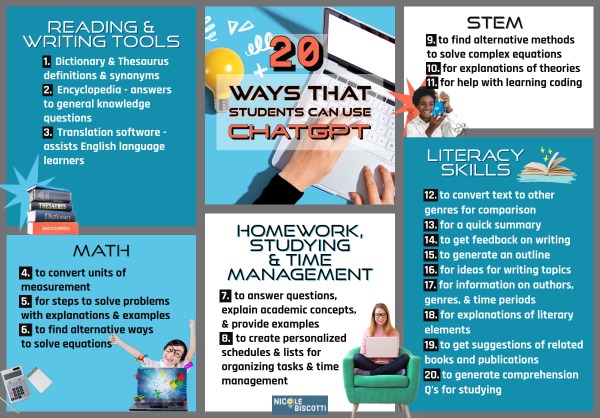
    Each student with ADHD is unique and has different support needs; but a common theme is tasks related to executive function such as organization, structure, and focus. The accessibility of ChatGPT means that students have the independence and agency to access support at any time and from any place. Students can ask ChatGPT to create a study schedule for them within their personal time constraints, create a list of suggested tasks to complete a project or assignment, provide ways to effectively study and manage time and much more.

    Students can also independently access commonly used scaffolding supports through ChatGTP such as visual aids, a summary of main concepts, comprehension questions, examples, the text restated differently, outlines, the text translated, steps to a process (with explanations), etc. When students with ADHD are taught to use AI as a support, far from “cheating”, they are accessing metacognitive learning strategies. The process of developing the awareness needed to identify the type of support a learner needs coupled with access to that support is one of growth and empowerment as students embrace the technology that will shape the workplace they will enter.

    Younger students require a significant amount of guidance and instruction on the effective use of ChatGPT. These skills have to be explicitly taught but the investment definitely pays off as they are integral to students owning their learning and becoming self advocates. It should also be noted that for students under the age of eighteen, parents and educators should use ChatGTP together since it is not currently authorized for minors due to legal and privacy concerns.

    Reading can easily become a landmine of distractions for the ADHD learner because of the sustained effort and focus required. Without going into the possible distractions that a student might experience from finding the text boring, a mismatch of rigor, or possible difficulties with reading, the assignment itself can present considerable distractions. When students are not able to understand a text, reading it over and over again can be overwhelming. Multi-step problems, word problems, and using formulas in Math present similar challenges for students in terms of maintaining focus and becoming overwhelmed. Students can easily find themselves in a negative cycle that ends in frustration and not completing their assignments.

    Enter ChatGTP which can function as a personal tutor of sorts. Students can type in specific questions or enter blocks of text and ask for a summary. They can also request a specific formula or multi-step operation with examples. ChatGTP’s interface is easier to use than a search engine since it is designed to be conversational in tone. It also provides an answer rather than a wide variety of results (some irrelevant) that are essentially just more information to sort through. ChatGTP can summarize difficult concepts or answer specific questions, provide steps for problem solving, and quickly defines terms within seconds.

    People with ADHD are brilliant, fast thinkers and many have trouble organizing their thoughts into linear language since they’re not linear thinkers. Their minds shift from different topics quickly and then at times they can hyperfocus in one area. While this way of thinking can facilitate forming connections that others miss, it can be difficult to communicate their ideas to others. The planning and organizing aspects of writing, as well as gathering research for longer pieces rely heavily on strong executive functioning skills which is an area of weakness for students with ADHD. ChatGPT offers assistance with creating outlines and templates, enhancing the style of writing, grammar, answers to specific questions, as well as a dictionary and thesaurus. This doesn’t mean that ChatGTP will do all of a person with ADHD’s thinking, researching, or writing for them; it means that ChatGTP can provide the executive functioning support that neurodiverse people need to be able to publish their ideas in written form.

    It’s important to understand that AI is a resource, a prompt, an organizer, a tool, not a think tank or a fount of innovation. Humans still reign as the planet’s visionaries, those with ADHD being some of the most brilliant and creative among them. The support that AI offers students who have ADHD can reduce or even remove some of what is standing in the way of kids with ADHD from communicating their thoughts and being successful academically. What more could geniuses with ADHD such as Einstein, Leonardo da Vinci, and others have accomplished with AI by their side?

    Nicole Biscotti is a Momvocate, Educator, & Author whose focus is on the future of school as being informed by relevancy and the needs of our currently marginalized, under-supported learners. We have a lot to learn if we listen!

    Nicole wrote I Can Learn When I’m Moving: Going to School With ADHD http://bit.ly/icanlearnwhenimove with her 9 year old son from the unique perspectives of a child and a mother who is also a teacher. She has seen both personally and professionally how children struggle to be understood and how adults are often at a loss with how to handle the difficult behaviors associated with ADHD. She empowers parents and teachers to provide game changing support for children with ADHD in school through sharing her and her son’s story, along with researched-based strategies.

    Nicole has also translated books into Spanish such as El Cuento del Perdón by Melody McAllister and Todos Pueden Aprender Matemáticas by Alice Aspinall. I Can Learn When I’m Moving: Going to School With ADHD is also coming soon en español.

    Her next book, Invisible con ADHD: Real Voices, Real Policy for Latino Students is co-authored with Andrea Aguirre. They address the issues around the disproportionate lack of support that Latino children with ADHD are faced with. Through interviews with former students, educators in the United States and Mexico, and extensive research, they will offer educators a holistic view of the obstacles that currently stand in the way of protecting kids from poor outcomes as well as offering research based solutions.   

  • Why Is US Public Schooling Designed This Way? Or Why Prussia, Mann, the Committee of Ten, and Sloan Continue to Influence Education More than Dewey and the Science of Learning  

    Why Is US Public Schooling Designed This Way? Or Why Prussia, Mann, the Committee of Ten, and Sloan Continue to Influence Education More than Dewey and the Science of Learning  

    This is Part 3 of Jim Flanagan’s summer project exploring instructional design.

    As a child, I watched too much TV, so “sit right back and you’ll hear a tale.” US public schooling, like Gilligan’s Island, seems trapped in the limitations of its design despite readily available means of improving. This quote is attributed to Winston Churchill: “Americans will always do the right thing, only after they have tried everything else.” Whether he said it or not, let’s hope that we are ready to do the right things to improve education. But the early signs of the post-pandemic response are not promising as we continue to feed more resources into the same, old coal furnace hoping for greater output. To understand the present, it is necessary to explore the past. So this blog is inspired by David Byrne’s prompt – “You may ask yourself, “Well, how did we get here?” ”

    Seat time, courses, summative tests, and schedules drive the current traditional design of K-20 schooling. We move the students based on time instead of allowing the instructional content to move to meet each student. In grades 6-20, there is a curriculum of courses in approximately 15-week semesters. Teachers develop lesson plans, deliver lectures based on curriculum, and grade students based on coursework and summative tests. Students access static textbooks, other reading, and increasingly digital materials based on a standardized scope and sequence. The institution, not the student, determines the pace of learning. The school building and classrooms are the predominant place of learning. I refer to this as the factory model because the students essentially move on schedule-based conveyor belts through instruction with little regard for their readiness. The traditional model contrasts with a personalized, competency-based model – based on the science of learning – in which students can learn at any path, any pace, any time, any place. In this blog, I outline some significant influences that formed our traditional system and drive our unyielding, nostalgic acceptance of it.

    Education is as old as humankind. On the savannah, our ancestors had to teach their young to survive. With the advent of societies and religious beliefs, norms, and doctrine were added to expected knowledge. Teaching was primarily spoken along with some gestures and imagery – PowerPoint in the dirt or on a cave wall. Stories emerged as a primary way to retain and share wisdom. Then came the technologies of symbols (~100,000 years ago), alphabets, and writing (~ 1900 BC) to store and transmit knowledge.

    Let’s pause our sprint to recognize Socrates – of the method and dramatic exit fame. His contributions to teaching and learning are well-trodden. Did you know that he also opposed learning from reading? He believed that reading – instead of memorizing the spoken word – could lead to forgetfulness, intellectual laziness, and misinterpretation. So an aversion to change is as old as learning itself.

    Back to the drive-thru history lesson. The concept of schooling emerged around the time of Socrates, Plato, and Aristotle (470 BCish.) They believed that learning should be compulsory, designed to help people develop their minds and souls, and based on inquiry, dialogue, and civic education principles. Socrates preferred to teach on the move, interacting with society. Plato created “the Academy,” so school as a place emerges. Aristotle added ideas about practical knowledge and personalized learning that is lifelong.

    In the last three paragraphs, I summarized 300,000 years of homo sapien education for my fellow short attention spanners. As of 1 AD, we have a concept of school with a place, time, expectations, methods, and curriculum. Before moving on, I recognize this blog has a Western bias. That is because Western influences overwhelmingly inform the US system of schooling. I do not mean to convey that these models are all-encompassing or better than those from other cultures. And most of the people I reference are white males. Unfortunately, most readily accessible history is biased. I recognize that they are not solely responsible for how our systems have succeeded or are increasingly failing. Our understanding of education history can use a healthy exploration of hidden figures.

    Skipping forward to 1452, Johannes Gutenberg used the first mass-produced movable metal type to print Bibles – a game-changing learning technology. For the next 350 years, formal education was elite, private, heavily influenced by the Protestant religion, and primarily reserved for white males.

    The founding of the US had a significant influence on education. Founded in 1635, Boston Latin School is the first public school and oldest existing school in the United States. There was an emerging belief in universal education to provide all citizens with the knowledge and skills they needed to participate in civic life and support this new democracy thing. English grammar schools served as a template. English educational methods were used to teach reading, writing, and arithmetic; reinforce family, church, community, and apprenticeship; and assess progress based on standardized tests. And even the English “six hours” school day influenced our six-period structure. Noah Webster introduced the Blue-Backed Speller in 1793 – a school staple for years with spelling and reading exercises, moral lessons, religious content, and a pro-American perspective. Thomas Jefferson promoted “universal” access to education – with some glaring exceptions to the universal concept. But formal education still remained mostly elite, private, male, and white until Horace Mann entered the picture.

    Why are over 50 public schools in the US named after Horace Mann? Well, he was kind of a big deal. In 1837, he was appointed Secretary of the Massachusetts Board of Education and took that job seriously. He visited over 100 schools by horseback and chronicled issues in detail. He founded and edited The Common School Journal promoting publicly funded and controlled, non-sectarian education to serve children with various backgrounds provided by well-trained, professional teachers. In 1843, a visit to Prussia led him to conclude that their system was:

    – “assiduously cultivated it in all its branches. The result has been that the Prussian people are the best informed in Europe.”

    – “highly centralized, with the government exercising a great deal of control over the schools.”

    – “very successful. The Prussian people are well-educated, and the country has a high level of literacy. The Prussian system of public instruction is also a model for other countries.”

    The Prussian system also emphasized obedience, duty to country, and general ethics. Mann’s national influence led to the Common School Movement – also championed by the first US Commissioner of Education, Henry Barnard. And the McGuffey Reader emerged to supplant the Blue-backed Speller. Mann (and others) had an incredibly positive impact on most Americans’ lives. And yet the system was still segregated, biased, inequitable, and designed for a time with limited understanding of human cognition and no digital technology.

    Education reform is a small world, as evidenced by Catharine Beecher, who advocated for women’s education along with Emma Willard and Mary Lyon in the early to mid-19th century. Catharine was the sister of author-abolitionist Harriet Beecher Stowe, whose husband was Prussian education advocate Calvin Stowe. In the early 19th century, men made up the majority of teachers in the US. Catharine believed that women were naturally more nurturing and patient than men and that they were better equipped to handle the challenges of teaching young children. So she championed Normal Schools to professionalize the teaching profession and train female teachers – particularly in the expanding West. By the late 19th century, women made up the majority of teachers in the US and have remained the majority ever since.

    Immigration and religion were two other significant education influencers in the latter half of the 19th century – especially battles related to Protestant versus Catholic doctrines. And the civil war should have eliminated all racial barriers to education, but we know it did not. We cannot ignore the racial and nationalistic exceptionalism that led to horrific phrases like “Kill the Indian, save the man,” first used by Richard Henry Pratt, the founder of the Carlisle Indian Industrial School. (I recommend the book Path Lit by Lightening: The Life of Jim Thorpe, who attended Carlisle.) This thread runs through the history of US education and continues to impede our progress toward high-quality education for all based on inquiry, evidence, and critical thinking instead of doctrine and cultural bias.

    Participation in public education was increasing but still not meeting the demands of the growing US industrial economy. So the National Education Association (NEA) created the Committee of Ten to study the state of secondary education. The members were all white males, and the majority were university presidents. In 1893, the Committee recommended that all high schools:

    – offer a common core curriculum that included English, mathematics, science, history, and foreign languages.

    – focus on college preparation, and offer courses that would prepare students for college-level work.

    – use standardized tests to assess student achievement and to compare the performance of schools.

    The Committee also recommended that teachers be better trained with opportunities to learn about new teaching methods, including the use of textbooks, lectures, recitations, labs, and libraries.

    Around that time, Gary, Indiana school superintendent William A. Wirt developed a “platoon” system in which schools were open eight hours a day, alternating groups of students between classrooms and recreational or vocational activities so that every facility was in constant use.

    In the late 19th century, John Dewey – philosopher, psychologist, educational reformer, and founder of the Chicago Lab School – authored The School and Society. He called his philosophy “progressive education” and argued for education based on the child’s experience, learning by doing, exploration, and experimentation. He also promoted social learning and cooperative work. Maria Montessori and later Loris Malaguzzi (from Reggio Emilia, Italy) had similar ideas – and differences.

    In 1906, the Carnegie Foundation developed the Carnegie unit to measure how much time students must spend in class to complete a course. It was based on seat time and determined that 14 units would translate into four years of high school education. (Note that the Foundation recently announced a project promoting competency-based assessment.)

    At this juncture, the powers that be convened and committed to redesigning teaching and learning based on a balanced, research-based evaluation of progressive and traditional models with a global perspective and appreciation for all cultures. Fake news alert! Of course that never happened. Instead, people like Dewey became both the most quoted and most ignored in favor of the status quo. More on that later.

    The first half of the 20th century saw steady increases in school participation driven by expanded compulsory attendance. And increased use of testing – including IQ tests – and academic tracking to sort kids into college-prep or vocational courses. The explicit and implicit bias against groups other than white males went largely unabated.

    Alfred P. Sloan Jr., President of GM and founder of the Sloan Foundation in 1934, significantly influenced public education. Scientific Management Theory, which emphasizes efficiency and productivity, was used to develop standardized tests, curriculum frameworks, and the departmentalization of schools. The Sloan Foundation also supported the Advanced Placement Program and the National Assessment of Educational Progress (NAEP.)

    In the latter half of the 20th century, we finally started to chip away at the inequity with court decisions or legislation, including but not limited to Brown vs. Board of Education (1954); Civil Rights Act of 1964; Bilingual Education Act of 1968; Title IX (1972); and Lau v. Nichols (1974.) But our education system is a reflection of our society so equity is a work in progress and the ideal of a high-quality, personalized, education – freely available to every child – remains an aspiration.

    While I have generally described US education nationally, public education is controlled primarily at the state and local levels. Everyone tells me that their state is the most local control. It is close enough, so I just agree with them all. Unfortunately, governance, funding, and accountability differ by state and zip code, but local control has yet to drive instructional design innovation at scale.

    The last 50 years feel like No Acronym/Catch Phrase Left Behind. It started with the Elementary and Secondary Education Act (ESEA) of 1965 and the eight subsequent reauthorizations with hollow names like No Child Left Behind and Every Student Succeeds Act. And targeted programs and policies like IDEA and Title I. And funding booms like Race to the Top and ESSER. And requirements like IEPs and MTSS. They were all important with positive intentions. Unfortunately, they all reinforce rigid instructional designs meant for a different time and purpose other than human fulfillment. And few political or educational leaders are calling that out. This inertia is on a collision course with advances in our understanding of cognition and the Science of Learning in areas such as plasticity, differentiation, context, feedback, encoding, retrieval, etc. Grab some popcorn because The Science of Reading is just a short before the full-length feature reckoning of the largely ignored Science of Learning.

    Admittedly, I missed a lot – especially technology and the pandemic. Unfortunately, technology has yet to effectively personalize learning without breaking the human connections critical to learning and human development. To date, edtech has just tweaked or reinforced the status quo. Consider data analytics and dashboards. How much time is wasted analyzing inputs like attendance and performance gaps created by the traditional system instead of redesigning it? And artificial intelligence won’t have an impact without the required instructional redesign that recognizes the importance of maintaining the instructional core of student, teacher, and content relationships. And the pandemic exposed how dated and rigid our system is more than it caused the problem. The cracks were all there.

    For another perspective on the history of US education, check out this brief video from 2012 by Khan Academy’s Salman Khan and Forbes’ Michael Noer. https://www.youtube.com/watch?v=LqTwDDTjb6g

    In my next blog, I will address the barriers to improvement and why the obvious is so darn hard to realize.

  • What Mindset is Required to Effect Change in Public Education?

    What Mindset is Required to Effect Change in Public Education?

    This is the second blog post in my summer series on instructional redesign in K-12 public education. Before I dive into the nitty gritty in future posts, let’s consider what mindset is required to effectively investigate, generate, evaluate, and implement the needed changes.

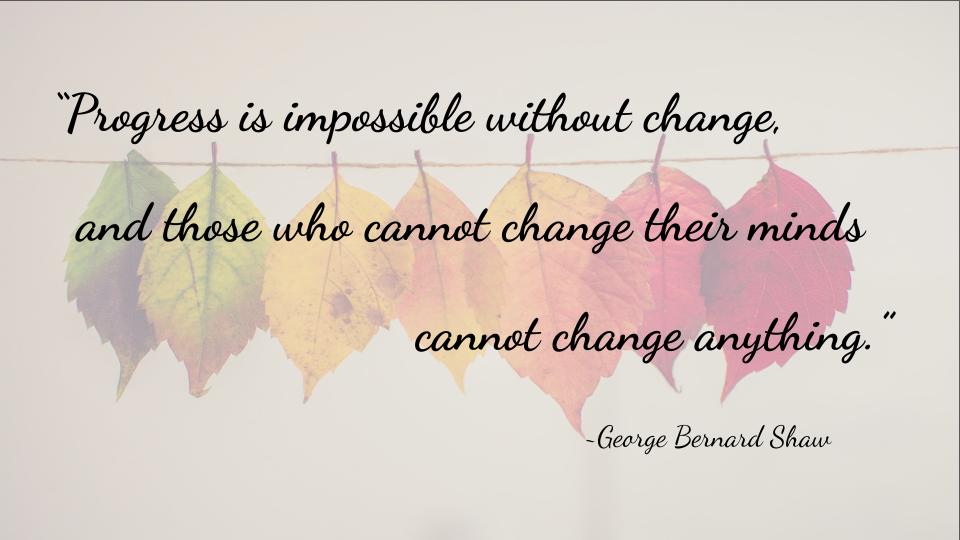
    George Bernard Shaw quote “Progress is impossible without change, and those who cannot change their minds cannot change anything.”

    Growth Mindset – It never hurts to start with some Carolyn Dweck, right? I’ll delve into her work in a future blog on the brain, cognition, and the science of learning. From a change management perspective, I like this definition from a Harvard Business School Online Blog: “When you have a growth mindset, you believe you can gain the knowledge and skills necessary to succeed, which makes every challenge a learning opportunity. People with a growth mindset tend to embrace challenges, persist in the face of setbacks, see effort as a path to mastery, learn from criticism, and find lessons and inspiration in the success of others.”

    Open-minded – How often do we find ourselves instinctively defending the status quo? It is understandable. In fact, it is human. Millions of years of evolution have conditioned us to resist change due to uncertainty, loss of control, fear of failure, and perceived loss of status. And there are times to defend – like from harmful groups like the Marms for Flibbertigibbet. (Using the words moms and liberty in the group’s actual name is an affront to both.) And, of course, we need to protect children. But that can’t keep us from considering new ideas that can better educate them. The principle of risk-reward applies to all improvements. And we need to honestly assess whether aspects of the traditional instructional do more harm than good.

    Check for bias – In Thinking, Fast and Slow , Daniel Kahneman explains System 1 or “fast thinking” – the ability to perform tasks unconsciously, automatically, and effortlessly. Based on his work with Amos Tversky, he also reminds us that this ability is vital to our survival but comes with a dark side – cognitive biases. (Here is a shortlist of 24 cognitive biases that are warping your perception of reality.) We know biases contribute to serious issues like institutional racism. Bias also influences perceptions of new ideas. We like homeostasis – things in balance – so we are more likely to be dismissive of new ideas or protective of traditional practices. It also means we should have a healthy skepticism of things that seem too good to be true. In short, I recommend ABtC, always be thinking critically. And since I’ll posit solutions to complex challenges in the coming blogs, please let me know when my Dunning-Kruger effect or illusion of explanatory depth are showing.

    Listen to the other side and challenge your side – I serve as a Town Meeting Member. (It’s an old New England thing.) We were fortunate to hear from Arthur Brooks recently that it is harder – if not impossible – to convince the other side in an argument. So it is better to listen and seek longer-term consensus. He said the best near-term change often comes from addressing issues on your side as a critical friend.

    Beware the False Dichotomy and binary thinking – I have worked with virtual schools for many years. If only I had a dollar for every time someone asked me, “Is virtual school good or bad?“ I wonder if we seek simple yes/no answers because we don’t consume K-12 education directly. I answer that it depends on which virtual school and the unique student needs they serve – which stops the conversation cold. My biggest peeve is the statement “teachers are,” followed by anything. Even if empathetic, it denies recognition of teachers as individuals. When administrators make blanket statements about teachers, it patronizes and contributes to teacher turnover. Education is complex. To improve it, we must use the appropriate lenses and be willing to disaggregate and think deeply.

    The Power of ”and” / “I don’t know” / “why?” – We have an incredible ability to hold two or more multivariate ideas in our head. So why do we offset, reconcile, or cancel things out? We need to focus on the idea and not just the person. For example, I agree with E.D. Hirsch, Jr.’s belief in core knowledge because you can’t think critically about nothing. And I disagree with his Core Knowledge curriculum’s Euro/Western-centric bias. A disagreement about some content does not cancel out the concept.

    Penn Jillette shared this nugget in a show, “The most important revolution in human history – more important than agriculture, more important than writing – is the scientific revolution which came down to three words – I don’t know. No institutions, no church, no king, no power structure had ever said in history I don’t know.” How often do we use those powerfully honest three words instead of blurting out an opinion to protect our ego? The older I get, the more I have learned. And yet, the more I accept all that I do not know. I guess I am developing greater intellectual humility. And the wisdom to ask questions and listen more.

    Regarding questions, I just finished reading The Great School Rethink by Frederick “Rick” Hess. He encourages us to use intellectual humility to challenge our assumptions of the “whys” of public education and collaboratively explore new, old, or remixed ideas of what might be. Rick emphasizes, “Resets start with recipes; rethinking with the right questions about what comes next.”

    Sorry this blog is so long, but I often think about barriers to change. Before focusing on education, I consulted on organizational and strategic change management for companies like GE and GM. Managing change in these companies was easy compared to public education. But they also had less at stake. I once asked Michael Fullan, a Canadian educator and researcher who studies educational change, why change in the education industry is so hard. His answer was something like, “I don’t know.”

    In the next blog, I’ll explore the history of school system design and how it influences instructional delivery. 

  • My Summer to Explore Instructional Design

    My Summer to Explore Instructional Design

    I am reflecting and writing about my K-12 public education experience and perspective this summer. After starting my career in finance and management consulting, I have spent 30+ years serving public education in many roles for many types of organizations – as you can see from my LinkedIn profile – linkedin.com/in/jimdflanagan, I also consumed it as a student for 16 years, including public university. And I am a parent of twin boys entering their 14th year of public schooling, including pre-K. Finally, I am the proud son of an elementary teacher and took a year off to volunteer in elementary, middle, and high school classrooms to inform my work. But I am certainly not a teacher, so I continuously cycle my ideas through educators for a much-needed reality check. For all the public education I directly or indirectly consumed and all of the educators I cherish, I’ve always viewed the industry with some skepticism – more as a critical friend than an advocate or cheerleader.

    I’ve observed that we overwhelmingly address change at the state, district, or school level. We change variables such as funding, school size, construction, school choice, governance, standards, course offerings, and staffing. But we spend little effort pursuing changes in instructional redesign based on the science of learning. (The delayed recognition of the science of reading is just one example.) Therefore, school improvements, reforms, and transformations all regress to the mean – if successful. So instructional redesign will be my focus. Along the way, I‘ll reference topics like personalization, differentiation, blended learning, student ownership, and Universal Design for Learning (UDL.) And I’ll explore the potential of edtech, but only as it advances the human relationships fundamental to effective learning. I’ll go deepest on the science of learning, cognition, bias, and critical thinking. How can we design effective teaching and learning without that basic understanding of how the brain works?

    I’ll use two models to ground my inquiry as I explore topics. First, The Instructional Core developed by Dr. Richard Elmore. I’ll ask how any change impacts the student-teacher relationship to each other and content. Early in my career, I did not fully appreciate how social and relational learning is, so I advocated for technological solutions that isolated more than connected. Most failures I’ve seen – especially in edtech – disrupt the relationships between and among humans – teachers, students, parents, mentors, tutors, etc. – instead of strengthening the social bonds. Second, I’ll consider how the proposed instructional practice impacts the lifelong love of learning. Does it degrade or support our innate curiosity and hunger for knowledge and understanding? Too many adults feel defeated by learning and are even skeptical of thinking because of their experience with “schooling.” According to a recent Gallup survey, on average, students give their school a C+ rating in making them feel excited about learning – and ratings decrease as students advance.

    I use K12Leaders as a platform because I believe in the mission and value the community. I welcome any feedback. If you agree, that is fine. But I prize a challenge or a different perspective – especially when accompanied by evidence or research. And additional reading or research recommendations are golden.

  • 3 Great Summer Reading Projects from K12Leaders!

    3 Great Summer Reading Projects from K12Leaders!

    We know by now that for K12 leaders the “end of school” really just means a chance to work on the projects that have been needing attention for the last 6 months. Networking, curriculum, enrollments, and maintenance all need to get done in an all-too-short window over the summer. But often part of that is personal maintenance as well, and we have some great opportunities on K12Leaders to consider your own development over the next several weeks!

    Discover The Secret to Transformational Leadership!

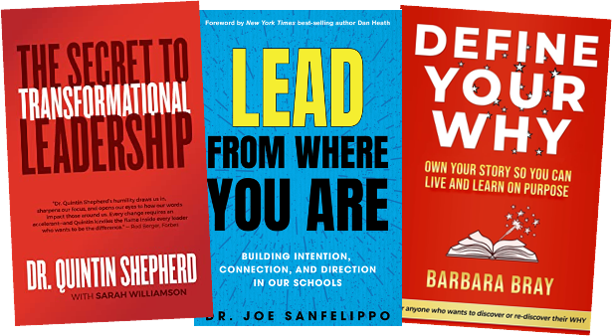
    Quintin Shepherd and Sarah Williamson have launched a learning community to explore a whole new language of leadership on K12Leaders based on their book The Secret to Transformational Leadership . This is a unique combination of a book group and online course focused on finding, nurturing, and implementing an authentic leadership style that helps leaders build connection with whatever community they serve. Within this nine-part, self-paced book study, you will:

    • Explore each chapter through videos, supplemental readings, a review of main points, reflection activities, and more. 
    • Gain practical strategies for adopting a new language of leadership. 
    • Hear from Quintin and other education leaders who believe that if the way we approach leadership can help others think differently, ultimately we can create a ripple effect of empathy, compassion, kindness, and a sense of purpose for our life’s work. 

    Quintin will also offer live online discussion opportunities to go even deeper into this unique model. Sign up today so you don’t miss the next one!


    Lead from Where You Are: Future Ready’s Summer Reading Group is live on K12Leaders!

    Join Shannon McClintock Miller and author Joe Sanfelippo for the third annual Future Ready Summer Book Club to read Lead from Where You Are: Building Intention, Connection and Direction in Our Schools . where we will embark on an inspiring journey that will undoubtedly reinvigorate your passion and empower you to make a meaningful impact in your professional life.

    Throughout the summer, we will gather virtually for weekly discussions, providing an opportunity for deep exploration and thoughtful reflection. Our aim is to foster a vibrant community where collaboration and shared learning flourish.

    “Lead from Where You Are” explores the profound concept of finding joy and value in our daily work. 

    Join Shannon McClintock Miller and author Joe Sanfelippo for the third annual Future Ready Summer Book Club to read Lead from Where You Are: Building Intention, Connection and Direction in Our Schools . where we will embark on an inspiring journey that will undoubtedly reinvigorate your passion and empower you to make a meaningful impact in your professional life.

    Throughout the summer, we will gather virtually for weekly discussions, providing an opportunity for deep exploration and thoughtful reflection. Our aim is to foster a vibrant community where collaboration and shared learning flourish.

    “Lead from Where You Are” explores the profound concept of finding joy and value in our daily work.


    Take the summer to Define your WHY!

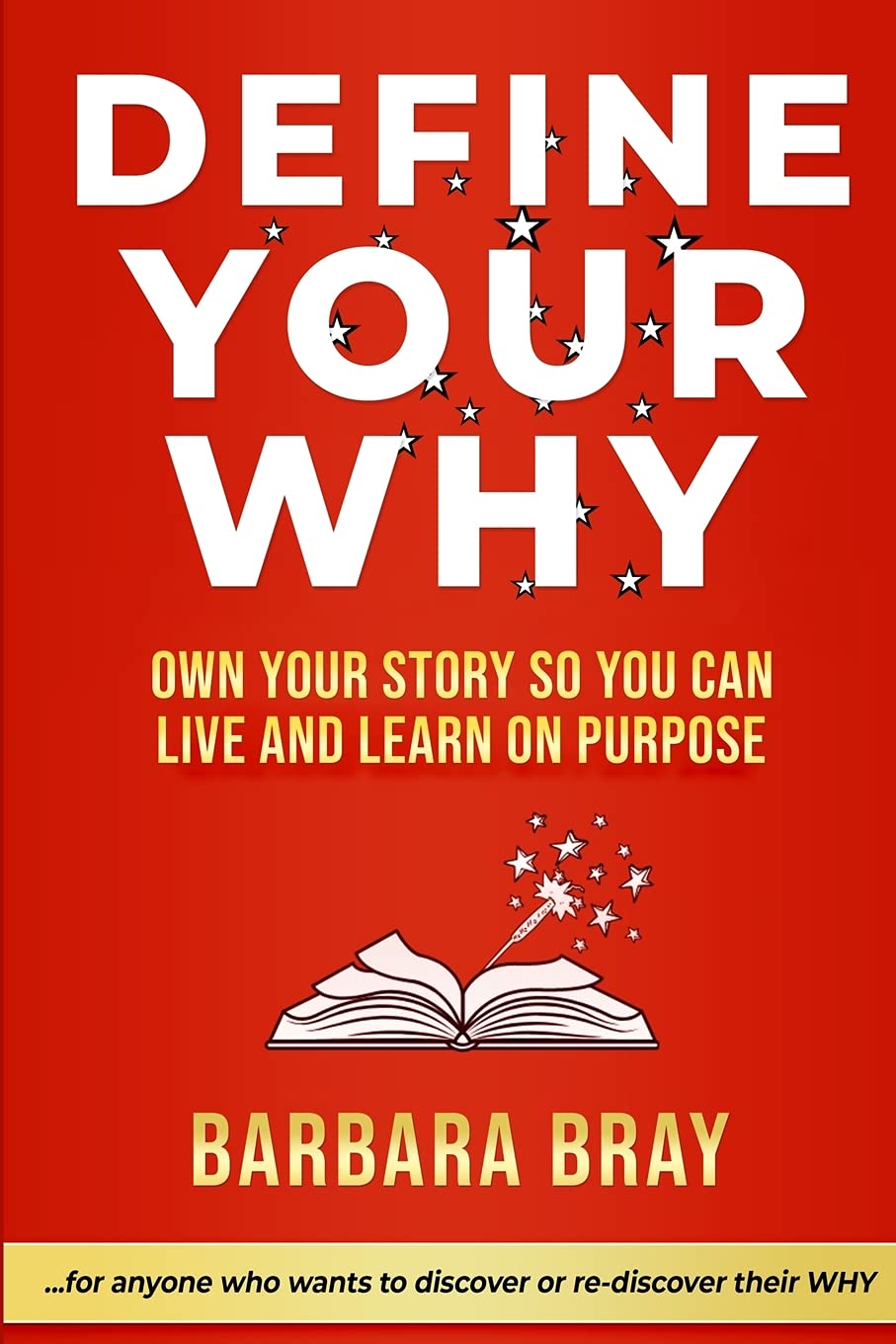
    Author Barbara Bray is a digital pioneer, founder of My eCoach, and host of the Rethinking Learning Podcast. Throughout Define Your WHY she guides you through a motivational and personal journey filled with thoughtful exercises and resources to help get the most out of each chapter, and to help you finish with a stronger sense of purpose and identity. This is a great read before heading back to school next year!

    cover define your why

    Do you ever feel like you’re going through the motions to get through the day? Do you continue to do what you do because you have always done it that way? You may not even have considered that you can change what you’re doing AND have more joyful experiences.

    Define Your WHY  shares stories and involves you in activities to get to know YOU better so you have a more meaningful life where you can live and learn on purpose. This book is for anyone who wants to discover or re-discover their WHY so they can grow their purpose. 

  • Know Your Audience

    Know Your Audience

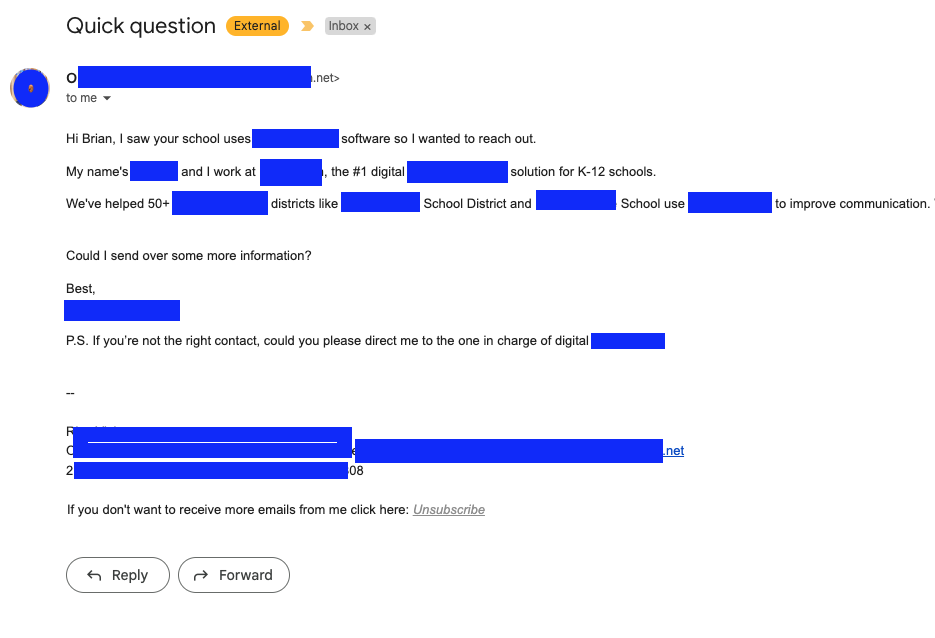
    Recently, I was wading through my email during what is yet another crazy time of the school year. (When I think about it, is there a time of year that isn’t crazy?). It seems no matter how many marketing and sales emails I hit the ‘unsubscribe’ button on, there are more messages waiting in line to take their place. This is one I received TWICE this week:

    My name is not Brian.

    I’m sure many K12Leaders receive unsolicited marketing and sales inquiries all the time… As part of their job, vendors are required to generate new leads and hopefully turn them into customers. I get it. I’ve seen some outlandish tactics from vendor representatives over the years, all ranging from funny to failure; from praise… to guilt.

    95% of the time, I ignore and unsubscribe. However, there are times I write back to the sender. For example, I will write back:

    • When a former (or current!) vendor reaches out. Staying in touch with current programs is important, so I try to respond when I can. Past vendor relationships can be tricky, all depending on how the breakup happened. However, sending me an email soliciting business without any background knowledge of our district is a real turn-off. Representatives should know whether we are current or former customers, and have a good idea as to why we left.
    • On a 4th email, I will always write back. At this point, the sender should know how their approach is not welcome or professional. Our job is to serve students. I can’t do that if I am wading through endless emails. Being relentless as a salesperson does not translate to our thinking you’ll be relentless in your customer service.
    • You are hilarious. I will answer you and tell you how funny you are, and how you stood out. Those emails make my day. Vendors who understand the sheer volume we receive and try to stand out in a positive way make a better impression. They are a breath of fresh air.
    • You have contacted me on LinkedIn. There are a few (very few) individuals whom I have connected with on LinkedIn. We chat about the industry or what’s new in education. If the topic turns to their company/product at some point, I am more willing to listen, and will schedule a time to chat. However, this can backfire. Do not contact me initially on LinkedIn and my work email at the same time.

    It’s important to remember that in all areas of education, we are networked. We all have our circles of colleagues both in and out of our school, district, state and country. Good news travels fast… however, bad news travels faster. Sales and marketing strategies should keep this fact front and center when it comes to choosing tactics and best practices.

    Sales are based on reputation. I can’t speak for all K12Leaders, but thought I’d share some free advice:

    Don’t Be A Vendor

    • Get the name, school and district right. I’d rather receive a generic email than one containing the wrong information.
    • Make sure what you are offering fits your recipient. Don’t offer WiFi solutions to teachers; mailing lists to tech directors; math programming to food service managers.
    • More does not equal Better. Receiving multiple unsolicited email requests is not endearing.
    • Mention schools and/or districts you are working with if they are nearby. Most decision-makers are networked and will ask around before working with a new provider.
    • Beware the busy times: start/end of the year, testing windows, before/after school breaks, etc…
    • Know when budgeting season is. We just set our budget for 24-25. Not all of our contracts run July-July, but many do.
    • If you don’t hear back, do not take it personally. Don’t resort to language designed to guilt or shame the recipient into responding.

    What are your thoughts? Does your inbox look like mine? There are some important messages here I need to (and do) read. However, it is very easy to miss them when mixed in with others I don’t.

    What insight would you add to strengthen the relationships between K12 providers and K12 education?

    At K12Leaders, we have done a lot of work to position vendors as solution providers, or even better – as Solution Partners . We believe the relationship between those inside and outside of schools can be mutually beneficial, and we encourage connections on K12Leaders to facilitate good conversation. If you would like to learn better ways to connect with prospective customers in education by becoming a K12Leaders Solution Partner, be sure to reach out to mike@k12leaders.com, or drop a comment below.

  • June Updates from K12Leaders

    June Updates from K12Leaders

    K12Leaders is growing in membership as well as capacity.  We have some exciting new features we’d love to share with you!

    Ambassador Program.  Are you already a raging fan of K12Leaders? We’d like to reward you with swag and other rewards. A new contest will be coming up soon!! Be sure to check out co-founder Carl Hooker’s article here .

    Banner for K12Leaders Ambassador program.

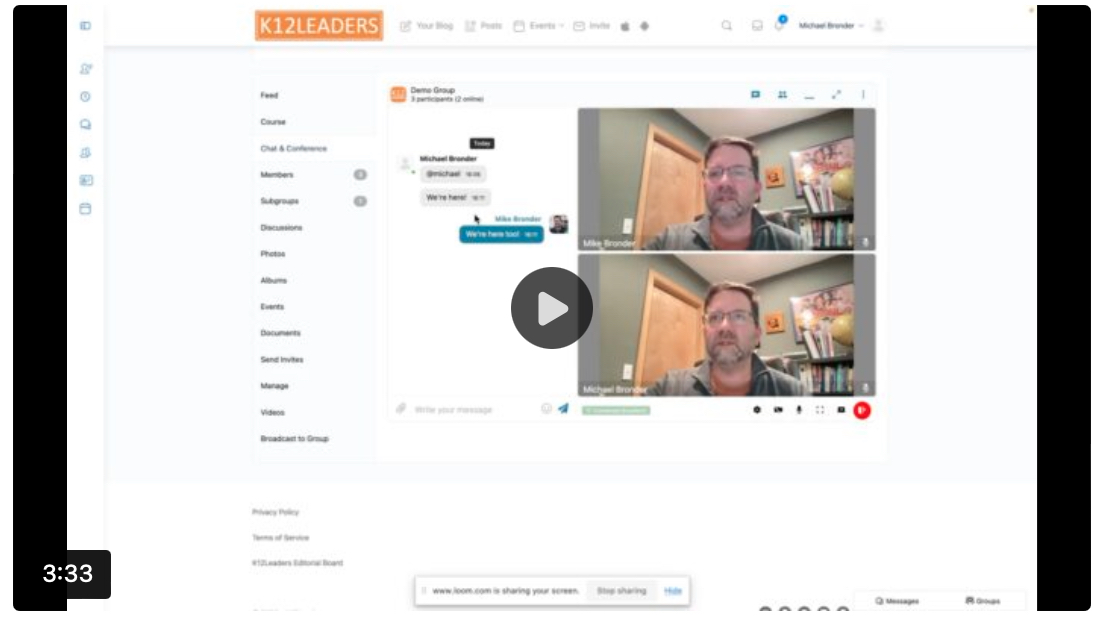
    Real-time Video and Chat- We’re all familiar with the mainstream platforms, and we’ve all relied on those for years. What’s been missing, though, is a way to “keep the conversation going” after the video conference ends. Any text chat are lost when the meeting ends.

    We’ve solved that by creating a persistent chat within your Groups and Communities that will maintain the text, inks, and media that you may have shared during your video conversation even AFTER the video ends.  So tomorrow or next week you can come back and pickup right where you left off!!!

    Want more than one conversation thread? No problem! Go ahead and create a “Child Group” to house that as well!

    Here’s a quick video intro, and we’ll be scheduling some regular “water cooler” meetups here too to help you get familiar with how it all works.


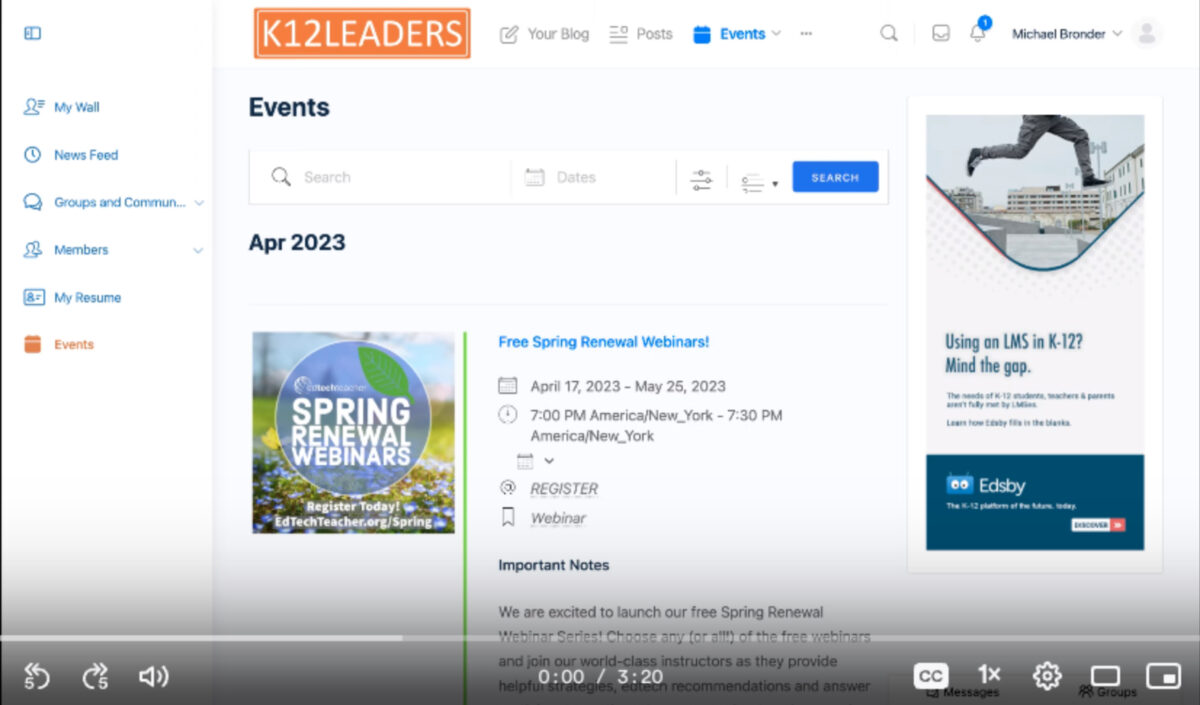
    – Better Event Management for educators, coaches, consultants, and our solution partners. This gives you:

    – Formatting control over event details

    – Ability to include an event image

    – Assign an event to a Community you organize so it appears in your group’s Event menu, and keeps it private from the global calendar.

    – Control over your event locations… Choose an existing venue (New Orleans Convention Center) or add your own, or assign an online destination like Zoom, or your own chat room.

    This new process also makes it MUCH easier for our team to review and publish your event to the calendar.


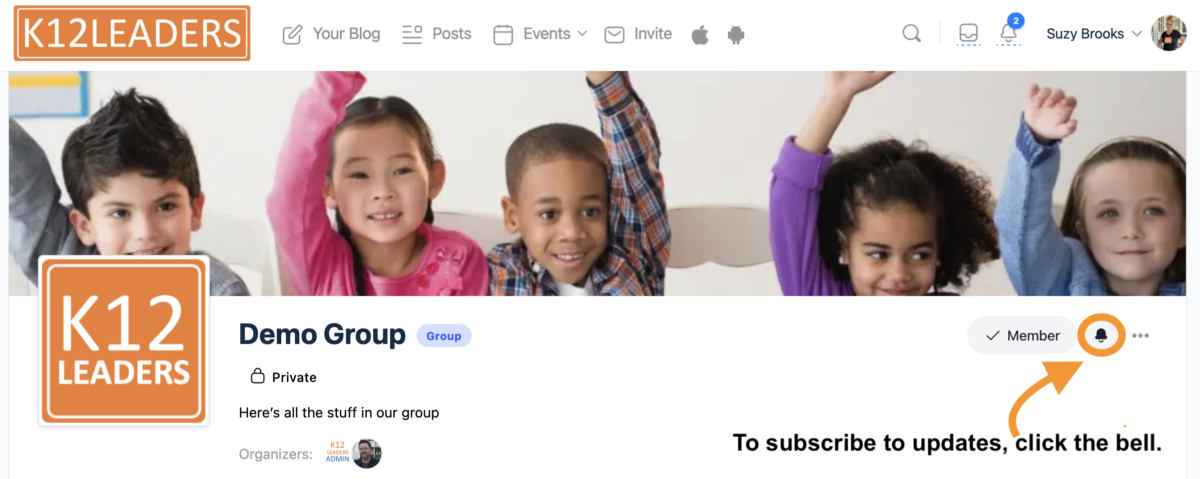
    “Subscribe” to Group Updates .  Groups on K12Leaders are buzzing – don’t miss a post or a reply when you use the new Subscribe feature!

    A group homepage with an arrow pointing to the bell symbol with a reminder to click on the bell to subscribe to updates.


    Course Builder Launched.   Are you or your organization looking to host an online course? We now have the tools you’ll need!  Feel free to check out the courses we are already offering as well here!.


    Mobile App Changes .  We have updated our K12Leaders app to look and respond much like the website.  Be sure to discard the pilot app and then download this new, more responsive one!

    Then, invite a friend to download the app and join you on K12Leaders!


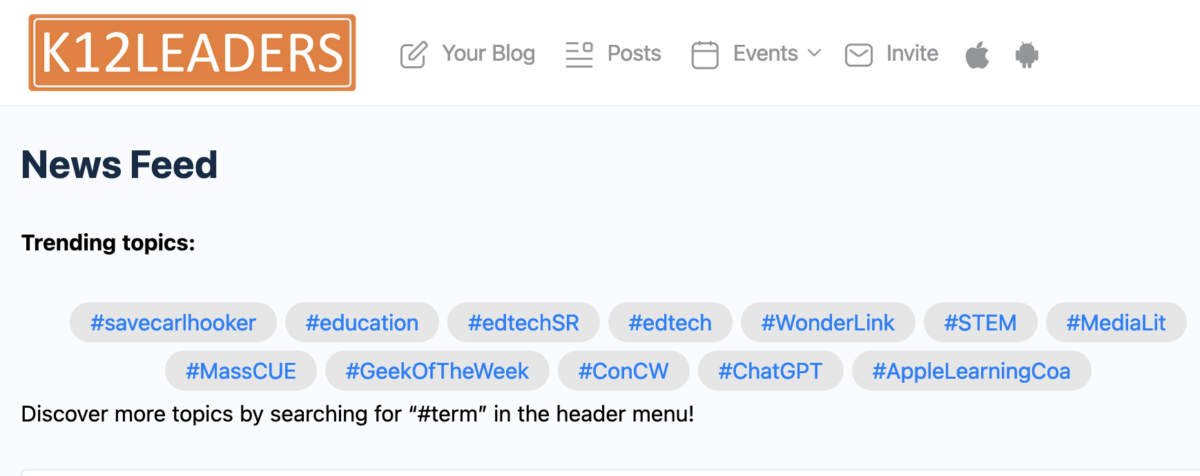
    Hashtags .  Have you noticed the trending hashtags on the K12Leaders’ home page? You can add hashtags to your posts to gain more visibility and interaction.


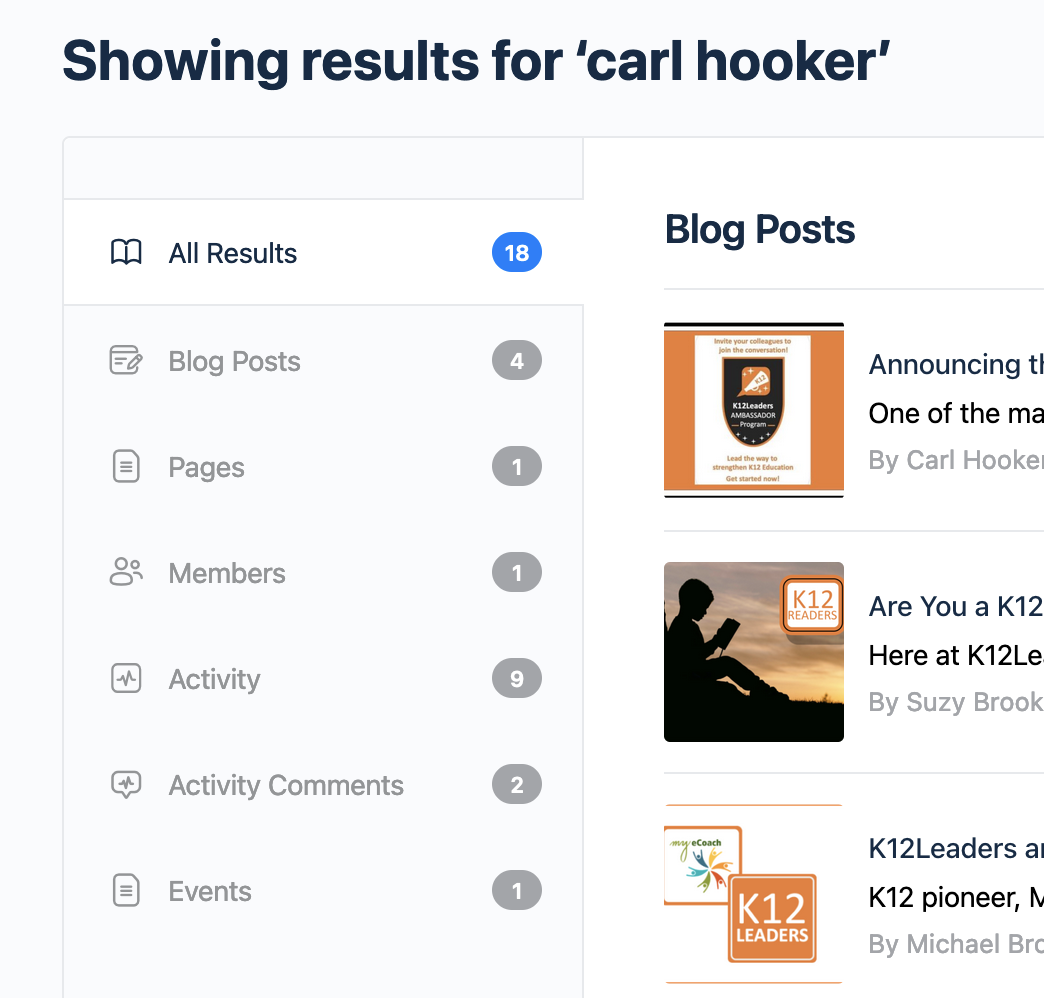
    New, improved searching capabilities !

    We have designed a comprehensive search engine within the K12Leaders site. When you search, you will see results for people, articles, posts and more! Give it a try and see what you can find!!

     So as you can see, we have many new features on the site, with more soon to come. Feel free to reach out if you have suggestions or feedback. We value the ideas of our members!!

  • Don’t just Survive…Thrive as a Superintendent by joining MASTERCLASS for Aspiring Superintendents

    Don’t just Survive…Thrive as a Superintendent by joining MASTERCLASS for Aspiring Superintendents

    MASTERCLASS for Superintendents is a mission-driven LLC dedicated to helping K-12 education leaders more effectively lead school districts. We ensure that aspiring and experienced superintendents thrive and not just survive.

    As we look out at the landscape of the present state of the Superintendency in Massachusetts, we see a significant yearly turnover of Superintendents.* Retirements, resignations, and terminations undermine this key leadership role in many districts. This is not just a cliche –

    “Districts that frequently change Superintendents continue to try to build for the future in fits and starts. One step forward and two steps back.”

    At MASTERCLASS for Superintendents, we strongly believe that there are two areas in need of much more attention – the pool of aspiring Superintendent candidates, and experienced Superintendents who have completed at least 3 years in the position. We prepare aspiring superintendents and better enable experienced superintendents to lead by combining a world-class leadership learning journey with proven real-world experience, delivered in an accessible, high-impact format.

    Developing a larger, more diverse, and better-prepared pool of aspiring superintendents (principals, directors, assistant superintendents, etc.) is critical to sustaining lasting leaders up to today’s superintendency’s complex tasks. Increasingly, new superintendents struggle to make it to their next contract – tripped up by the constant day-to-day decision-making and negotiating required by multiple stakeholders with competing interests in our increasingly politicized environment. While many superintendent preparation programs focus on setting a vision and building a successful entry plan, these alone are not sufficient skills to set superintendents up for success. As we emerge from the challenges of the pandemic, building trusting relationships and strengthening teams must also be superintendents’ key areas of focus. Even the most talented and experienced leaders cannot lead alone. Collaborative leadership, inclusive of School Committee members, can ensure that districts are poised for the kind of lasting leadership that results in improved opportunities and outcomes for all students.

    Through a cohort model, MASTERCLASS provides high-impact modules focused on the most important actions to take when leading complex public school districts. 

    In our Aspiring Cohorts, we support participants as they explore the challenges and opportunities inherent in the superintendency and discern whether it is the path they feel called to pursue. The Aspiring Superintendents Cohort supports participants so they are ready to step into the role and be effective on day one.

    The Experienced Cohorts focus on Superintendents who have finished three years or more in the role. Recognizing that the role can be isolating and can test even the most talented leader. As an experienced superintendent working closely with – as well as supervising – a district leadership team, it can be difficult to solicit the kind of honest feedback needed to continue to grow and improve. In addition, the superintendent’s relationship with the school committee and the chair, especially given the context of open meeting laws, can be challenging. As the job of Superintendent continues to grow in complexity, it is increasingly vital for experienced superintendents to have a cohort of trusted peers with whom they can have safe, supportive, and energizing discussions to inspire them to continue to lead and to help them face and effectively overcome challenges as they arise.

    In MASTERCLASS we believe a cohort model based on discussing and sharing strategies, solutions, and skills, helps every member of the cohort to grow and thrive.

    In both MASTERCLASS cohorts, we take a personalized approach grounded in real-world experiences. Integrated throughout is individual executive coaching from experienced professionals. Our MASTERCLASS coaching team has over 60 collective years of experience as superintendents and educational leaders and innovators in large, mid-sized, and small Massachusetts districts.

    Cohort members participate in monthly meetings focused on topics they have identified themselves. In addition, participants engage in peer consultation during which they identify areas for growth and work with expert MASTERCLASS coaches to develop solutions.

    Our cohort model provides a supportive environment that helps superintendents survive AND thrive. Too often support for superintendents focuses more on problems than on strategies or viable solutions – leaving superintendents feeling more burdened and less energized. In MASTERCLASS, the support and solutions-based approach of each cohort of peers helps strengthen participants, builds leadership skills, and empowers participants to lead their districts forward.

    MASTERCLASS faculty are experienced Superintendents and successful instructors/coaches who ensure that each individual grows and improves as a leader.

    Learning to thrive in challenging times does not just happen! We have proven we can help. Become a member of MASTERCLASS for Superintendents. We are currently enrolling members in Cohorts for Aspiring Superintendents. 

    To learn more about MASTERCLASS programming, and become a member, please visit MASTERCLASSFORSUPERS.COM

  • Resource Share – SlidesGPT

    Resource Share – SlidesGPT

    I, like many of us in educational technology, have been somewhat taken away by AI over the last few months. ChatGPT, Dall e, and Midjourney have been weekly, if not daily, topics of discussion, along with AI policy, frameworks, assignments, and assessments in education. For example, just in this past week I have run an edcamp session on AI in schools, developed coursework for an AI course, and shared a presentation with a local educator team on creativity and AI.

    However, throughout all of the changes, I have been keeping an eye on two specific threads. First, is the aforementioned creativity aspect of AI and how it will change the creative output of learners and educators. Yesterday I discussed how a decade or so ago, education feared the proliferation of cell phones and its limiting of creativity in individuals, but we have seen the opposite. Short-form videos are just one example of how cell phones are a tool for creativity right now. The other strand I have been following is the easy-to-learn, adaptable tools for any classroom. Tools like Conker, Mote’s AI quiz generation tool, or Firefly, Adobe’s in-beta AI Swiss knife, are two that immediately come to mind as useful tools for many educators to move through their designing, planning, and creation phases in their classrooms.

    SlidesGPT is another tool that I think fits this group. If you are unfamiliar, SlidesGPT uses an AI Chatbot format to build a slide deck for you on a topic of your choosing. In the deck above, you will find my first exploration of SlidesGPT. I had it build a presentation on a topic I presented early this year and it did a fairly good job of addi威而鋼
    ng pictures (from Unsplash) and providing good content. The really interesting thing is that slide two was generated by SlidesGPT and it is basically a caveat for users that it might generate inaccurate or offensive content. Other education-focused AI tools have particular blocks that will not accept specific, inappropriate content (looking at you, Conker) as prompts. As a starting point for slide decks, much like using chatbots to help build assignment descriptions, SlidesGPT is a good starting point if you are not sure where to start or need help with an outline, but the human element for editing, rephrasing, finding accurate information, and personalized content, is where the rubber hits the road. Check out SlidesGPT at this link.